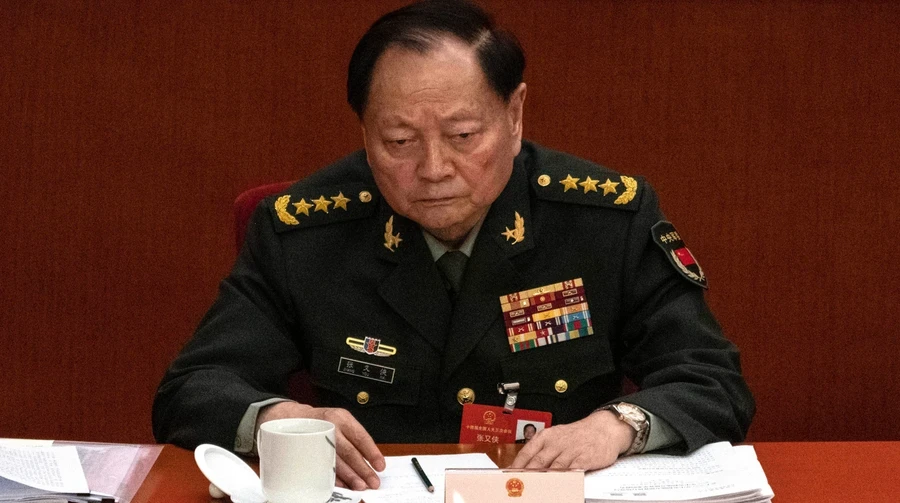
According to information published by The Wall Street Journal, a high-profile general from China, Zhang Yuxia, is suspected of transferring secret data about the country's nuclear arsenal to the United States.
Reports indicate that the general is accused not only of leaking information about the nuclear program but also of accepting bribes, including the appointment of an officer to the position of Minister of Defense.
At a briefing held on Saturday with the participation of senior military officials, an investigation into Zhang Yuxia was announced, who was previously considered a close ally of Chinese President Xi Jinping.
The official statement from the Ministry of National Defense did not contain details, other than mentioning serious violations of both party and state norms.
However, sources familiar with the situation claim that Zhang is under investigation for creating political factions, which implies attempts to form a network of influence undermining party unity, and for abusing his official position in the Central Military Commission.
The authorities are also conducting a thorough review of his activities as head of the agency responsible for military technology developments. According to information disclosed during the briefing, Zhang may have received large sums of money in exchange for promotions within the military procurement system.
The most shocking accusation presented at the closed briefing was the claim that Zhang transferred critically important technical information about China's nuclear weapons to the U.S.
Some evidence against him was obtained from Gu Jun, who previously held the position of General Director of China National Nuclear Corp. — the state company managing nuclear programs. On Monday, Beijing announced an investigation into Gu for suspected serious violations of party discipline.
During Saturday's briefing, it was revealed that Gu's investigation is related to violations in the field of nuclear technology security, although specific details were not disclosed.
Zhang is also accused of facilitating the career advancement of former Minister of Defense Li Shangfu in exchange for bribes, according to sources.
Xi Jinping has tasked a special group with investigating Zhang's activities as commander of the Shenyang Military Region from 2007 to 2012. Group members arrived in Shenyang and chose to stay in local hotels to avoid potential influence from Zhang.
The authorities have already confiscated mobile phones from officers who worked with Zhang and General Liu Zhenli, who is also under investigation.
The publication reports that starting from the summer of 2023, the party has been conducting a purge among high-profile officers of the Chinese armed forces, including the Air Force and Navy. According to official data, over the past 2.5 years, more than 50 high-ranking military and defense industry leaders have been investigated or removed from their positions.
Xi Jinping has effectively conducted a large-scale purge of military leadership, unprecedented since the time of Mao Zedong, notes The Economist. Although Generals Zhang and Liu have not yet been officially removed from the Central Military Commission, such investigations often lead to detentions.
Four other officers have already been dismissed from party and military positions, and now only two active members remain in the Central Military Commission — Xi Jinping himself and General Shengmin, responsible for discipline in the People's Liberation Army.
The ongoing investigations are a vivid testament to the problems Xi Jinping faces as he seeks to transform the PLA into a modern combat force.
His frustration may stem from General Zhang's failure to achieve expected results by the deadline when the PLA should be ready to seize Taiwan.
These purges may also be driven by Xi's concerns about the growing influence of General Zhang.
“This is one of the most significant events in Chinese politics since Xi came to power,” claims Dennis Wilder, a former CIA analyst on China.
Zhang managed to win the clan struggle within the country's leadership, which granted him unprecedented power but also made him a potential threat to Xi Jinping.
“He is tough, sometimes foul-mouthed, and while he was an ally of Xi, he was never his subordinate,” adds Wilder about General Zhang.