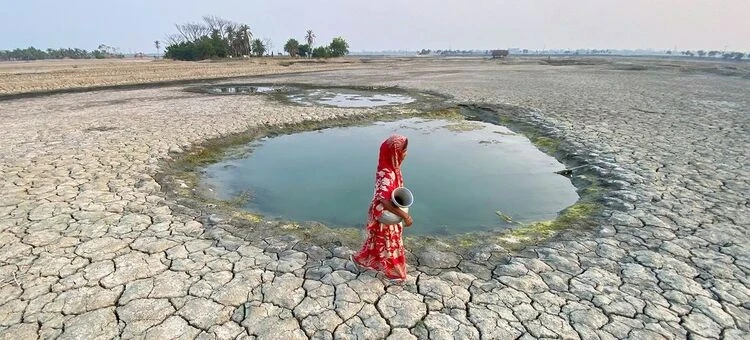
According to the latest report from the Food and Agriculture Organization (FAO), access to renewable water resources per capita continues to decline, having decreased by 7 percent over the past ten years. This data was obtained from the updated AQUASTAT database review.
As reported by the UN News Service, this concerns freshwater resources that are replenished through the natural hydrological cycle.
According to FAO, Central Asian countries have lost 12 percent of available renewable water resources per capita since 2015, which is one of the highest rates in the world.
FAO experts use the indicator of "water stress" to assess water scarcity, which reflects the ratio between the volume of water withdrawn and its reserves. Central Asia experiences a high level of "water stress," as 82 percent of all water withdrawals in the region are attributed to agriculture.
However, FAO also notes positive changes in water resource management in Central Asia. The total volume of freshwater withdrawals has decreased by 9 percent (from 123 million cubic meters in 2015 to 112 million in 2022), and the level of "water stress" has decreased from 76.8 to 70.2 percent, representing a reduction of 8.6 percent.
Research data shows that pressure on freshwater resources is increasing worldwide.
In 2022, the global average level of "water stress" was 18 percent, but in some regions, this figure is significantly higher:
- North Africa — 121 percent;
- South Asia — 76.7 percent;
- Central Asia — 70.2 percent;
- Western Asia — 65.1 percent.
A high level of "stress" means that annual water withdrawals are approaching or exceeding the volume of its natural replenishment, threatening the sustainability of water ecosystems and economies.
FAO emphasizes that agriculture remains the main sector of water use worldwide.
In Europe and North America, the share of water used in agriculture is only 34 percent, but these regions are responsible for nearly half of global industrial withdrawals (47 percent).
According to the Food and Agriculture Organization, some regions, including Central Asia, are experiencing improvements in water use efficiency. However, the high level of "stress" in most arid regions highlights the need for the development of long-term adaptation strategies and sustainable water resource management.