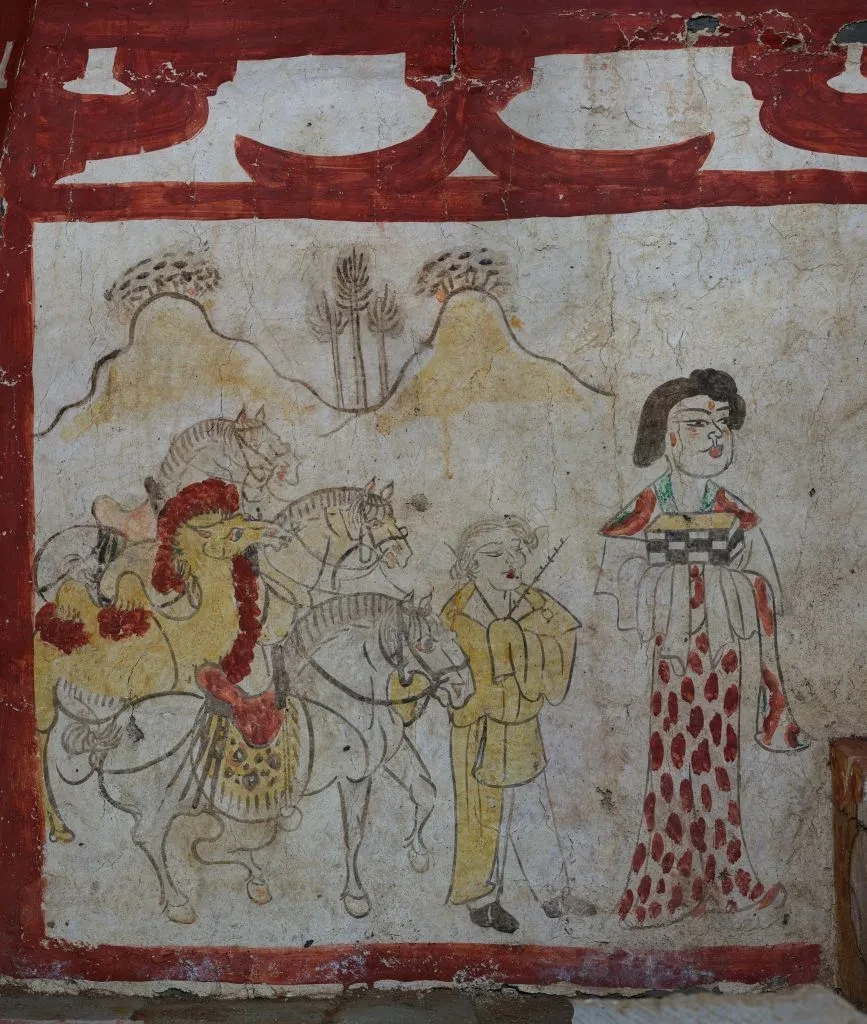
According to information provided by Long Zheng, the tomb contains images of women grinding flour, men preparing noodles, as well as women with oranges and men helping to grind rice. Scientists suggest that the tomb belonged to a man who passed away in 736 AD at the age of 63, during the Tang dynasty (618–907 AD). He was buried alongside his wife.
The eight scenes discovered on the walls of the tomb are executed in the "figures under the tree" style characteristic of that era, depicting everyday activities under intricately depicted trees. These images provide a unique opportunity to glimpse the daily life and responsibilities of people during the Tang dynasty.
The images on the walls primarily represent members of the Han ethnic group, except for one, which depicts a man with light hair and a beard. Victor Hsün, a history professor at Western Michigan University who was not involved in the discovery, noted that the "westerner" leading camels is likely a Sogdian from Central Asia, judging by his facial features and clothing.
Sogdians, who inhabited the territories of modern Tajikistan and Uzbekistan, played an important role in trade along the Silk Road. The frescoes covering the tomb share a similar style with other artworks of that era, characterized by clear lines and simple shading.
Zheng pointed out that the style of the frescoes matches the paintings found in the tomb of Wang Shenzhi, an important historical figure from the late 800s, which may indicate the work of the same artist.
Not only the tomb itself but also the entrance gates, corridor, and pedestal with sarcophagi were adorned with paintings. The domed ceiling stands out with an image of a dragon, and the figures at the gates likely represent guards in yellow clothing with swords.
The frescoes also depict a woman in a bright dress driving four horses, as well as scenes with men and women holding ritual bowls and boxes. The same old man can be seen in various scenes, suggesting that he might have been one of the tomb's owners. The frescoes provide insight into the daily life and customs of people of that time, while the presence of the "westerner" adds an element of mystery to the depicted world.