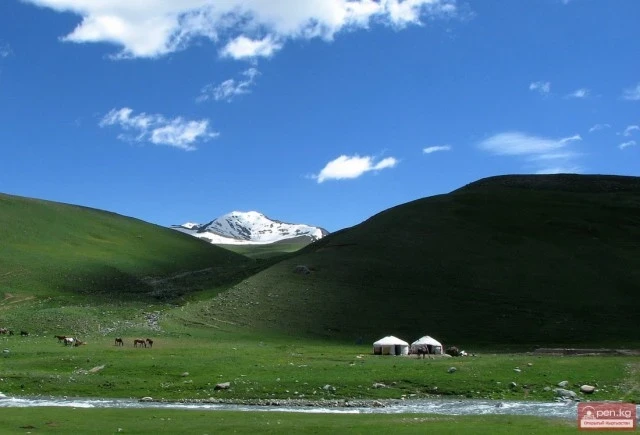
Currently, about 70 households live in this settlement. According to local legends, the residents of Deino are considered descendants of the famous Babur.
Zaheer-ud-din Muhammad Babur, born on February 14, 1483, in Andijan, was an outstanding poet, thinker, and statesman who founded the Baburid dynasty. He wrote numerous scientific works, including the "Treatise on Aruz" (1523-25), which explores Eastern metrics. In 1521, he created the philosophical and religious work "Mubayyin," which describes the fundamental principles of Islamic Sharia.
In 1494, Babur became the ruler of Fergana, and in 1526, he established a centralized state in India known as the Baburid Empire, which is historically referred to as the "Empire of the Great Mughals," existing until 1848 when India was conquered by the British. He passed away on December 26, 1530, in Agra.
Babur's poetic legacy includes the "Kabul Divan" (1519) and the "Indian Divan" (1529-30), which compile his lyrical works. He wrote poetry in more than ten genres of Eastern lyricism, reflecting his life, the surrounding reality, and significant historical events, with a particular focus on love themes. His mastery is evident in the original literary style and expressive means of the Turkic language.
According to legend, a small son of Babur remained in the settlement of Tash-Bulak (formerly known as Deino), where he stayed. It is believed that his lineage is considered to be descendants of the Uzbek thinker. Some of these descendants live in a border village in Tajikistan.
Despite differences in citizenship and residing in neighboring countries, Babur's descendants maintain connections with each other by participating in joint weddings and celebrations. However, in recent years, due to the escalation of the situation on the Kyrgyz-Tajik border, their meetings have become less frequent, and many have not seen each other for a long time.
The main occupations of the residents of Tash-Bulak focus on agriculture—both crop production and livestock. On average, each family keeps about 15 heads of cattle. The high mountain pastures are rich in forage grasses; however, the issue of water supply remains relevant. Despite this, agriculture continues to develop.
On the territory of the settlement lies the national natural park "Sarkent," covering more than 40,000 hectares. The main goal of the park is to protect biodiversity and natural landscapes. Rare species of animals listed in the Red Book inhabit its territory, such as the snow leopard, lynx, brown bear, golden eagle, and steppe eagle.
There is one school in the settlement, built at the initiative of local residents. Currently, it provides education for students up to the 9th grade, with fewer than 50 children enrolled.
The village of Tash-Bulak (Deino) is considered one of the most remote settlements in Kyrgyzstan and borders the Tajik village of Zaily.
Since the early 1800s, ethnic Kyrgyz have lived in the areas adjacent to the Sarkent National Park, but there are no permanent settlements within the park itself. Names such as Sarkent, Gosh, Jakurut, and Jumurut reflect the ethnic nature of the region. In the summer, local shepherds temporarily move to summer pastures. In the early 20th century, with the establishment of forestry enterprises, state policy shifted towards the intensive use of natural resources, including timber harvesting and pasture lands. The greatest damage to the ecosystem occurred during the war and in the pre-war years, when mass logging of coniferous trees took place.
Now, one of the park's tasks is the sustainable preservation and rational use of forest resources and biodiversity.
The Sarkent Natural Park is known for its five naturally occurring lakes and ancient juniper groves, whose history spans thousands of years.
Within the park are high mountain cliffs, where caves of interest to speleologists are located at altitudes ranging from 500 to 1000 meters. Such caves can be found in the areas of "Gosh-Jailoo," Kol, and Gadanlyk, which are used by local shepherds, hunters, and tourists.
There is also a unique place called "Bedeldin Korum," where battles with the Bolsheviks took place, leaving their mark in history.