Information about the history of the village and its hero-baatyrs was provided to Turmush correspondent Roza Noruzbaeva, the head of library No. 5 in this locality.
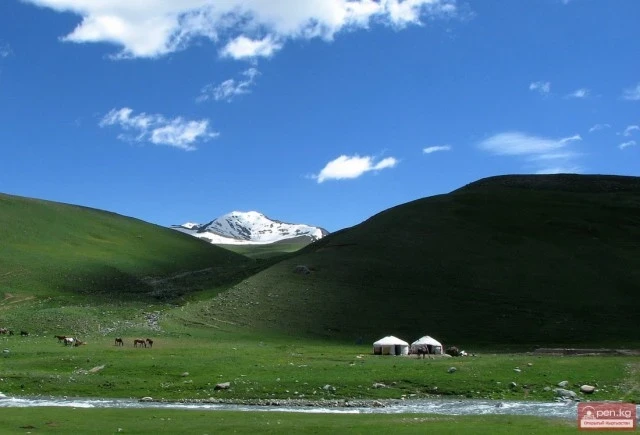
According to her claims, the name "Kichi-Kemin" could have originated from the Tuvan word "khem," which translates to "water." "Chon-Kemin" was likely previously called "Uluu-Khem" (which translates as Great Water), while "Kichi-Kemin" means "Kichi-Khem" (Small Water). Over time, the word "khem" transformed into "Kemin," and "Uluu" (Great) was replaced by "Chon" (Big). These terms are close in meaning, suggesting that the name "Kemin" indeed came from the word "Khem." This hypothesis is also supported by the geographical characteristics of the area. Writer Seyit Zhetimyshev reflected on this topic in his work "Living Water," published on November 4, 1986, in the newspaper "Evening Frunze."
The water flowing through Kichi-Kemin originates in the Suulu-Tor area on the well-known jailoo of Sary-Kungey. It is formed from melting glaciers and springs flowing from the mountains and used to flow into the Chu River. In the 16th-17th centuries, three clans that now represent Kichi-Kemin already inhabited the upper part of the river: the Azyk clan in the Uiy-Bulak area, the Zhetigen clan in Bel-Saz, and the Tazdar clan in Konur and along the banks of the Chu River. These clans formed communities and engaged in livestock breeding.
About potatoes as "the breast of the witch"...
The proximity of Kichi-Kemin to the Great Silk Road facilitated trade for the local residents. They drove their livestock to Andijan and returned with household goods. Agriculture began to develop here only in the late 17th to early 18th century when local residents started using plows (buursun) for tilling the land and sowing grains. With the arrival of the Russians, conditions for agronomy improved: wooden plows were replaced with iron ones, and mills for processing grain began to be built along the rivers. The first water mill was built by a Russian named Moisey near the dam located in the northwest of the current village of Zhany-Zhol. Local residents began to actively develop agriculture, creating irrigation ditches. When Mamyrkan aji from the Margozu clan started planting potatoes to feed his family, some local residents did not understand this and called potatoes "the breast of the witch" (albarsty), as they had never seen them before.
Shabdan Baatyr and his dzhigits...
In the late 19th century, when the Russian Empire began its conquest of Central Asia, including Kyrgyzstan, Shabdan Baatyr played a key role. He realized that the Kyrgyz would not be able to withstand the numerically and militarily superior Russian troops, which was confirmed in the battle of Uzun-Agach (Kazakhstan), in which he himself participated. In this battle, the troops of the Kokand Khanate clashed with the imperial Russian army, and the Kokandis were defeated. Shabdan Baatyr, understanding that direct confrontation would lead to bloodshed and the extinction of the Kyrgyz people, decided that it would be best to submit to the Russian Empire peacefully.
As part of his strategy, he headed to Alai, where he met with Kurmanjan Datka, known as the Alai Queen. He warned her of the possible extermination of the Alai Kyrgyz in an unequal battle. His dzhigits from Kichi-Kemin also participated in the peaceful transition of Alai under the protection of Russia: Nogoy son of Tulogula, Zhanibek son of Kuttubai, Bolot son of Suttubai, Tagay son of Suttubai, Zhansary son of Dosa, and Suyunbay son of Choton. They accompanied Shabdan to the south and actively supported his intentions. Among them, Suyunbay Chotonov remained a loyal dzhigit after Shabdan's death and took care of his eldest son Mokush.
In the years of independence, the name Azhiyiman Shabdanov became known, who was raised in childhood by Suyunbay. Mikhail Vasilyevich Frunze, a famous commander, studied in Almaty. One day, he and his comrades came to Kemin to collect a herbarium of wild plants. Suyunbay Chotonov showed them the way and arranged overnight stays in yurts of prosperous local residents, honoring them as respected guests. Suyunbay Chotonov is an ancestor of the modern writer Seyit Zhetimyshev.
Approximately in 1875, outstanding figures such as Saalybai biy, Nazarbat biy, and Kalaybai biy emerged from Kichi-Kemin. They were often mentioned among the people: "Kalaybai from the taz, Saalybai from the zhetigen. One of you is Venus (Cholpon), the other is the Moon." They were leaders, governed the people, and shared all hardships with them. Shabdan Baatyr highly valued Boronbay aji, who once directly told him: "My red-eyed duvana (wanderer)." This caused discontent among Baatyr's dzhigits, who suggested taking revenge on Boronbay and seizing his livestock. However, Shabdan, sensing that this could lead to conflict, stopped his dzhigits and prevented hostility.
A secret courier and a baatyr who fought in World War I...
During the time of the Russian Empire, Kurmanaaly, son of Abirdin, delivered secret mail on horseback from the Bishkek district to Karakol in one day. For his merits, he was awarded the Red Cross medal.
As for Toichubek Malaev, who participated in World War I, the elder of the village Kenjebay Japar recalls that in 1913 he was serving in the military and during one of the battles with the Germans went on reconnaissance with three Russian soldiers. During a break, he noticed approaching German scouts and warned his comrades, but they did not believe him and continued to rest. Toichubek, not waiting for them, single-handedly eliminated three enemy scouts.
Upon returning, the Russian soldiers reported to their commander, claiming the merits for themselves. However, Malaev, not understanding Russian well, found a Tatar translator and told the truth. After that, he became a respected person and returned from the war, later participating in the struggle against the Basmachi, reaching Tashkent. When he walked around the city with the Red Cross medal and saber he received for bravery, the commanders of the Red Army asked him to remove the medal.
(to be continued).
if(aki_gallery==undefined){var aki_gallery=[];var aki_gallery_title=[];}
aki_gallery[312764] = new Array('cdn-1.aki.kg/cdn-st-0/qhs/G/3922492.47583208f8f1656226c05d75ab52c5e4','cdn-1.aki.kg/cdn-st-0/qhs/G/3922482.47a96187b7b1d359384d53bedce08471','cdn-1.aki.kg/cdn-st-0/qhs/G/3922487.371244688b6208abaedf02a1507ba16f','cdn-1.aki.kg/cdn-st-0/qhs/G/3922497.74ad661e8fff73663acb373666e994b7','cdn-1.aki.kg/cdn-st-0/qhs/G/3922507.9e727bde111fc454323e1b2179611304','cdn-1.aki.kg/cdn-st-0/qhs/G/3922512.c491ffa45469959600ba300e2f1be715','cdn-1.aki.kg/cd...