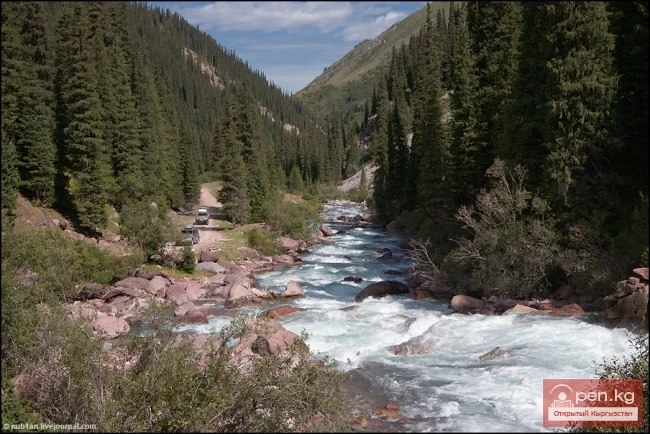
Venera Jumabekova, the head of the local library No. 3, shared that the abundance of springs in this region is the reason for its name — Kara-Bulak, which translates to "Black Spring." The water, mixing with the black soil, acquired a dark hue.
From 1930 to 1937, a collective farm named "Kara-Bulak" was established in the village. In 1950, it merged with the Beishike collective farm, forming the Stalin collective farm, which was led by Achakey Borombaev. During this period, the cooperative actively developed: the livestock population increased, yields were high, and people's lives improved thanks to the construction of a club and a school. During the Great Patriotic War, local residents sent grain and warm clothing to the front.
In 1970, the collective farm was transformed into the collective farm named after the XXII Congress of the Party, with Kapar Imankulov elected as its chairman. In 1981, it merged with the Kirov farm, and in 1988 — with the Birlik collective farm.
With the collapse of the state farm in 1992, local residents began to create private peasant farms, and each was allocated 0.50 hectares of land.
As of 1960, the farm had 25,000 sheep, over a thousand horses, 2,000 heads of cattle, 700 birds, and 170 beehives. From Kara-Bulak, 200 people went to the front during the Great Patriotic War, of whom only 22 returned home.
The village has four main streets: Abdylas Maldybaev, Majike, Ryspek Kachkeeva, and Uch-Khoz.
The first school in the village was located on its outskirts and was painted blue, which is why it was nicknamed "Kök-school." In 1930, it was moved to Kachkeeva Street, and a woman named Rakiya became the principal. In 1936, Kychumbay Shabolotov, who graduated from a pedagogical college, became the head of this school. A medical and obstetric point was built in 1957.
Kara-Bulak has a multinational composition. For one and a half centuries, its residents have lived in peace and harmony, as they say, "drinking water from the same irrigation ditch." The Kyrgyz in the village are represented by various clans: chertki, azyk, chechey, konurat, kytay, kyron, munduz, moltoy, and zhediger.
The area of Kara-Bulak is 15 km from the district center. The streets here are straight and tidy, and local residents engage in agriculture and animal husbandry. According to the latest data, the population of the village is 1,034 people.
Among the notable people born in Kara-Bulak are:
- Tokchoro Zholdoshov, the first Minister of Public Education and literary critic;
- Abdylas Maldybaev, People's Artist of the USSR and founder of Kyrgyz music;
- Arstanbek Altymyshev, the first pharmacologist and academician;
- Nasyr Davlesov, People's Artist of Kyrgyzstan and author of the national anthem;
- Kychumbay Shabolotov, a statesman;
- Kairykul Sartbaeva, People's Artist of the USSR;
- Abdygul Chotbaev, Colonel General;
- Kydyrmu Orozaliev, former Minister of Transport and Roads;
- Karyp Ibraimov, ex-Minister of Tourism;
- Jumakady Duyshiev, Doctor of Philological Sciences and Professor;
- Saynake Boobekov, Professor at the National University;
- Sagyna Makekadyrov, a well-known documentary filmmaker and honored figure in the culture of the Kyrgyz Republic;
- Sagynaly Ormushev, honored doctor of the Kyrgyz Republic.