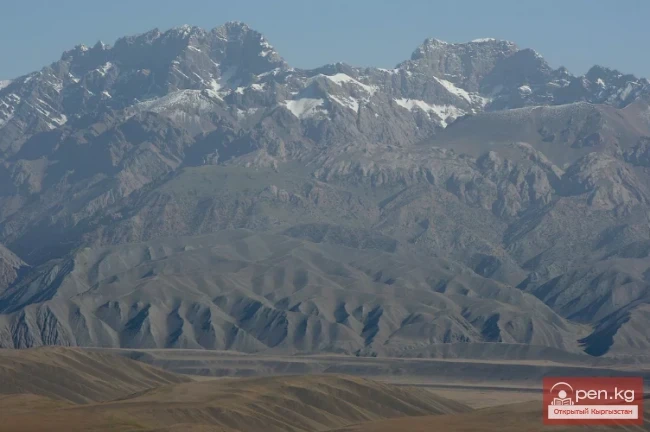
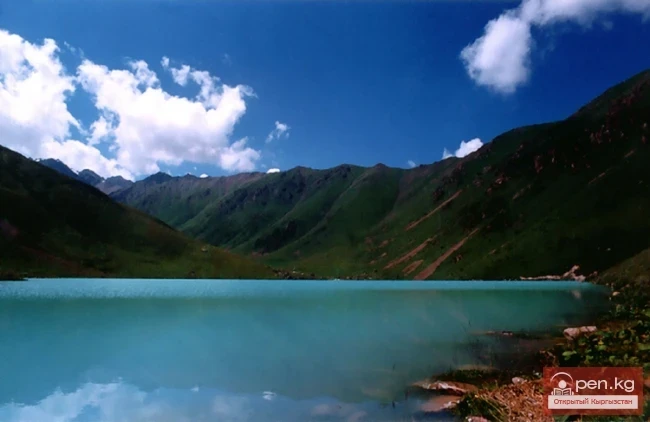
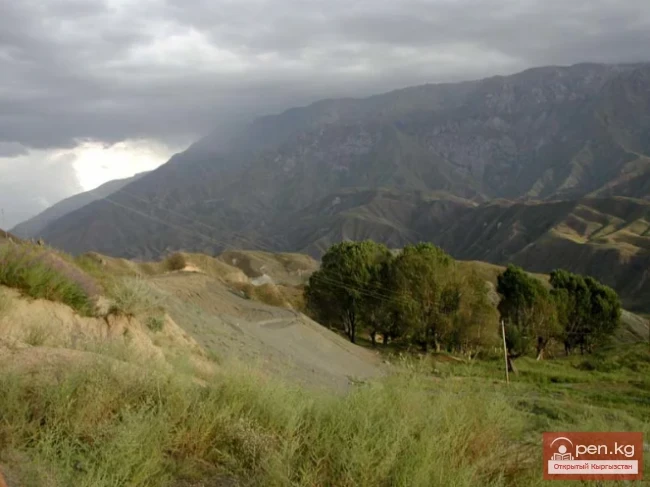
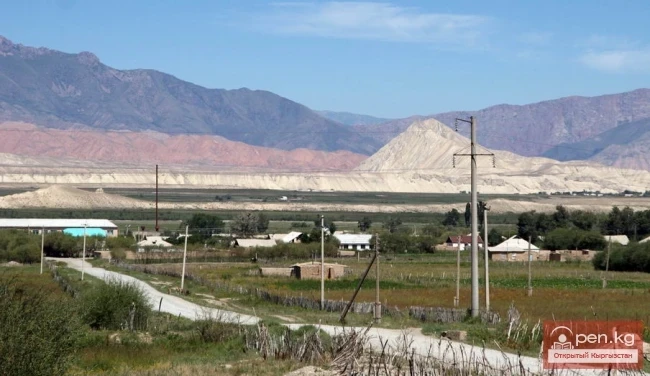
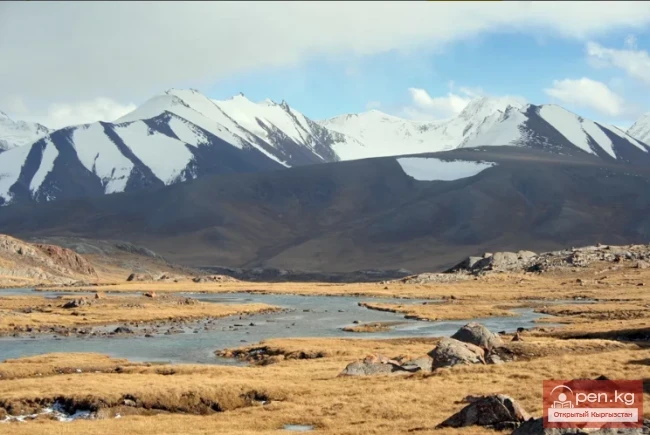
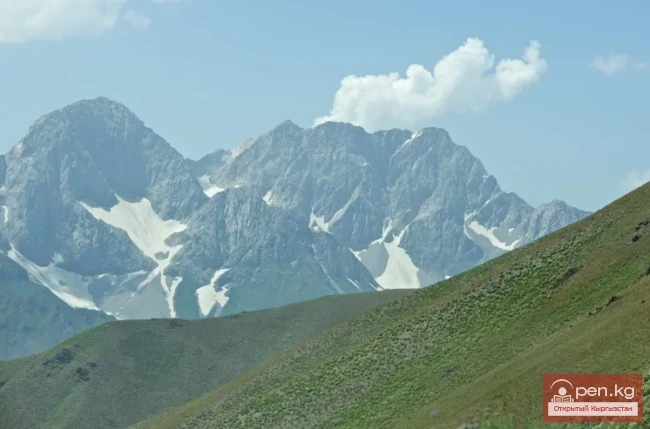
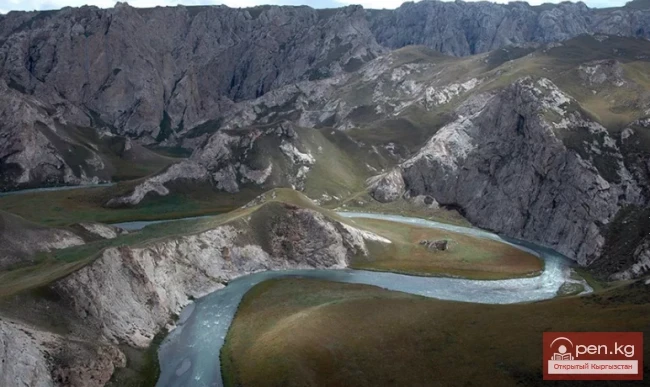
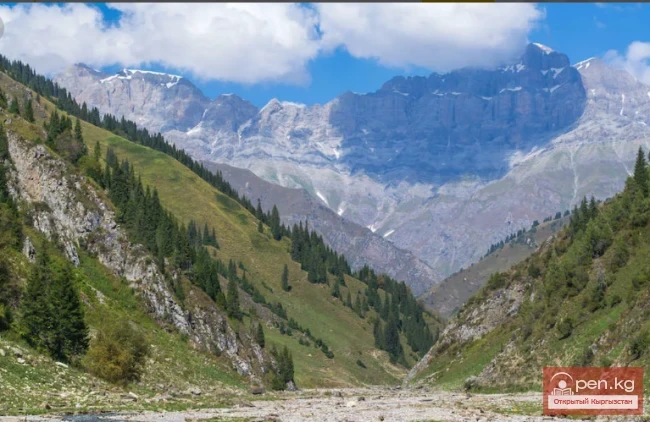
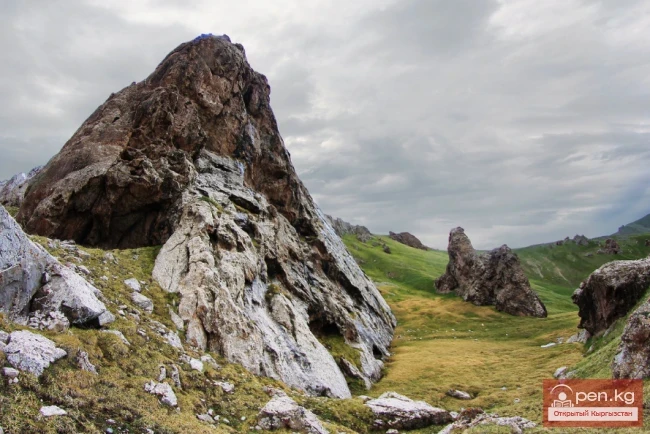
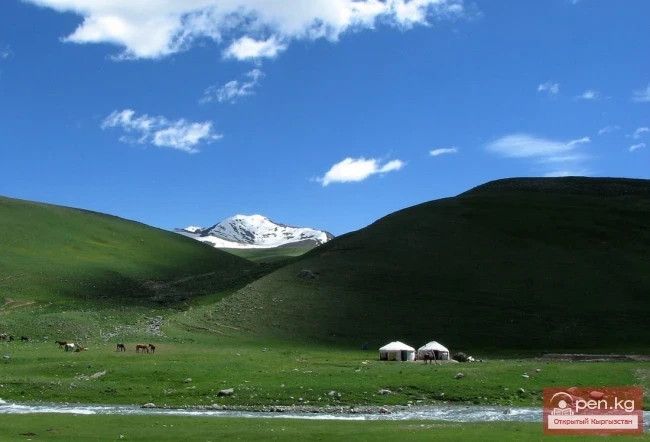
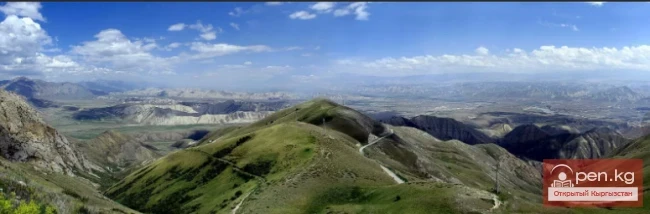
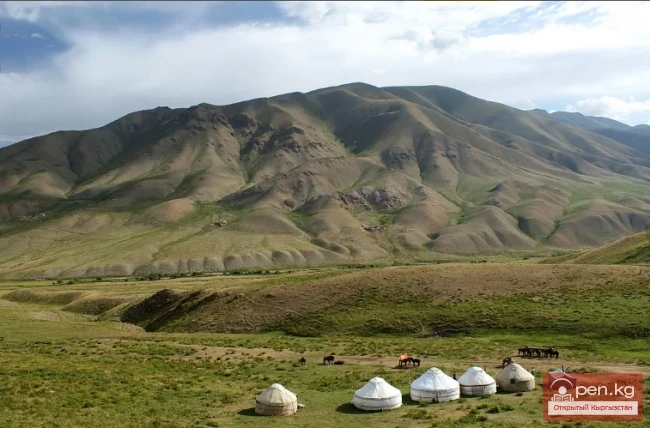
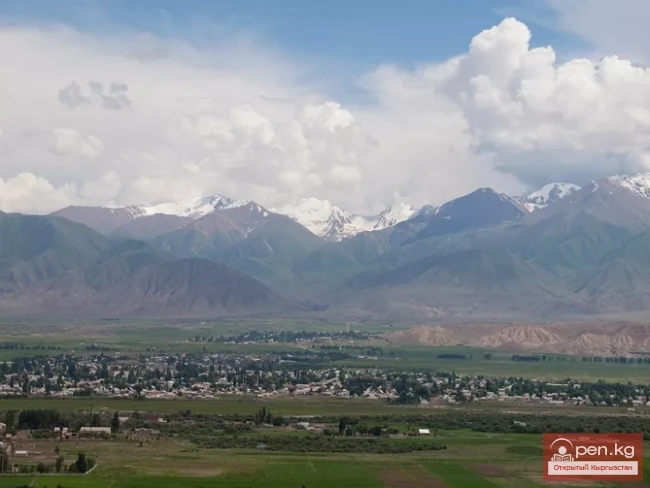
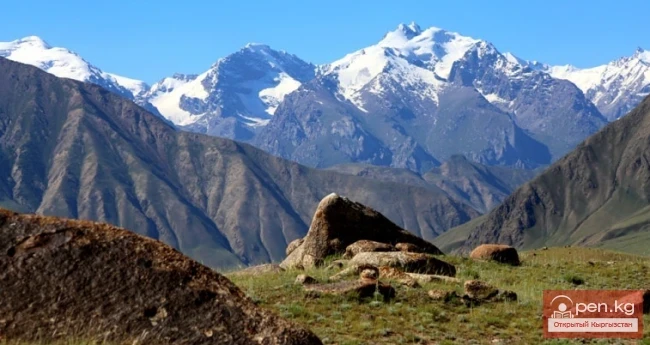
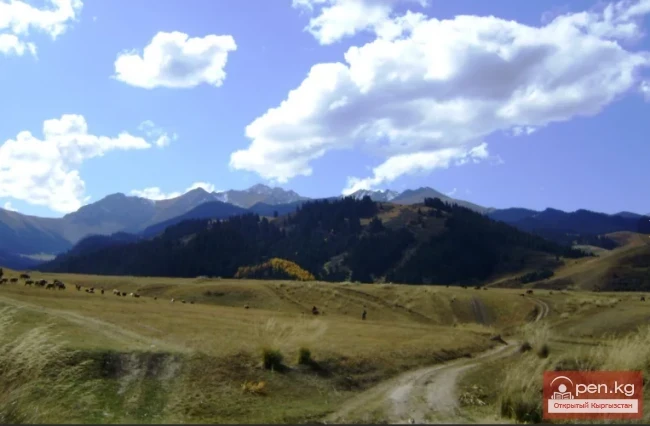
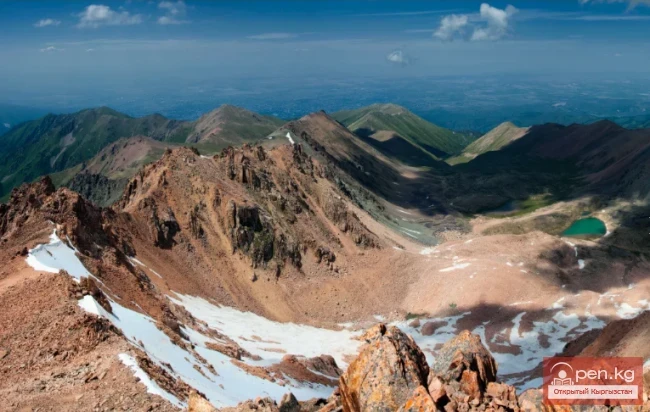
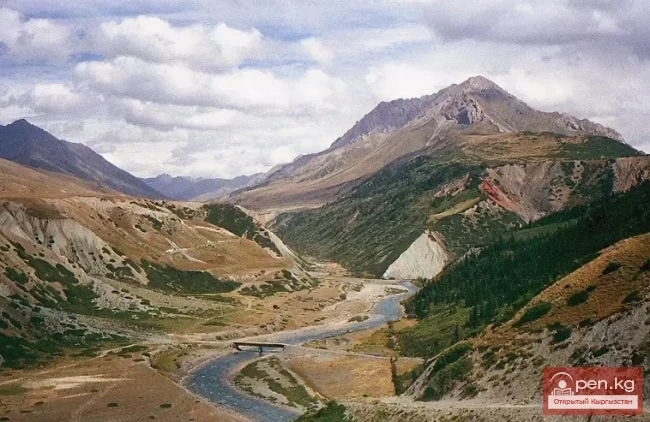
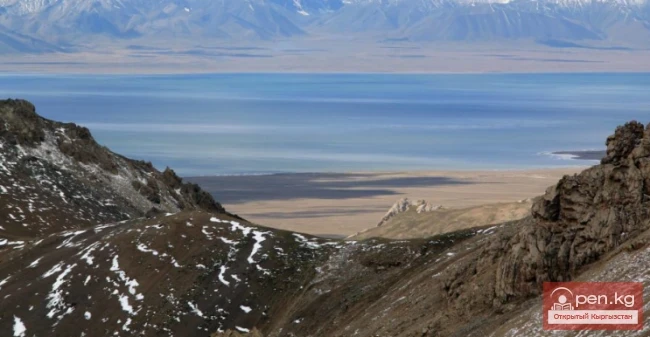
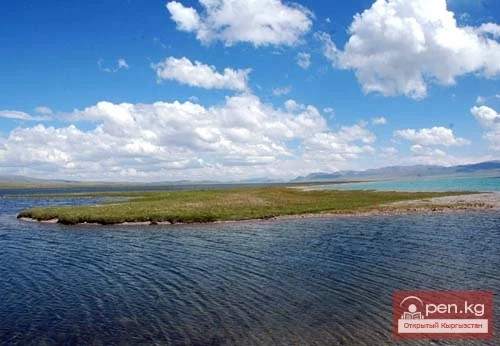
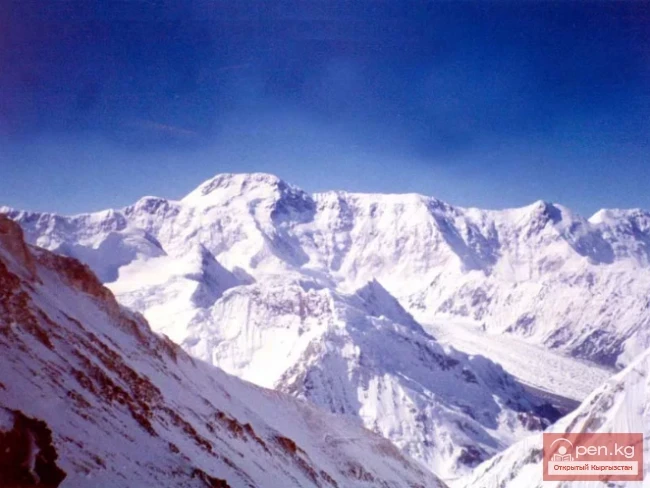
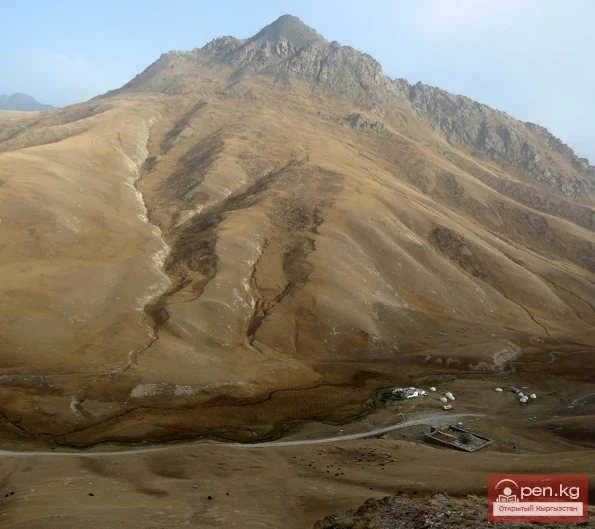
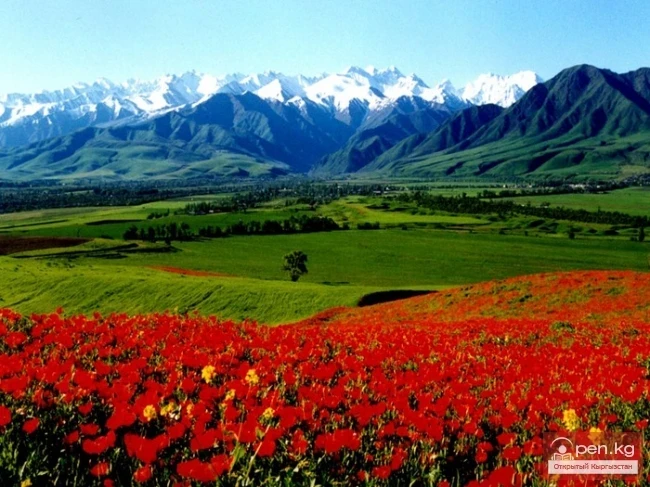
The pasture of Arpa is located in a high-altitude valley in the southwestern part of the inner Tien Shan. To the southwest, it is bounded by the Fergana Range, and to the south is the Torugart Pass.
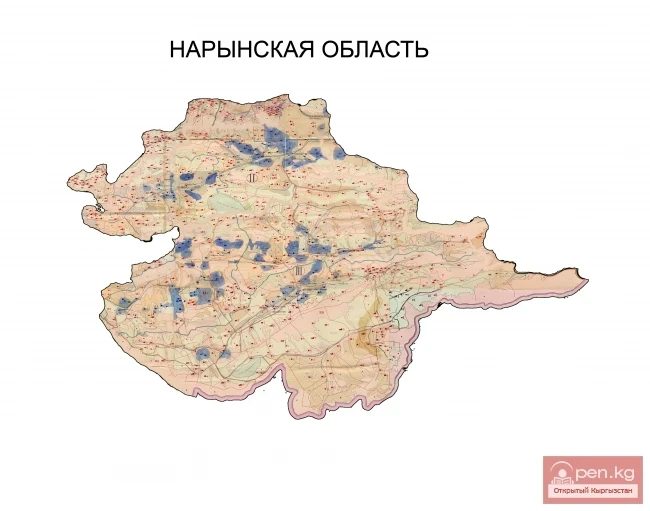
The Arpa Valley is a high-altitude space in the southwestern part of the inner Tien Shan (Naryn region). It stretches 60 kilometers in length and 32 kilometers in width, with an elevation ranging from 2700 to 3600 meters above sea level. To the southwest, the valley borders the Fergana Range, to the south — the Torugart Range, to the east — the At-Bashinsky Range, and to the north and northeast — the Ortok-Ttoo and Zhaman-Ttoo ranges.
The Arpa River divides this valley into two parts. The climate here is quite harsh, and meadows and pastures alternate with shrubs; in the eastern part of the area, you can find steppes and wastelands.
In Kyrgyzstan, the Arpa Valley is considered one of the most extensive pastures. Livestock herders from the Ak-Talinsky, At-Bashinsky, and Naryn districts drive their cattle here. The eastern part of the valley is intersected by the Bishkek—Naryn—Torugart highway.
A local resident, Kylimbek Chodonov from the Ak-Talinsky district, shared an interesting story about Sanchy-synchy, who once found himself in Ak-Tal. Upon seeing the surroundings, he exclaimed: “Karysы karap turbagan, zhigiti zhilik albagan, kataal zher ekan” [“This is a harsh place where the old do not sit down with folded hands, and the young do not touch the delicacy (meat)”]. After that, he continued on his way, but when he reached the Arpa Valley, his horse stopped. Sanchy-synchy decided to let it rest by removing its gear. After a while, when he tried to harness the horse again, it wouldn’t budge and ran away. At that moment, he said: “Bul zherdin chöbü arpaday kүchtyu ekan” [“The grass in these places is as strong as barley, it also gives strength”]. He managed to get back on the horse and continue his journey, but when he reached the place where At-Bashy is now located, the horse got tangled in bones, and he could not move on. In response, he said: “Dalyны acha kыlyp koyush kerek” [“The shoulders must be straightened”]. Angered, Sanchy-synchy decided to kill the horse on the spot, hung its head on a post, and left an inscription: “At bashy menen er bashy, kayda kalbayt bir bashy” [“A young man with a horse goes everywhere, and where he perishes”]. Since then, this area has been known as At-Bashy, and the valley, where the grass gave strength like barley, was named Arpa,” Chodonov shared.
Sanchy-synchy, who lived in the early 16th century, is known as an outstanding predictor of human destinies, possessing the gift of foreseeing the future of people and their descendants.
Photo by: resident of the village of Bayetov Farhat Öskönbaev
In his time, at the request of the founder of a large tribe in the Chuy Valley, Solto, Sanchy predicted the future of his descendants — the sons Kuntuu, Kultuu, and Chaa, and all his prophecies came true. He paid special attention to a person's manner of speech, asserting: “A thoroughbred horse is recognized by its neighing, a wise person — by their speech.”
Sanchy-synchy was also well-versed in laughter and handshakes, evaluating people by their eyes: “A wise person can be seen in their eyes.” He became the author of many proverbs and aphorisms, but only a few have reached us: “From good comes good, a bad person leaves worthless offspring,” “Do not call a good person a stranger, nor a bad one your friend,” “If the wife is good, you are always well-groomed, clean, and the children are good; but if she is bad — you gray early, and the children are bad.”
Among the qualities of Sanchy-synchy were insight and intelligence. According to folk legends, he knew all the children of Solto and predicted who among them would become outstanding. Evaluating Khan Kudaian, he predicted the people's troubles during his reign and the inglorious end of the ruler. He also accurately predicted that the wife of Bolot biya Talake would give birth to Esengul batyr and other significant events.
Gulsun Zhyrtakova, a resident of the Ak-Talinsky district, recalls how her father told stories about a traveler who was returning from China through the pass. Tired, he stopped to rest with his horse in a place that seemed boundless. They stayed there for 2-3 days, and when the traveler began to prepare for the next leg of his journey, he discovered that his horse, exhausted from the journey, had recovered and gained strength. This reminded him that a horse, like cattle, could regain strength by eating barley, and the valley stretching before him resembled a field of barley.
Kushtar Arpachieva, another resident of the Ak-Talinsky district, shared memories of how her parents grazed cattle on the pasture of Arpa. “My father was a horse herder. I remember that as soon as we arrived, the adults said: ‘Watch the children, tie the calves so they don’t get lost.’ The grass there was taller than us, and we couldn’t move freely. Perhaps that’s why the valley got the name Arpa,” Arpachieva noted.
The Arpa Valley is also mentioned in some “sanjyrahs” [genealogies], which describe its borders: to the southwest, it touches the Fergana Range, to the south — the Torugart, to the east — the At-Bashinsky Range, and to the north — the Zhaman-Too mountains. These sources also mention “Kozhogul’s site,” “Kalmata’s light,” and the territory where the girl-hero Zhanil-myrza once lived, as well as the Maseilya Range and the river “Burgandyn site.”
The small heroic epic “Zhanil Myrza” holds a special place among Kyrgyz folk works. It is distinguished by the fact that its heroine is a girl-hero who fights against external and internal enemies. Other female heroes are also found in Kyrgyz epic poetry.
Four versions of “Zhanil Myrza” have been published, three of which are known as the versions of T. Moldо, A. Chorobaev, and Y. Abdrakhmanov, while the fourth — the version of M. Musulmankulov — has been preserved in written form. All of them describe the feats of Zhanil Myrza, but differ in specific motifs and situations.
According to Musulmankulov’s version, Zhanil, who comes from the Noyguts tribe, was willful from childhood. At twelve, she learned to shoot a bow and hunt with a golden eagle and hounds. At sixteen, she led a group of forty jigits and began to fight against the enemies of her people. The enemies avoided the lands of the Noyguts.
Zhanil-myrza was married to Kalmatai, and Kozhogul, Maseil, and Burgan were her “kayin ini” [husband's younger brothers]. According to legends, she killed the famous batyrs Uchuk and Tulku from the Sarybagysh tribe to defend her honor. After killing them with arrows, she fled but was pursued by a young man named Akkokchkor from the Chagalak clan. When Zhanil saw that he was almost catching up to her, she thought about whether to kill him but decided to surrender. However, the Kyrgyz biys decided to marry her off to Kalmatai, who was already over 60.
At a celebration in Semizbel Saz, in the Arpa Valley, representatives of four tribes gathered. However, Zhanil-myrza’s “kayin” did not calm down and began to torment her. They organized competitions in “jamby,” and after knocking down a bar, Zhanil fled again. She was pursued by Kozhogul, and she mortally wounded him when he crossed a river, which later received the name “Kozhogul’s site.”
Kalmatai, her husband, was killed when he caught up with her. The place of his death became known as “Kalmatai’s resting place.” Despite the cries of the child, Zhanil tried to hide again, but Maseil and Burgan also died, and the places of their fall became known as “Maseil’s back” and “Burgan’s site.”
Ultimately, Zhanil reaches Ak-Beyit, Tash-Rabat, crosses Ak-Say, and through Chatyr-Köl arrives at Ak-Chiy, where representatives of the Noyguts tribe are waiting for her.
Objects
Satellite
⛶