The Bukhara Invasion of Fergana
The successful conquest of Kyrgyzstan by the Kokand khans was facilitated by inter-clan and tribal strife among the Kyrgyz feudal lords, who were unwilling to unite even in the face of a common enemy. Thus, in late summer 1821, Omar-khan sent Beknazar-biy — his loyal Kyrgyz feudal lord, who headed the Kutluk-Seyid clan and was simultaneously the hakim of the city of Kasan — to subjugate the Kyrgyz of the Sarybagysh clan, who were migrating beyond Osh on the way to Kashgar. Omar-khan ordered that "the Kutluk-Seyid tribe with their detachment [lashkar], having taken care of equipment and supplies for gunfire, should set out with all diligence on horseback. It was ordered to destroy all the time [the Sarybagysh], giving no mercy to anyone from ... the tribe..." To assist the Kyrgyz feudal lord in his predatory raid, a detachment of Kokandis was assigned. "Having committed terrible robberies and murders, among which neither women nor children were spared, taking a large booty [mainly livestock] and a mass of captives," — noted in Kokand sources, Beknazar-biy returned to Kokand with the khan's detachment. As a result, not only through the force of arms but also skillfully using the rivalry and enmity among the Kyrgyz feudal lords, the Kokand khans expanded their possessions at the expense of neighboring southern Kyrgyz lands. Specifically, through them lay the trade route to Eastern Turkestan and India.
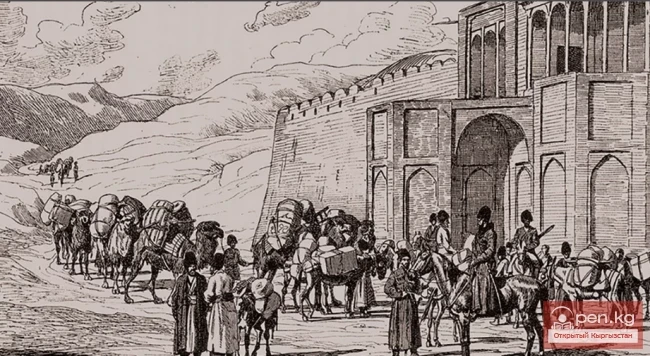
One of the trade routes ran directly through Osh to Kashgar. To ensure its safety, Madali-khan ordered the construction of two fortifications in Alai — Sufi-Kurgan and Kyzyl-Kurgan, which was executed by the Andijan hakim Isadatkha in the 1820s.
Later, this played a significant role in preventing Qing aggression in Fergana. When Chinese troops launched a campaign from Kashgar to Kokand, they did not dare to take the Alai fortifications, and after standing before them for 20 days, retreated empty-handed.
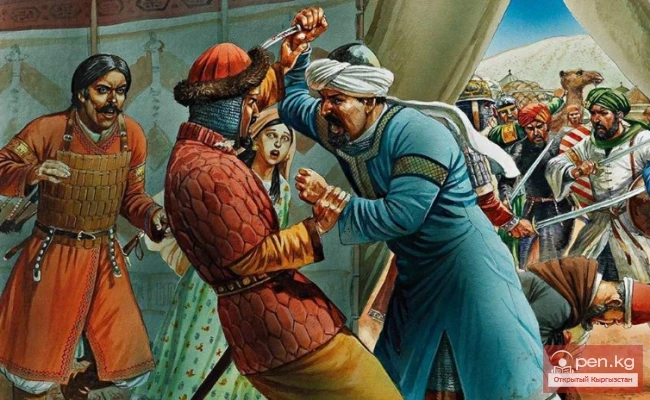
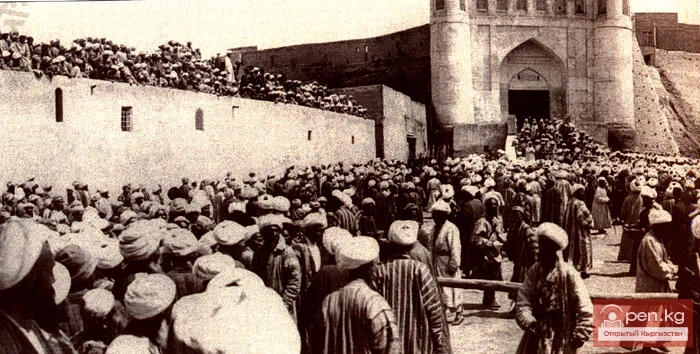
In the early 1840s, the Bukhara invasion of Fergana began. Temporarily, power on the Kokand throne fell into the hands of the emir's appointee from Bukhara — Ibrahim-khayal parvanachi. He, as a true conqueror, immediately imposed exorbitant taxes on the population, and the Bukhara soldiers who came with him began to riot and plunder the residents with impunity. Soon this led to a general uprising in Kokand, in which the Kyrgyz played an important role. The Kyrgyz feudal lords decided to elevate Sheraly, who had been languishing in the nomadic camps on Talas, one of the descendants of the Kokand dynasty of Ming, to the throne. Taking advantage of the popular uprising, the ruler of the Kyrgyz clan Kyrk-ogul, Yusuf-minbashi, along with his supporters, brought Sheraly from Talas to his clan's nomadic camps by the Kara-Su River in the vicinity of Osh. Here, rebel detachments of Kyrgyz and Kipchaks began to gather from all sides. Here, at the mazar of Safid-Bulan, following traditional nomadic rituals, Sheraly was raised on a white felt and proclaimed khan. From here, the significant army, consisting mainly of Kyrgyz and Kipchak rebels, easily occupied fortresses, villages, and cities (presumably without a fight, including Osh), and triumphantly entered Kokand. Ibrahim-khayal fled to Bukhara. As noted in Kokand sources, he ruled for only a month and seventeen days (though other sources state — 79 days), and then an uprising broke out, as a result of which "from the group of Sartiya and Kipchak and Kyrgyz in agreement with all the Fergana people" Sheraly was elevated to the throne.
Initially, Sheraly was a rather indifferent to power, peace-loving person. Rumor attributed to him the following couplet: "Usually, when khans embark on a path, rain falls (prosperity pours). What kind of khan are you when blood flows from the eyes of the people on your path?" However, soon the "good words" diverged from his deeds. The methods of governance, tax oppression, and exactions of Sheraly, surrounded by greedy feudal lords who had elevated him to the throne, did not differ from those that existed during the rule of his predecessors. The Kyrgyz feudal lords complained about the charters with the right of power over clans and tribes, receiving control over cities and villages. Gradually, the Kipchak grouping led by the clever, cruel leader Musulmanqul gained more influence at court. The oppression of the Kyrgyz intensified, who expected, on the contrary, a relaxation of tax burdens. And in 1845, a new uprising of the southern Kyrgyz broke out. The Kokand historian Mulla Niyaz Muhammad in his work "Tarikh-i Shahrokhi" narrates about this event: "The confusion and anxiety that seized the hearts of the Kipchaks were caused by the fact that news of the Kyrgyz uprising in the vicinity of Osh, [which covered the area] up to Uch-Kurgan and to the border of Alai, and about the siege of Osh reached the Kipchaks of Shahristan, who informed Musulman-Kuli" — the leader of the Kipchaks, who was the de facto ruler of Kokand.