The Uprising of the Kyrgyz
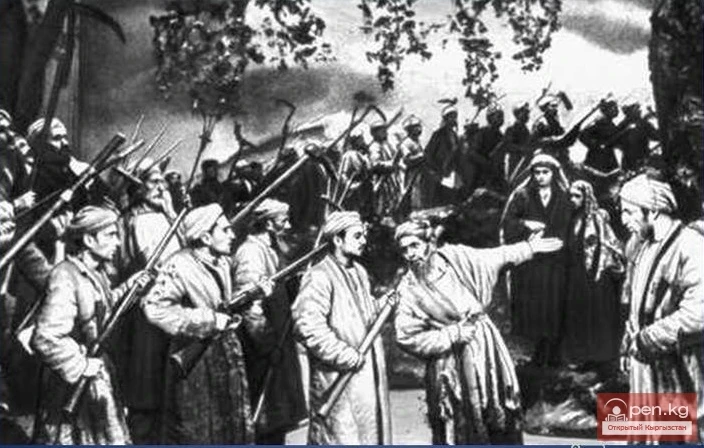
The uprising of the Kyrgyz was led by Alymbek-datka, Saidbek-datka, Pulat-datka, and other Kyrgyz feudal lords. The rebels besieged the fortress of Mady and the city of Osh itself, which they likely captured. The main role in the uprising was played by the Alai Kyrgyz, later supported by the surrounding population of Osh. The Kipchak feudal lords from Shahristan, led by Kur-ogly, who set out to suppress the uprising, along with the troops of the Kokand commander Musulmanqul, defeated the rebels.
In "Tarikh-i Shahrokhi," it is stated: "After receiving this alarming news [about the uprising, the Kipchaks], setting aside Tashkent affairs, engaged in repelling the Kyrgyz. Having no other means and forced by necessity, they gathered a koshu and began to advance on the Kyrgyz. A Kipchak named Kur-ogly, who was the ruler [hakim] of Shahristan, set out with the koshu of this vilayet two days earlier than the troops of the capital and, encountering the Kyrgyz, put them to flight."
From Osh, captured Kyrgyz were sent for execution in Kokand. On market day, they were brought to the khan's urda. A large crowd gathered in the square. Taking advantage of the absence of Musulmanqul and the main Kokand troops, disgraced feudal lords — a certain datka Rahmatulla-mirza and the hakim of Isfarin, Kyrgyz Satybaldy, conspired against Sheraly. They called for the help of the Kyrgyz of Alai. The captured Osh residents seemingly played a certain role as well. The coup ended with Sheraly being executed — "forced to drink the cup of martyrdom," and Murad-bek — one of the sons of Alim-khan was elevated to the throne. However, he did not remain on the throne for long — only eleven (according to some sources — seven) days. But, according to contemporaries, his main desire in life was "to reign for at least two days." Murad had no social support; the Kyrgyz detachment that arrived with him numbered only 100-200 people, and soon Kokand fell into the hands of the enterprising Kipchak leader Musulmanqul, who placed the minor son of Sheraly, Khudoyar-khan, on the throne.
Over the years, Khudoyar-khan became increasingly burdened by the guardianship of his powerful regent Musulmanqul, who also became the father-in-law of the khan. He waited a long time for his moment but took revenge with extreme cruelty. In 1853, relying on the Uzbek nobility, Khudoyar-khan ordered the execution of the regent-Kipchak Musulmanqul and "to wipe out all Kipchaks and Kyrgyz from the face of the earth." And the khan's henchmen, carrying out the order, killed them in all cities — from Kokand to Osh, as well as in markets and roads, exterminating them indiscriminately by age and gender. Thus, by inciting interethnic strife, the khan and his court entourage — the true culprits of all the people's woes — skillfully diverted the people's anger away from themselves.
In general, the city of Osh, as one of the peripheral cities of the khanate, surrounded by "restless" Kyrgyz nomads, repeatedly became the center of the anti-Kokand uprising movement. Here, dissatisfied with the khan's power, claimants to the throne sought support and refuge. In 1858, Mallya-bek, the elder brother of the ruling Khudoyar-khan, decided to fight for the throne, finding support from Kyrgyz feudal lords. But the conspiracy was uncovered, and Mallya-bek fled to Osh, visited Kara-Su and Uzgen, seeking help and support from the influential Kyrgyz feudal lord, the Alai tribal leader Alymbek ibn Hasan-biy. He, "being in great power among all the nearest Kyrgyz" and having his base in Kara-Su, supported Mallya-bek's uprising. As a result, in the same 1858, Mallya-bek triumphantly entered Kokand. Kyrgyz tribal leaders received important appointments: Alymbek-datka became the ruler (hakim) of Andijan, Saidbek-datka was sent to Khojent, Mulla Kasym — to the fortress of Nau, etc. Soon Alymbek-datka became the chief vizier, and the Kyrgyz feudal lords temporarily seized political power in the khanate.
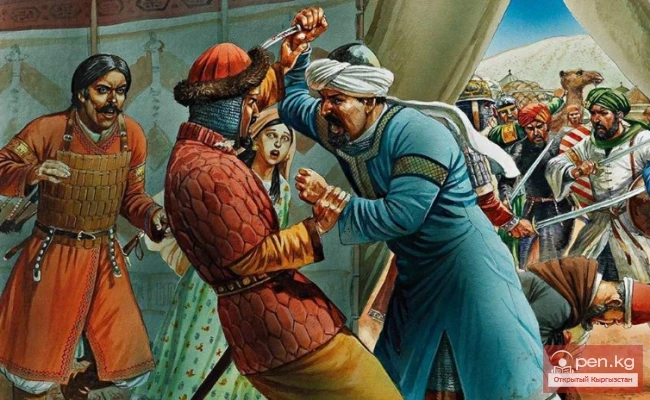
But as soon as Mallya-khan decided to infringe upon the interests of the close Kyrgyz-Kipchak grouping and remove the Kyrgyz feudal lords from the political arena, he "was stabbed at night in the urda by some hired Kyrgyz." According to Kokand sources, the execution was carried out in February 1862 by parvanachi Alymbek, Khydyr-biy eshikagasi, parvanachi Shadman-khodzha, Khuday Nazar-datka, Dust-Mikhtar, Muhammad Ibrahim Mirzabashi, and other feudal lords from the Kyrgyz, Uzbeks, Kipchaks, Turks, etc. In some sources, it is mentioned that the decisive role in this was played by Kyrgyz Alymbek-datka (already a parvanachi), while in others — Kipchak Mulla Alimkul — a rival of Alymbek. The grandson of Sheraly, Shahmurad, was elevated to the throne, but he remained in power for less than a year.
Later, when Khudoyar-khan once again regained the Kokand throne with the help of the Bukhara emir, Kyrgyz and Kipchak feudal lords fled from Kokand in search of refuge in Andijan and Osh.