This library was located in a building that previously belonged to merchant I.O. Abramov, who traded in iron goods, paints, and carpets.
According to historical data, on May 14, 1902, in Przhevalsk (now Karakol), at the intersection of Barsov Street (formerly October Street) and Preobrazhensky Street (or Gebze), the reading room of the first public library was opened. The two-story wooden building became a home for books and knowledge.
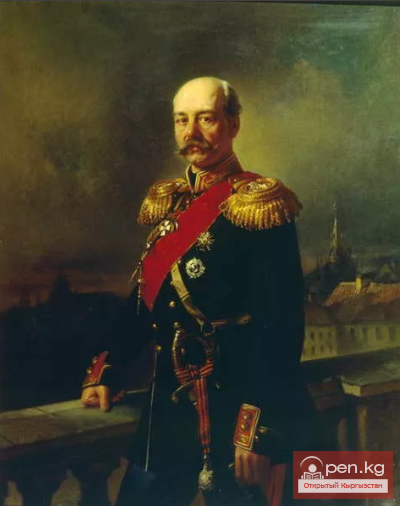
The initiator of the library's creation was Nikolai Matveevich Barsov — the chief physician of the military hospital and the first elder of Przhevalsk. This graduate of Moscow University was appointed to the Issyk-Kul district of the Semirechye region of the Turkestan Territory.
Barsov served twice as the elder of the city.
Nikolai Barsov with his wife and children, 1889-1891
// Issyk-Kul Regional State Archive.
Support for the establishment of the library was provided by notable figures: geographer and traveler N.M. Przhevalsky, Colonel of the Tsarist Army V.I. Roborovsky, and military geographer P.I. Kozlov.
Y.I. Korolkov, P.I. Livatov, and others also made significant contributions to the development of the library.
At the time of its opening, the institution had two reading rooms: the first floor was intended for everyone, while the second was for the privileged class. The library started with a collection of 1,000 books, and by 1903, it had been visited by 5,000 people, and a practice of lending books for home use was introduced.
The library subscribed to publications such as "Novoe Vremya," "Birzhevye Vedomosti," "Russkoe Slovo," and "Sibirskiy Vestnik."
Over time, the building housed the Issyk-Kul State Television and Radio Company.
Thus, the Issyk-Kul Regional Library, opened in 1902, became the oldest library in Kyrgyzstan. On August 4, 1901, the vice-governor of the Semirechye region, Ostashkin, approved the "Charter of the Przhevalsk Public Library - Reading Room."
The history of the library is inextricably linked to the development of the city. In 1888, N.M. Przhevalsky, the famous explorer of Asia, died in Karakol while preparing for another expedition.
In his memory, his friends and students, P.K. Kozlov and V.I. Roborovsky, decided to establish a museum and library.
A monetary transfer of 200 rubles was quickly sent to local historian Y.I. Korolkov to support this idea.
In the accompanying letter, Kozlov and Roborovsky requested to organize a fundraising campaign for the creation of a public library. The city mayor, Nikolai Barsov, also actively supported this initiative.
In 1896, the city assembly decided to allocate 300 rubles annually for the needs of the public library. These funds were directed to the savings bank of the local treasury.
From that moment, active appeals from the public, led by physician Barsov, began for the opening of the library.
It was previously reported that by the decree of the emperor on March 7, 1889, Karakol was renamed Przhevalsk.
As Kaulbars noted, "I am proud that our city bears the name of Przhevalsky — the outstanding explorer of Asia."
In 1874, a primary school was opened in Przhevalsk. By 1879, the number of classes had increased to four. A school called "Maktab" began operating in the Tatar mosque, where the basics of the Quran, history, geography, and mathematics were taught.
In 1890, resettlement of residents from the central provinces of Russia and Ukraine began. By 1897, the population had reached over 8,000 people, and by 1919 — 11,610 people.
Nikolai Mikhailovich Barsov became the first elder of the city, elected in 1894. He made a significant contribution to the city's development, initiating the creation of a drama club and the construction of schools and libraries. In 1895, a park was laid in his honor, now named after A. Pushkin.
Military doctor Barsov was an active participant in the opening of the Przhevalsk City Public Library on May 14, 1902, which he initiated.
On March 19, 1908, the coat of arms of the city of Karakol was approved, which was used for some time as the coat of arms of the Issyk-Kul district.
In 1909, the head of the district was V.A. Ivanov, his assistant was A.I. Belyaev, and the elder of the city became E.S. Lokshakov. Residents were actively engaged in agriculture, fishing, and beekeeping. In that year, 5,200 poods of honey were produced in the city, and trade was developing.
In 1913, the first magazine "Przhevalskiy Selskiy Khozyain" was published. In 1918, 7 schools, a women's gymnasium, an educational institution for men, 4 madrasas, and various associations opened in the city. The city became a center for research on Asia for Russian and foreign scholars.
On May 25, 1918, Soviet power was proclaimed in Przhevalsk.
According to the "Siberian Trade and Industrial Yearbook" for 1913, more than 60 industrial enterprises were operating in Karakol and its surroundings, including:
- Tannery factories
- Soap and candle factories
- Rope and cord production
- Sawmills
- Mills
- Wool washing facilities
- Two factories for the production of artificial waters
Merchants, mainly Tatars, significantly contributed to the development of the city by building trading rows on Karavannaya and Toktogul streets, as well as mosques and other buildings.