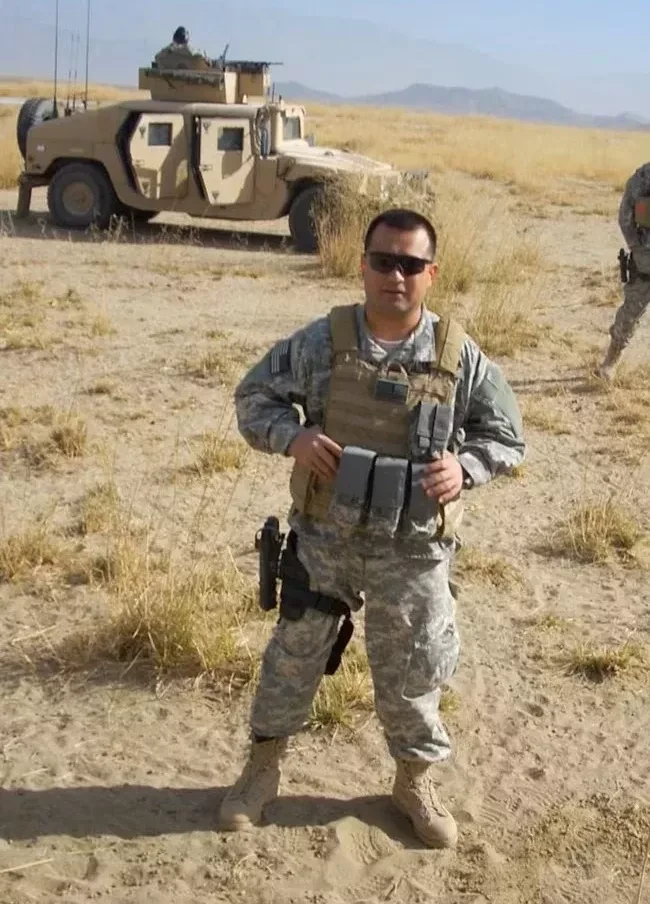
One of those who participated in this war is Sheishenbek Sharshenkulov.
Sharshenkulov grew up in the village of Ak-Bashat, located in the Jayil district, where he completed his schooling. In 1980, he was drafted into the army. He spent the first 10 days at the Kalinin district military enlistment office, and then, while training at an aeroclub at the Sosnovsky turn, he acquired parachutist skills, making three jumps. Although he aimed to join the "autobat," the military enlistment office sent him to Kazakhstan, where he became part of the airborne troops.
“We arrived in Kapchagay on January 8. It was terribly cold at that time. I ended up in the special forces of the 'Muslim Battalion,' which included five other guys from the Jayil district. The other soldiers and officers were from Kazakhstan, Uzbekistan, and other Soviet republics. At that time, there was an 'iron curtain' between the USSR and China, and we studied the Chinese language, intelligence, and mine-blasting techniques,” Sharshenkulov shares his memories.
According to him, the main service in Afghanistan began in early February 1981. At 3 a.m., the battalion was put on alert, and everyone was ordered to remove all identifying marks. On the same day, they set off on a ferry with military equipment, ammunition, and food, heading through Uzbekistan to the city of Maimana. For this, they had to cover about 500 kilometers across Afghanistan. In the very first village, they were met with gunfire — the first vehicle was hit, and a firefight began. Out of 500 people in the battalion, seven were killed in this battle, most of whom were young and had no idea what war was, not realizing that they would have to save the wounded and lose comrades with whom they had shared food just the day before.
Sharshenkulov recounts that despite the difficulties, they managed to reach Maimana. “But all the hardships of war were still ahead of us. We set up camp in a tent city, and our task was to conduct sorties for 2-3 days, clearing roads for Soviet troops and providing medical assistance to the wounded. We returned to base only for rest and personal hygiene, after which we would head out again for reconnaissance. We had modern weapons, but it was not easy to fight the mujahideen. We were not trained in mountain warfare tactics, and they had all the advantages: good endurance, knowledge of the terrain, and they hid in caves. We had to relearn their tactics,” the veteran continues.
The reconnaissance group in which Sharshenkulov served was preparing for an important operation that was planned for 3 months. Their task was to work in one of the hottest spots, high in the mountains, where the rebels' base was located. These conditions were the harshest of his service.
“Our unit was at a high altitude, where it was hot during the day and freezing at night. We stored supplies in a clay women's monastery that came under fire. We slept in vehicles with 2-3 people. Starting the engine or lighting a fire was prohibited to avoid attracting the enemy's attention. We washed in the river, and it was impossible to wash our clothes, so soon we were plagued by lice. Sleeping in the vehicle was extremely difficult, as each of us was itching until we bled. We conducted joint operations with Afghan soldiers, but we could not fully trust them — anyone could switch sides to the mujahideen. We took water from a well with caution, first giving it to the prisoners to drink, and then drinking it ourselves. This is how we spent three months, after which we were sent to Mazar-i-Sharif for another operation,” the veteran recalls.
Later, the "Muslim Battalion" was stationed in Mazar-i-Sharif, where one of the significant events occurred, after which Sharshenkulov was nominated for an award for saving more than 15 people. Several combat vehicles were moving to the deployment site through an Afghan village.
During this movement, Sharshenkulov noticed one of the mujahideen aiming a grenade launcher at the column. The enemy used a tactic that could damage both combat vehicles. The grenade launcher was aimed at BMP-021 and BMP-022, and the mujahideen was ready to pull the trigger, but Sharshenkulov eliminated him first. For this, he was awarded a combat order. “However, the joy of the award was overshadowed by the loss of two of my combat commanders in a firefight that occurred the day before. The hardest part of war is losing people who become close to you,” Sharshenkulov shares.
Sheishenbek Sharshenkulov served in Afghanistan for 1 year and 3 months, participating in the most intense battles, including against the dangerous field commander Ahmad Shah Masood, who threatened to destroy the "Muslim Battalion" within a month and offered a million dollars for the head of their commander.
“From the Jayil district, 220 draftees were sent to Afghanistan, of which 36 were from Ak-Bashat. I was long troubled by the question of why there was no monument to the veterans of the Great Patriotic War in our village. In the administrative center, the village of Novo-Nikolaevka, there is a monument, but it lists the names of only three front-line soldiers, although there were many more. Therefore, I took on the task of addressing this issue. For six months, I appealed to the Ministry of Defense of the Kyrgyz Republic, and in 2018, with the support of my comrades-in-arms, we were allocated a combat infantry vehicle (BMP),” recalls the veteran who became the initiator of the monument's construction.
The process of obtaining permits and delivering the BMP to the remote village was only half the battle; then it was necessary to find a suitable location and install the monument. “To unload the tank, we involved two units of special equipment. The BMP was unloaded and left at the fork between three villages — Ak-Bashat, Aral, and Aydarbek. However, the work was temporarily halted. The BMP stood for a year and a half, and my wife Aigul-ezhe said: 'Sheishenbek, look, your tank is overgrown with grass, soon it will be invisible. We need to do something,' — this pushed me to take further action,” Sharshenkulov recounts.
Another year and a half was spent for the Ak-Bashat ayil okmotu and local deputies to find funds for the installation of a fence, the construction of the monument, and the improvement of the area. Now there are little fir trees growing here, covered benches stand, and on the pedestal majestically rests the combat infantry vehicle with the number 022, just like in Sharshenkulov's years of service. The monument bears the names of 115 veterans of the Great Patriotic War and several names of "Afghan" warriors who passed away in peacetime. All of them are residents of the village of Ak-Bashat.