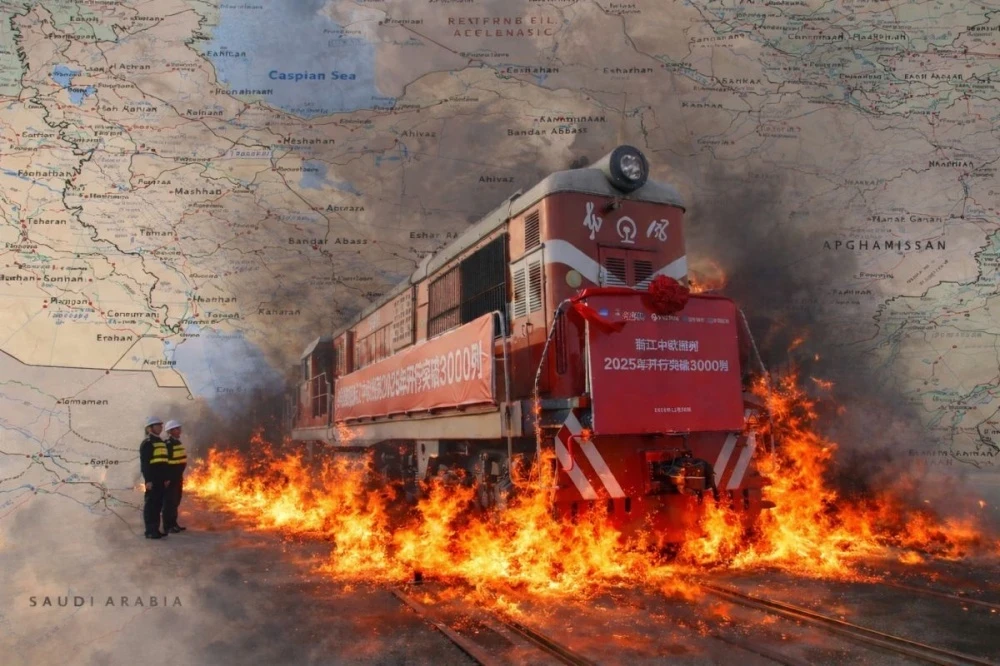
The conflict in the Middle East is rapidly escalating, and its influence is already spreading to a broader range of countries. Political scientist Denis Borisov, head of the laboratory at the "Center for Regional Comparative Studies 'Russia – Central Asia'", shared his views on how this affects Central Asia in an interview for "VES 24".
The failure of the American-Israeli strategy
At first glance, events in the Middle East may seem distant, occurring somewhere in Iran or Israel. However, the dynamics of the conflict show that its geography is expanding much faster than one might expect. Strikes on Caspian infrastructure, which were previously considered protected, raise questions about the conflict approaching the borders of the South Caucasus and Central Asia, as well as the implications for key logistics projects involving Russia, Iran, and neighboring countries. As Borisov notes:
“The failure of the blitzkrieg by the American-Israeli coalition was expected. The conflict in the Middle East continues to expand, and new regions are beginning to be affected by this spiral of escalation. Strikes on Caspian oil and energy infrastructure indicate that the conflict is approaching the borders of the South Caucasus and Central Asia,” he noted.
This is a critical moment—previously, hostilities were mainly concentrated in Israel, Palestine, and border areas of Lebanon, while strikes on Iran were selective. Now, however, the conflict affects facilities located far from traditional "hot spots." The Caspian oil and energy infrastructure represents not just internal assets of Iran, but important links in a complex system related to the economic interests of several states.
Threats to logistics routes
Denis Borisov emphasizes that the situation significantly alters the balance of power in the development of Eurasian logistics routes.
“The northern direction, in particular, the southern ports of Iran, is under threat. If previously there were discussions about development prospects, now we are witnessing how the northern Caspian ports are also being called into question,” he adds.
The context here is important. For a long time, the focus has been on the southern part of the international transport corridor "North-South," including the ports of the Persian Gulf and Iranian terminals. However, now that strikes are shifting northward, key nodes connecting to the Caspian Sea are also at risk. This affects the interests of Russia, Azerbaijan, Kazakhstan, and Turkmenistan.
Moreover, Iranian Caspian infrastructure played a crucial role not only in "North-South" routes but also in "East-West" routes connecting countries through the Caspian Sea. These routes have been used by Central Asian states such as Uzbekistan, Kyrgyzstan, and Turkmenistan.
Thus, through Iran and the Caspian, not only goods moving from north to south passed, but also significant volumes of goods moving along the "East-West" axis, allowing Central Asian countries access to international markets and diversifying their logistics paths.
Risks for Eurasian logistics
The political scientist notes that current events are beginning to have a serious impact on transport flows.
“Thus, this escalation significantly complicates Eurasian logistics. If attacks on Caspian infrastructure continue, it will necessitate a revision of plans for the development of trans-Caspian logistics,” warns Borisov.
The key phrase here is "if attacks continue." At present, we see signs of the formation of prerequisites, and the dynamics of events may lead to a tangible change in the situation in the coming weeks. In the event of ongoing attacks on Caspian ports and oil terminals, logistics companies and states involved in the development of TMTM (Trans-Caspian International Transport Route) will be forced to seek alternative routes, which will undoubtedly lead to increased transportation costs and delays in delivery times.
A new strategy for the American-Israeli coalition
One of the key points that the expert highlights is the change in tactics of the American-Israeli coalition. The failure of the blitzkrieg, in his opinion, forces Washington and Tel Aviv to consider new strategies.
“The initiation of attacks on the northern regions of Iran indicates that the American-Israeli coalition is moving to Plan B—a protracted confrontation. Realizing that Iran will not be easily defeated, they are beginning an active infrastructure war aimed at destroying key infrastructure,” notes Borisov.
This also explains the shift of strikes northward: the goal is to deprive Iran of strategic ties with the outside world.
“It is clear that the logistics channels operating in northern Iran provide it access to Russia, China, and several Central Asian countries, which is critical for its economy,” explains the political scientist.
Consequently, northern routes, including Caspian ports, are becoming vital for the Iranian economy and military-industrial complex. The blockage of these routes could significantly weaken Tehran.
Humanitarian supplies as a trigger for attacks
Interestingly, Borisov notes that recent humanitarian supplies may have triggered the expansion of attacks.
“Recent announcements of large-scale humanitarian assistance, especially from Tajikistan, could have served as a catalyst for the expansion of attacks on Iran,” he concludes.
Even humanitarian supplies in the current conditions are perceived as a form of support for one of the warring parties. Large-scale shipments from Central Asia demonstrated that Iran is not isolated, and its connections with the post-Soviet space continue to function. This became a signal for the coalition seeking to weaken Iran to attack the channels through which this support is provided.
Conclusions
Based on Denis Borisov's analysis, several key conclusions can be drawn:
First, the conflict in the Middle East has extended beyond its borders and is directly impacting the Caspian region, creating risks for the South Caucasus and Central Asia.
Second, not only military facilities are under threat, but also civilian infrastructure critical for international transport corridors "North-South" and "East-West."
Third, the American-Israeli coalition is transitioning to a protracted strategy of infrastructure warfare, aimed at depriving Iran of logistical ties with Russia, China, and Central Asia.
The further development of events will depend on how systemic the attacks on Caspian infrastructure turn out to be. If they continue, plans for the development of trans-Caspian logistics may be revised, requiring countries in the region to quickly adapt to new conditions where logistics acquire not only economic but also military-strategic significance.