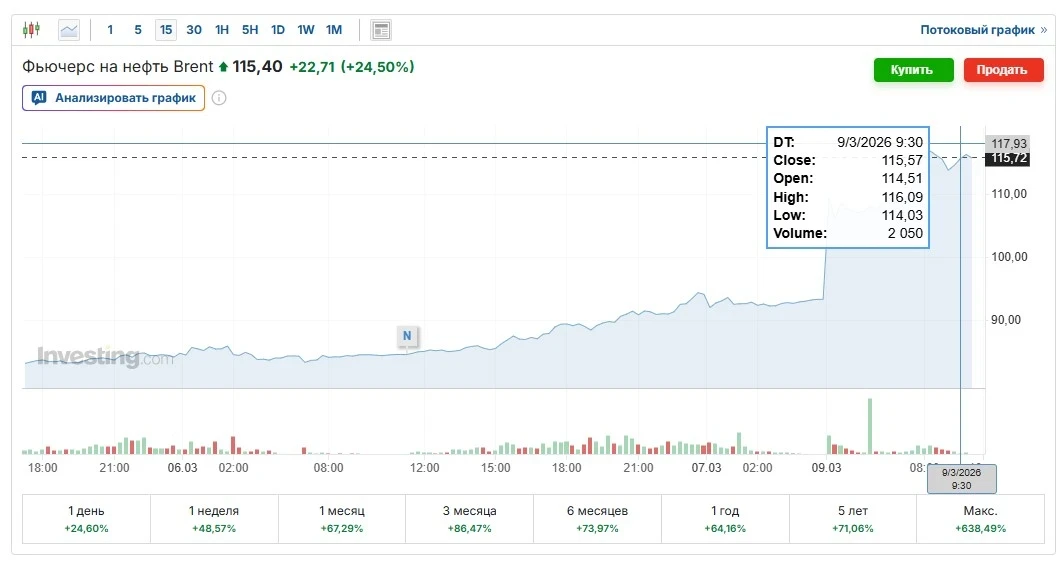
According to RBC, since the beginning of last week, the price of oil has increased by more than 50 percent. The market is concerned about the potential closure of the Strait of Hormuz, through which about 20 percent of the world's total oil volume passes.
Analysts at "VTB My Investments" predict that due to the escalation of the conflict in the region, prices could rise to $100–120 per barrel in the coming days.
Shares of Russian oil companies have also reacted to the rise in oil prices. For instance, Rosneft's shares increased by 4.42 percent, Surgutneftegas by 2.9 percent, and Gazprom Neft by 1.51 percent.
The Minister of Energy of Qatar expressed concerns that if the conflict continues, global oil prices could reach $150 per barrel in the coming weeks.
The situation is exacerbated by the fact that the largest oil storage facilities in Saudi Arabia and the UAE are quickly filling up, as the export of crude is hindered. According to Citigroup estimates, due to the blockade of the strait, the global market is missing out on between 7 to 11 million barrels of oil per day. Meanwhile, the U.S. administration has no plans to use the strategic reserve to lower prices.
- The conflict between Israel and the U.S. against Iran began on February 28 and was accompanied by numerous air and missile strikes on Iranian cities and military facilities. In response, Tehran attacked Israel and U.S. military bases in several Middle Eastern countries. In the first hours of the conflict, several high-ranking Iranian officials and military personnel were killed. Following the start of the attacks, U.S. President Donald Trump announced the beginning of Operation "Epic Fury" in his address to the nation.
- The Supreme Leader of Iran, Ayatollah Ali Khamenei, was killed along with about ten high-ranking officials. His position was taken by the son of the slain ayatollah, Mojtaba Khamenei, who became the new Supreme Leader of Iran.