Azmat Ormonov, a local resident, noted that in recent years there has been an increase in the number of tourists, both local and foreign, wishing to see the remains of this historical fortress.
Ormonov conducts tours for guests, sharing with them the fascinating history of this military structure.
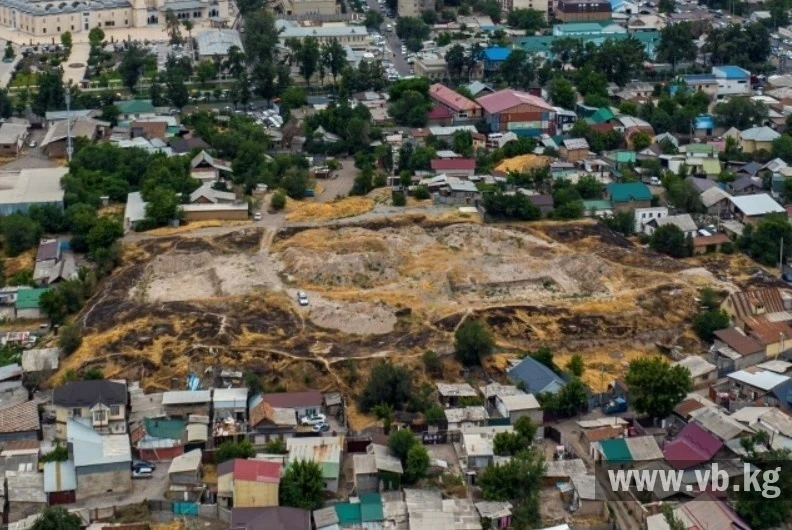
The fortress reaches a height of up to 5 meters at its tallest tower, although historical sources also mention a figure of 3.5 meters. Currently, the length of the fortress is about 200-300 meters, and its width is 1-1.5 meters. Clay, sand, and stones were used for construction, and the building techniques allowed this structure to be preserved to this day.
Some time ago, local residents began to dismantle the fortress, using its materials for fertilizers or to build their homes. In 1999, during the invasion of militants into the Batken region, the Kyrgyz military used this fortress during a military operation. After these events, the area was fenced off and became protected.
According to open sources, this military structure was erected in the 18th-19th centuries, with the participation of thousands of local residents.
Historian Abdinabi Kadyrov shared information that Khan Kudayar's fortress was built in a mountain gorge with a panoramic view of the valley. Workers specifically leveled the elevation during construction to improve visibility. "The highest point of the structure reaches 4.9 meters, and the second defensive structure occupies an area of about one hectare. The construction process involved layering rammed earth walls, with designated cylindrical spaces and service rooms. Two parts of the fortress are connected by a passage, and there are openings for rifles in the walls, indicating its defensive function. The construction was initiated by the khan, and during the Soviet era, the fortress was not used," the historian said.
Azmat Ormonov added that in the past, there were no water sources in this area. Workers formed a chain and passed water from the river located in the lowlands. "Local legends say that those who were lazy were bricked up alive in the walls and then covered with clay. I have not encountered remains, but our foreman Mukhtaj said he saw the remains of tall people in black chapans. Some local residents confirm these stories," Ormonov shared.
Today, local residents have rented the area, where they have planted a garden and grow grain crops.
According to Azmat Ormonov, Khan Kudayar's fortress is an important historical site in Kyrgyzstan; however, the Ministry of Culture has not yet included it in the list of cultural heritage sites and has not conducted restoration. "It would be beneficial to carry out restoration work on the fortress so that it could attract tourists again. This would bring additional funds to the budget that could be directed towards maintaining the complex," he noted.
Recently, tourists from Japan visited the village, who were impressed by the monument and noted the beautiful panoramic view. They expressed the opinion that attention should be given to this site by scholars and that an open-air museum should be organized.
Khan Kudayar (1829-1879) ruled the Kokand Khanate in 1845-58, 1862-63, and 1865-75.
According to information from open sources, the fortress with massive walls and loopholes occupies an area of five hectares. Builders transported construction materials such as stones, clay, and water from distant locations. Local residents claimed that many people were involved in the construction, passing water in a long chain. As legends say, the disobedient were bricked into the walls, and later remains of people in robes were found.
This powerful defensive structure became a necessity for the rulers of the Kokand Khanate, one of the youngest states in Central Asia, which emerged in the Fergana Valley in the late 18th to early 19th century.
According to legends, Khan Kudayar's life was full of adventures. He repeatedly lost and regained power, and once even fell into captivity of Russian troops in Orenburg, from where he miraculously escaped.
During the construction, the khan invited the famous singer Bekboto to entertain his wives with his singing. The beautiful women loved the singer so much that they took him with them to Kokand. It is said that his descendants now live throughout Central Asia.
Today, many parts of the fortress are destroyed, as local residents used clay in the construction of their homes. A similar fate befell the small house at the entrance to the fortress. However, after several incidents with destroyers, the walls were restored, as local residents feared the wrath of the spirit of Khan Kudayar, who, according to beliefs, guards his domain.
In the 1970s, an apricot orchard was planted inside the fortress as part of community work.