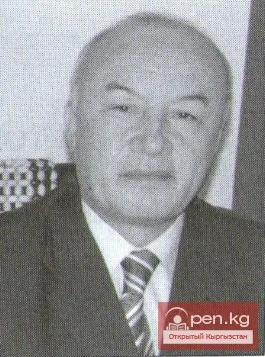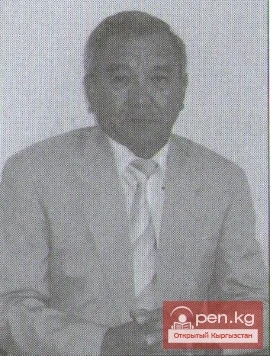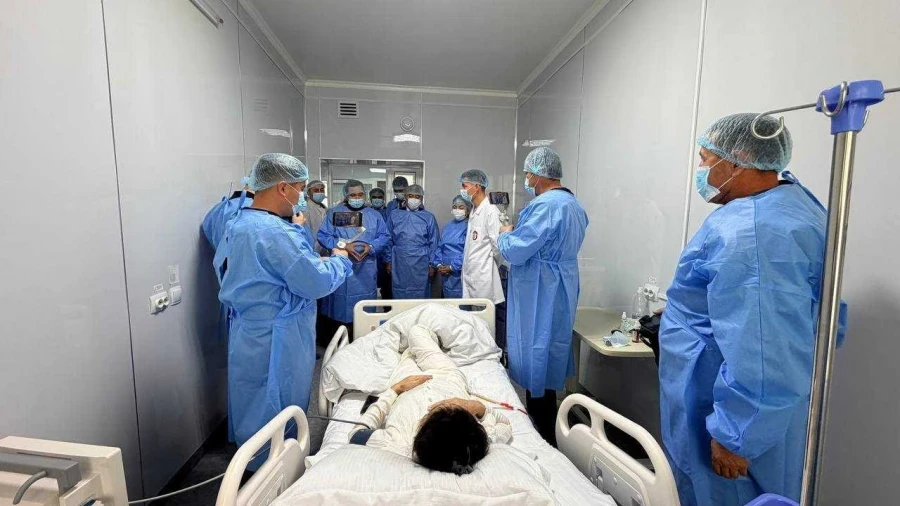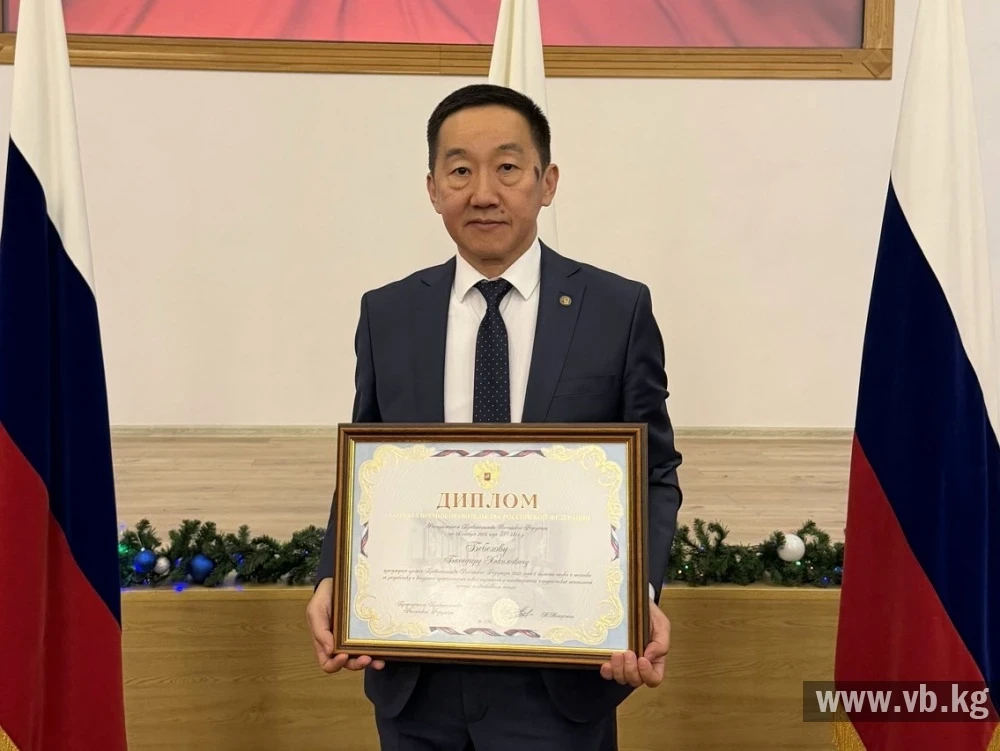
Among the awardees was, for the first time, a representative from Kyrgyzstan — the head of the Department of Innovative Surgical Technologies at the I.K. Akhunbaev Kyrgyz State Medical Academy, Doctor of Medical Sciences and Professor Bakhadyr Hakimovich Bebezov. The diploma of the laureate of the 2025 award in the field of science and technology was presented to him by the Chairman of the Government of Russia, Mikhail Mishustin. Professor Bebezov became a laureate for developing a new strategy and innovative surgical technologies for the treatment of alveococcosis of the liver.
Upon returning from Moscow, a correspondent from VB.KG congratulated Bakhadyr Bebezov on his achievement on behalf of the entire editorial team and asked him several questions.
Bakhadyr Hakimovich, how long have you been dealing with the issues of diagnosis and treatment of alveococcosis of the liver, also known as "parasitic liver cancer," due to its ability to metastasize and recur? Why is the incidence increasing in the country?
- The problem of alveococcosis of the liver in Kyrgyzstan is not new. Academician I.K. Akhunbaev and his students studied it. In 1966, one of the graduate students defended a dissertation on the topic "Alveococcosis of the Kochkor Basin in Kyrgyzstan," and for more than half a century, this problem has remained relevant due to the rising incidence.
We continued scientific research in this area and conducted five expeditions from 2011 to 2015 to remote high-altitude regions of Kyrgyzstan, where an unfavorable epidemiological situation is observed. As a result, new foci of alveococcosis were identified, such as the Alaï and Chon-Alai districts of the Osh region. Internal migration of the population also contributes to the increase in incidence in the Chui region and Bishkek. In 2012, we organized an international expedition that included 10 foreign scientists, including Professors David Greig and Paul Thorgerson. This work allowed us to collect important epidemiological data to prevent the spread of the disease.
We were the first to implement anatomical liver resections for focal lesions. Thanks to our efforts, extensive liver resections are now performed in specialized medical institutions in Kyrgyzstan. We also have significant experience in performing liver resections in children, which we are developing in collaboration with colleagues from the National Center for Maternal and Child Health. Modern technologies such as ultrasonic dissection and argon coagulation have been implemented.
The only radical method for treating alveococcosis of the liver remains surgery. Unfortunately, two-thirds of cases are diagnosed at late stages when traditional methods do not allow for radical surgery. In such situations, only palliative methods are used, leading to a high risk of recurrence and requiring lifelong antiparasitic therapy, the effectiveness of which is extremely low. This, in turn, leads to disability and a significant deterioration in the quality of life of patients, 90% of whom die within 10 years.
What’s new in the joint development of scientists from Kyrgyzstan, Russia, and Belarus? How effective is your work against alveococcosis?
- In 2015, at an international congress in Tashkent, Professor Vladimir Evgenyevich Zagaynov presented a report on liver autotransplantation for alveococcosis, in which a new classification of this disease was proposed and the term "transplantation technologies" was introduced. The report sparked lively discussion, and we exchanged contacts. Professor Zagaynov invited us to his center, and since then we have been actively collaborating.
Our author team consists of specialists from five leading medical institutions in Russia, Belarus, and Kyrgyzstan, including the A.I. Burnazyan Federal Medical Biophysical Center, the Privolzhsky Research Medical University, and others. Among the authors are renowned scientists such as Corresponding Member of the Russian Academy of Sciences S.E. Voskanian and Academician O.O. Rummo.
Our work presents the largest experience in the world of radical treatment of alveococcosis of the liver, including radical resections and the application of transplantation technologies. We have performed a number of operations that were carried out for the first time in world practice.
The implementation of our strategy and innovative surgical technologies has led to an increase in resectability to 96.5 percent and has addressed the key problem of alveococcosis, which previously resulted in unsatisfactory outcomes from traditional treatment.
Complete recovery was achieved in 96% of operated patients. The 10-year overall and recurrence-free survival rates are 98.3% and 95.8%, respectively. Our strategy is actively being implemented in specialized surgical centers both in Russia and abroad.
I would like to express my gratitude to the rector of KGMA, Indira Orozobayevna Kudaybergenova, for her support in nominating me for the Russian government award, as well as to all the staff of the Department and Clinic of I.K. Akhunbaev at the National Hospital. This is our common success and achievement of our medical science.