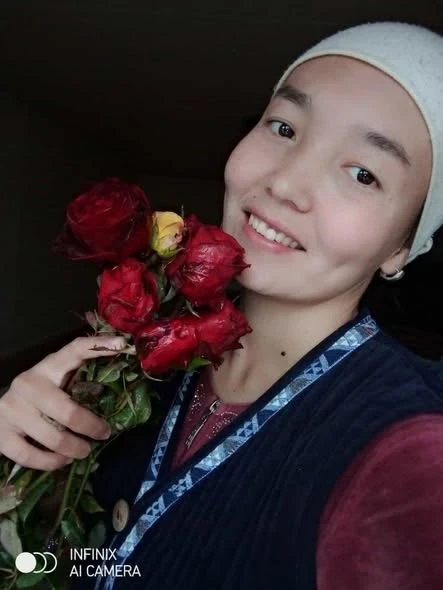
With 12 years of experience as a junior staff member in the forensic department of the Osh regional bureau of forensic medical examinations, Damira participates in the process of handling bodies that come to her. She works with victims of traffic accidents, murder victims, suicides, and those who died under strange circumstances.
Her duties include receiving bodies, washing, cleaning, stitching, dressing in a shroud, and placing them in the refrigerator—all these tasks fall on the shoulders of one woman.
Damira was born in 1976 in the village of Japalak near Osh. She is married and has two children—a son and a daughter.
“Like many, I dreamed of going to Russia. But when the children started school, I needed to take care of them. So I stayed, and an acquaintance offered me a job here,” Damira recounts.
Initially, she worked as a cleaner in the forensic department, but soon began to participate in the main work. “When I was cleaning the offices, my colleagues would gather for tea, and I would ask, ‘Are you free?’ At that time, they could be carrying out a body. I waited, got used to it, sometimes helped, and soon it became ordinary work for me,” she notes, adding that she is not afraid of the dead: “They are scarier than the living.”
Damira remembers her first day at work when she first worked alone with a body: “A boy who died in an accident was brought to us. We carried out all the necessary procedures and handed him over to his relatives.”
She emphasizes that society often misunderstands the essence of forensic examination. “When they hear the word ‘examination,’ everyone immediately thinks of the morgue. But that’s just one part of the work. In our field, there are many departments—laboratories, histology, biology, and the department for injuries,” Damira highlights.
Once the body is delivered, the responsibility shifts to the experts and sanitary workers. “The police work ends at the delivery stage. We receive the body, and the investigator records the data in a log, indicating who delivered it and their signature,” she explains.
If relatives cannot be found, the body is placed in the refrigerator. “After receiving, we transfer the body to the autopsy room and lay it on the table. If a person has no relatives, we keep them in the refrigerator until the investigator provides the documents,” Damira adds.
Sometimes they also receive newborns who died shortly after birth. “There are cases when children who lived only two hours are brought in. Their father files for an examination, accusing the doctors of negligence,” she shares.
According to Damira, the number of suicides among teenagers sharply increased in September 2025. “Children born between 2000 and 2012, mainly in 2009 and 2010, began to hang themselves. Two to three bodies were brought at a time. There was even a girl born in 2011, as well as cases where children drank vinegar,” she recounts.
When 5 to 6 people die in a traffic accident, all bodies arrive simultaneously. “This is considered a mass arrival. We conduct autopsies, and sometimes the bodies are in terrible condition, with obvious injuries. Sometimes we have to restore their shape by stitching and wrapping tissues,” Damira explains.
Despite her experience, she admits that sometimes she cannot hold back her emotions. “When you see crying relatives, it’s hard to remain indifferent. Everyone has children, and your heart tightens. There are days when I cry too. Children who were raised with hope... sometimes I just step outside, reflecting on how it was meant to be,” she shares.
She explains how they determine the time of death by post-mortem stains. “Depending on the position of the body, stains form, and we determine how much time has passed since death by them,” Damira says.
Sometimes they receive bodies that have been lying for a long time. “Recently, a body of a man of Russian nationality was found near the airport—it was mummified. But regardless of the condition, we conduct an examination and place the body in a special bag,” she adds.
Relatives are shown the body only with the investigator's permission. “We can only release the body based on an identification document, and only with the investigator's permission,” Damira clarifies.
Unfortunately, very few people want to work in this field. “No one wants to go into this profession. We searched for employees but found none. If something happens in the districts, we go ourselves. Now I work alone throughout the Osh region,” she says.
Sometimes examining one body takes a significant amount of time. “If there are many injuries, it can take more than an hour. When bodies arrive daily, it is very exhausting. After the examination, we strictly follow all requirements,” Damira shares.
Recalling the pandemic period, she talks about the difficulties. “We worked in protective suits, examining those who died from coronavirus, taking samples, stitching, and washing bodies. The deceased had enlarged lungs, as if filled with pus. It was terrifying, but we continued to work,” she remembers.
Damira was also at the site of the tragedy in Oң-Adyre. “A mother and five children died there. We went out with an expert, examined the bodies, and brought them here. It was hard—how they lay, they burned. Relatives brought film, and we wrapped the bodies,” she recounts.
Sometimes additional permission is required to straighten limbs. “If they are stiff, we ask for permission on how to straighten them. Sometimes we have to cut to fit them in the shroud. The skin of burned bodies hardens,” Damira shares.
It is difficult for her when bodies remain unclaimed. “It’s good when relatives are found. But sometimes the body begins to decompose, and a smell appears. If no one comes forward within a month, we carry out a burial at the expense of the mayor's office,” she explains.
Openly discussing her financial difficulties, Damira admits: “The salary is small. My husband cannot work due to health issues, so I am the sole breadwinner. We have two school-aged children.”
Young people are not eager to enter this profession. “Now I do all the work alone—wrapping bodies, cleaning the premises, and transferring bodies to the refrigerator. Even students are afraid of this work. We offer them to do an internship, but they refuse. There is one resident, and sometimes I call him for help. He will become an expert in two years,” Damira concludes her story, facing death every day.