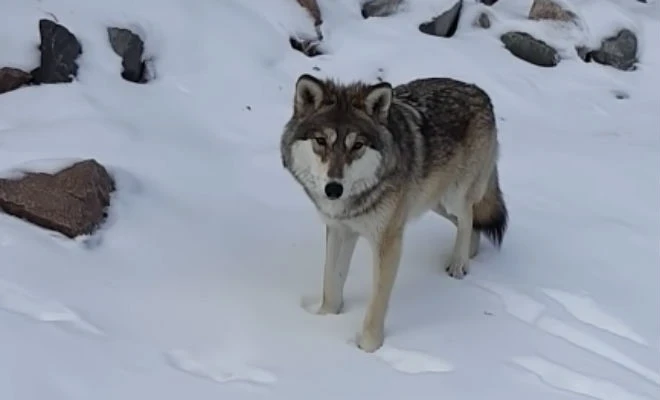
According to the hunters, the black wolf was shot in the Suusamyr Valley in December 2021. Later, it was sold for a significant amount. However, one problem arose: the hunters refused to share details about this hunt and did not provide a more accurate description of the trophy, without explaining the reasons for their silence. Nevertheless, this information quickly spread across social networks. A few days later, cases of black wolf hunting were registered in the Sokuluk district and in the vicinity of the village of Manas, resulting in the total number of caught "black wolves" in December rising to several individuals.
Ecologist Alexander Sosnovsky commented on the situation as follows:
“In nature, there are melanistic individuals, that is, animals with completely black fur. Melanism is a phenotypic variation in which the coloration is significantly darker than that of other members of the same species. This phenomenon, caused by hereditary changes, is observed in various animals, including mammals, reptiles, insects, and fish. The opposite of melanism is albinism, which manifests as completely white coloration. The question is: have you ever encountered white albino wolves in Kyrgyzstan? Melanistic forms of wolves do occur, but much less frequently than in dogs, and only a specialist can distinguish a dog from a wolf,” he added.
Andrey Bushuev, a cynologist from the Chui-Bishkek Society of Hunters and Fishermen, noted that wolves can be distinguished from dogs by several characteristics, such as the structure of the jaws and teeth.
“Having studied the provided photos and videos, I can confidently say that the hunters likely made a mistake and mistook a dog for a wolf, which is not surprising, as dogs can go wild and inhabit the wilderness. To avoid such misunderstandings, hunters should interact more often with specialists, such as cynologists and hunting experts. During my time in the hunting community, I am not aware of any cases of black wolves being hunted in Kyrgyzstan,” he emphasized.
Hunter Nikolai Radchenko, who has caught many gray predators himself, also added that disputes about whether a wolf or a dog was caught are not uncommon in the history of hunting.
“In the 1950s-70s in the USSR, conflicts arose between hunters and fur buyers when hunters tried to pass off dog skins as wolf skins. The reason for this was economic considerations: three rubles were paid for a dog skin, while fifty were paid for a wolf skin. Catching a wolf is much more difficult than shooting a dog. Hunting experts easily recognized attempts at deception, as the fur on a wolf's skin has a two-zone coloration, while a dog's has a three-zone coloration,” he added.
In conclusion, hunter Nikolai Radchenko noted that such disputes about the difference between wolves and dogs were quite common in the past, and in resolving them, it is always important to consider details and expertise.