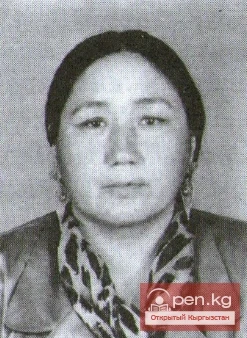
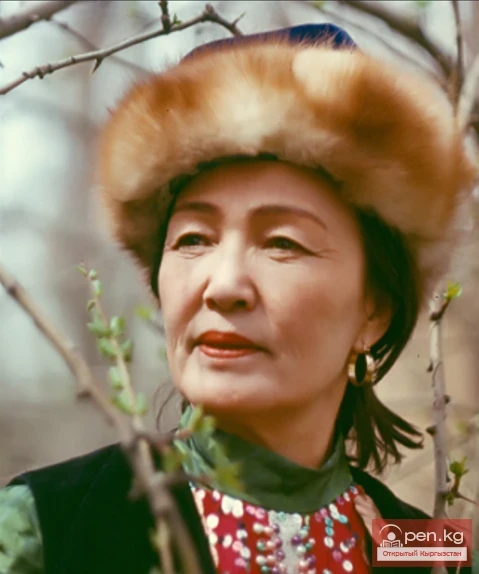
Ibraimova (maiden name Asanova) was born in the village of Tegene in the Aksy district. In Salamkan's family, three generations have operated tower cranes — the family can be called a dynasty of crane operators. Her late husband, Kailybek Ibraimov, was also a crane operator. Their children and grandchildren followed in their parents' footsteps.
In an interview with a Turmush correspondent, Ibraimova shared that she studied at the Toktosun Tanybekov Secondary School in Tegene until the 8th grade. After finishing school, her family moved to the city of Kara-Kul, where Salamkan continued her education at Secondary School No. 2 named after Cholponbay Tuloberdiev, graduating with 10 grades.
Due to her mother passing away at a young age and other family circumstances, I was unable to enroll in and graduate from a higher educational institution. It was the Soviet era, and six-month courses were opening in Kara-Kul. Therefore, I tried to attend any courses available at that time to improve my education level.
I have 7 certificates from completing such courses — crane operator, electrician, secretary, typist (for light work), and sewing. The most significant document, in my opinion, is the completion of the stoker courses (she says with a smile). At that time, to work as a stoker, one needed to obtain a certificate, which was very important. I worked for 5 years as a controller in the power grid (now RES), then became an installer. Soon, the Naryn HPP enterprise in Bishkek began constructing multi-story residential buildings. They were looking for a crane operator, and my husband worked on a tower crane. Every month he had to go on business trips — traveling back and forth. Since he couldn't keep up, he suggested considering my candidacy for the crane operator position: "My wife has received education as a crane operator. If you hire her, we can work together in the capital until the construction of the residential buildings is completed." During the day, I was transferred from RES to work at Naryn HPP — I started operating the tower crane. That's how our enterprise built houses in the capital of Soviet Kyrgyzstan in 1978," the resident reported.
According to Ibraimova, she became a crane operator at her husband's suggestion: "You can do it, you'll succeed." "Thanks to his support, I succeeded. Of course, I was scared to start operating the crane. I was on a bridge crane 200 meters above the dam — we were lifting concrete slabs from the ground. The weight of one load [of concrete] reached 12 tons. During the construction of the Kurpsai HPP, the so-called 'red concrete' was used, which we lifted and placed on the top layer. At that time, the city leader was Kozubekov. I remember lifting the 'red concrete,' and Kozubekov threw his wristwatch. Moreover, those present began throwing pens and coins. There was a time when they filmed stories about us for television and published materials in magazines. That's how I learned to work at heights without fear. If you put in the effort, anyone can do anything. I worked a week on the crane, and the next week part-time at the Household Combine," she says.
She recalls how in 1980 they started the construction of the Kurpsai HPP "from scratch." "In 1981, I became pregnant and worked on the crane until I was 7 months along without any fear. At that time, pregnant women were transferred to lighter work and then sent on maternity leave. The day after I went on maternity leave, the foreman asked where I had gone. They told him I had gone on maternity leave. He was surprised: 'Did she really work on the crane until 7 months... How could that happen? What if she had lost consciousness and fallen?!' On one hand, he was surprised, and on the other, he was worried. Women did not work on tower cranes at that time. Moreover, it was the Soviet Union, and many workers were of Russian nationality. They called me 'the national woman,' saying I couldn't work on a tower crane. But I said I could work and tried to show my abilities. I first operated the tower crane 'KBGES' at the construction site of the HPP, after which we were transferred to the Tash-Kumyr HPP. Then we worked at the Shamalda-Say HPP.
Soon, the collapse of the USSR occurred, and work was suspended. After that, we worked on the construction of the oil refinery of the company 'Petrofakt' in the village of Uchkun in the Jalal-Abad region. With the help of bridge and gantry cranes, I lowered pipes. As soon as the work for the crane operator ended, I started working as an electrician. A friend from Kara-Kul jokingly said: 'Look, a Kyrgyz girl!'. I participated in the construction of a four-story building of a lyceum on Kurmandjan-Datka Street in the city of Osh. The funding for this project was provided by one of the foreign billionaires. I also worked on the tower tubular crane. After the work was completed, acquaintances invited me to work in Moscow. It was 2002... I thought it was only for three months. Together with my husband, we went to work there, as crane operators were needed. We left our five-year-old daughter in the care of our older daughter. In Moscow, we were met by a foreman whom everyone called Petrovich. We rested for two days after our arrival and then started construction, jokingly saying: 'We came to finish the unfinished Moscow.' So much time has passed, and the capital of Russia is still being rebuilt. After working there, my husband and I retired. Now we are enjoying our well-deserved rest," Salamkan said.
According to Ibraimova, her son Kazybek and daughter Gulnara are currently working as crane operators in Moscow, and her second daughter is also a crane operator working in Kara-Kul.
After working in Moscow and retiring, Ibraimova was awarded the title of "Labor Veteran." "It has been 10 years since then, and to this day, when I visit the capital of Russia, tram, metro, bus, and intercity train rides within Moscow are completely free for me. I show my card and travel. Thank God, our work has been appreciated. I am grateful to them for this," says Salamkan.
She has 12 grandchildren and, together with her husband, raised 7 sons and daughters.
In her free time, she engaged in handicrafts and sewing — it was her hobby. "When I worked at the Household Combine, a friend of Korean nationality, Pak, was recruiting those willing to study in Poland to learn how to sew sheepskin coats. It was the 1990s. The girls working in the sewing shop started saying they couldn't go because the road was too far. To which Pak replied: 'If I send Kyrgyz girls there, they will learn, come back, and teach other Kyrgyz girls.' He also added that if he sent Kyrgyz girls for training, he would have the opportunity to approach Askar Akayev and ask for help. My husband quickly sent me on a labor leave. At the end of November 1990, I went to Poland. I didn't make it in a month; they were supposed to send a truck with raw hides for me. But on the way, the car broke down, and the hides never arrived. I stayed there for 3.5 months. The Poles then said that Russians are such that they do not keep their promises. I lived in their homes for free, embroidered sheepskin coats for children and vests for women, trying to demonstrate my abilities.
In the end, they told me: 'If there were two workers like you, a whole factory could be established.' The factory director, Andrey, appreciated my work and asked me to sew a leather coat for his wife. I agreed and started working. When I had finished two sides, a notification came from Kyrgyzstan. I left Poland for Minsk. By that time, the car with the hides that had broken down on the road had just arrived in Poland. For that truck with the hides, the Poles were supposed to give me a good sewing machine, which could be used to sew jackets. Thus, agreements were reached. But in the end, I returned without that machine. Upon returning home, Pak and I sewed a limited number of leather items — 7 sheepskin coats. Soon, Pak disappeared for unknown reasons. My daughter Dinara is now engaged in sewing; she has her own workshop. At one time, I opened a workshop called 'Kakay,' naming it after my mother. But I had to close it because I was leaving for Russia," Ibraimova reported.
In Ibraimova's house, there are many flowers. According to her, she loves growing flowers very much. "In my free time, I try to take care of the flowers — watering them, removing dried leaves. Today, I have more than 100 pots. Every autumn, I go to Moscow for health check-ups and examinations by doctors. During this time, I give my flowers to neighbors for temporary care. I like begonias the most. On my birthday, my children and friends give me flowers because they know how dear they are to me," says the resident.
When asked who named Salamkan apа, she said it was probably her maternal grandmother. Her mother, Kakaya, passed away when Salamkan was only 13 years old. Ibraimova was born on May 9.
"For some reason, they didn't name me Zhenishgul or Mayramgul... I would like to wish the entire people of Kyrgyzstan good health and well-being, so that we all together overcome difficulties. I hope that wonderful times will come, and our children will live happily and prosperously," says Ibraimova.