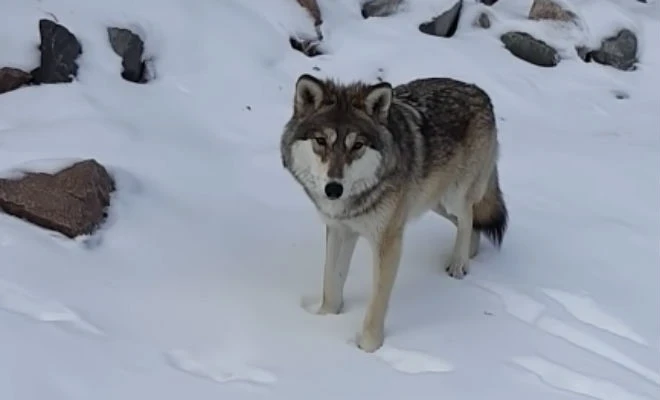
Perceptions of crows as "freeloaders" of wolves have proven to be incorrect. A new study has demonstrated that these birds behave like true strategists, rather than mere observers.
A group of scientists from the University of Veterinary Medicine Vienna and the Max Planck Institute for Animal Behavior conducted an extensive study in Yellowstone National Park, where wolves have been reintroduced since the 1990s. As part of the experiment, 69 crows were equipped with GPS trackers, which is unprecedented for such studies.
Additionally, the movements of 20 wolves were studied in parallel, as reported by "Around the World".
The results were quite unexpected. Over two and a half years of observations, the scientists recorded almost no instances of crows following wolves in search of food. This calls into question the previously held theory that birds simply follow predators in anticipation of a meal.
In fact, crows act in a much more complex manner. They possess advanced spatial memory, allowing them to remember areas where wolves are most successful in hunting, such as open valleys where predators can more easily catch deer or bison. Crows make targeted flights, covering up to 155 kilometers in a day and spending up to six hours in the air without a break. This enables them to arrive at the scene first and secure a piece of meat before the wolves begin their feast.
Thus, crows do not merely follow wolves; they calculate their actions by regularly checking hunting sites. Although they may sometimes rely on sounds or movements of predators, their intelligence and experience play a key role in understanding the situation over a vast territory.
According to the researchers, this discovery radically changes our perception of crow behavior. These birds demonstrate a level of planning and navigation that was previously thought to be characteristic only of the most intelligent animal species. They do not depend on a specific pack of wolves and can flexibly adapt their strategies, relying on their memory and analysis of the environment.
The study showed that crows are not just companions of predators, but independent "landscape analysts" capable of predicting events.
The article "The Magnificent Intelligence of Birds: How Do Crows Know That Wolves Nearby Have Caught Prey and Are About to Feast?" was first published on K-News.