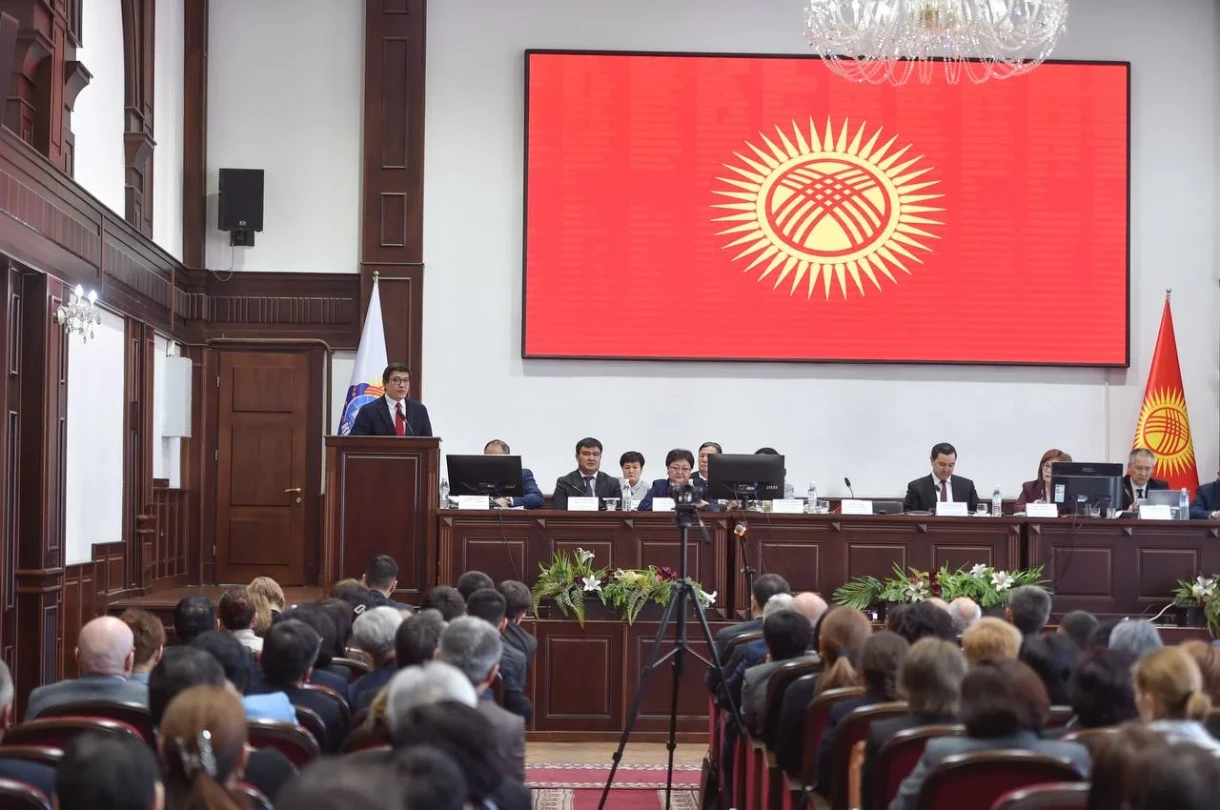
- He currently also heads the A. Tashieva Scientific Center for Maternal and Child Health.
Askerov noted that in this field, medical education is undergoing transformation, which is associated with the introduction of modern technologies and a shift towards a competency-based learning model. He highlighted the importance of simulation training, the development of narrow specialties, and the increase in clinical practice, adding that systematic investments in educational infrastructure are required for the successful implementation of these aspects.
Quote:
“With the rapid development of medical knowledge and technologies, educational programs are becoming increasingly intensive. Developing an effective educational process in obstetrics, gynecology, and pediatrics that can prepare students for various medical professions in a short time is a global challenge. In our country, there is a trend towards the standardization of educational programs that integrate core competencies but do not emphasize early clinical practice.
Currently, there is a transition to competency-based medical education (CBME), where the focus is on developing surgical skills and diagnostics, rather than just on experience. Leading global programs are actively implementing simulation training, virtual reality, and structured internships (for example, in perinatal medicine, pediatric gynecology, and reproductive medicine) to enhance independent clinical competence.
The American Board of Obstetrics and Gynecology (ABOG) has recognized such narrow specialties as perinatal medicine and gynecologic oncology.
In the process of in-depth training, modeling surgical skills and preparing for emergency obstetric situations play a crucial role, contributing to increased confidence among trainees. Specialized continuing education programs are emerging, covering reproductive health issues from childhood to puberty.
However, adequate training in these areas is not provided, including a three-year general residency followed by internships (for example, in pediatrics—pediatric cardiology and neonatology). The program for general practitioners in the first year covers more topics related to therapy and family medicine, which form the basis of clinical residency for all specialties. At the same time, clinical bases in the relevant areas of family medicine do not always meet modern requirements.
The transition from theoretical training to clinical internships and continuous professional development remains a challenge. For instance, specializations related to managing high-risk patients, complex gynecological surgeries, and digital tools in healthcare are insufficiently developed.
Education in obstetrics, gynecology, and pediatrics is undergoing transformation, accompanied by the introduction of new technologies and standards, but significant disparities remain, especially in resource-limited settings.
It is important to note that training in modern clinical bases helps identify residents who require additional support in certain areas and provides a broader skill set by the end of their training. Clinical sessions in emergency obstetric care (for example, managing postpartum hemorrhage) are not often conducted jointly with midwives and nurses, which limits team interaction. Research shows that team simulation training improves not only technical skills but also communication, which is critically important for patient safety.
Simulation training is also of great importance in obstetric-gynecological education. Due to limited working hours and safety considerations, residents have fewer opportunities to practice complex surgeries. To address this issue, simulations using anatomical models and virtual simulators are employed.
While common scenarios (natural childbirth, cesarean section) are becoming part of simulation training, critical scenarios such as amniotic fluid embolism and maternal cardiac arrest remain outside its scope. This underscores the need for developing simulation training that covers complex cases so that graduates can better handle emergencies.
Considering new surgical methods and therapies, practicing physicians must continuously update their knowledge and skills. Continuing education in these areas includes not only lectures but also simulation methods, which is particularly important for providing assistance in emergency situations.
Many medical institutions already conduct regular drills involving not only interns but also experienced doctors and nurses. These drills aim to maintain high standards and teamwork. Research shows that even suboptimal simulations combined with e-learning can significantly enhance students' knowledge.
By developing infrastructure, simulation training programs demonstrate a reduction in the number of lawsuits and adverse events in obstetric-gynecological practice. However, challenges remain in scaling these methods, including cost and ensuring the relevance of simulations. The growing interest in virtual and augmented reality, as well as artificial intelligence as educational tools, holds great potential, but these tools must be evaluated for their educational value.
Thus, investments in educational infrastructure and the adaptation of curricula are critically important for training qualified specialists. Modern educational approaches emphasize practical skills and validated competencies, using simulations and technologies to shape physicians who possess both technical and humanistic skills in women's and children's health.”