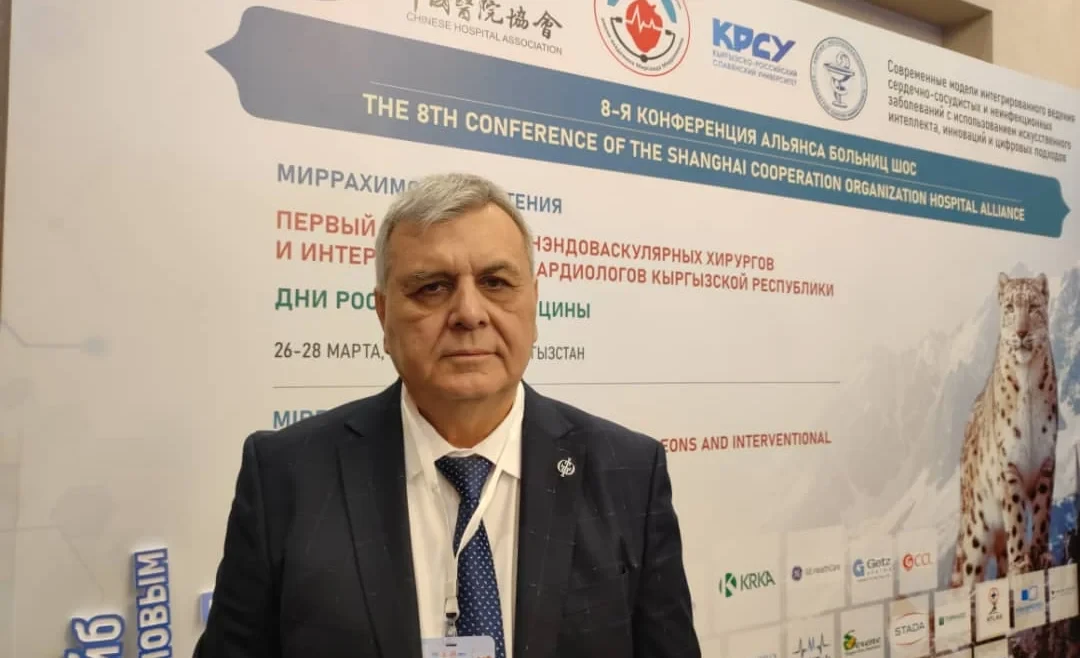
Significant progress in the field of interventional radiology is being observed in Kyrgyzstan due to the implementation of new technologies. This was reported by Professor Murat Dadabaev, who heads the department of cardiac and vascular interventional radiology at the National Center for Cardiology and Therapy. According to him, endovascular treatment of valve diseases and other structural pathologies is already being successfully carried out in the country. For many years, work has also been ongoing with patients who have congenital heart defects. “Previously, such operations were performed very rarely, but now their number has significantly increased, and surgeries are being conducted in all medical centers,” he noted.
Dr. Dadabaev added that with the support of the government, the provision of assistance to patients with acute myocardial infarction has significantly improved. Last year, more than 4,000 interventional procedures were performed in the department for patients with various diseases, especially with infarction. Such patients typically receive free treatment, which contributes to an increase in their numbers.
He also noted that a significant number of young specialists are currently being trained in this field. According to the professor, there are about 80–100 specialists in Kyrgyzstan.
As part of the development program, three new catheterization laboratories will open this year in Talas, Balkychi, and Naryn. “The specialists are already trained, and modern technologies will be actively applied in these centers,” he added.
Dadabaev also spoke about new operations that were performed recently. “Yesterday we carried out several interventions, including one of the most significant — the use of intravascular imaging in patients with acute infarction and coronary diseases, which makes the surgeries safer and of higher quality,” he reported.
Additionally, biodegradable, self-dissolving stents were implanted at the center for the first time. “Such operations may have been performed elsewhere, but for us, it was the first time. Yesterday, three master classes were also held with the participation of specialists from Moscow and St. Petersburg,” Dadabaev clarified.
According to him, three units of new equipment are currently being installed at the center. Next year, it is planned to install another 7 devices across the country through a grant. The professor noted that although there is already a sufficient amount of equipment in the country, most of it is concentrated in private clinics.
He emphasized that various directions are actively developing, such as neurointervention (treatment of strokes), interventions for peripheral vascular diseases, and oncological interventions. Although oncological intervention is not yet well developed, there are plans to prepare and train new personnel for this area in the near future.
According to the professor, there are four state and about 20 private clinics operating in Kyrgyzstan. He pointed out the need for integration between the public and private sectors in providing medical care, as is done in other countries.
As part of the state program "Healthy Heart" for 2025–2030, it is planned to install another 7 angiographic devices in the regions, including Batken, Osh, Jalal-Abad, and Issyk-Kul regions.
“A patient must be admitted to the department within two hours after the onset of a myocardial infarction to receive timely assistance. The artery gets blocked, and it is necessary to quickly open it and place a stent. The faster this is done, the higher the chances of saving a life and preventing disability,” he noted.
The specialist added that the center actively uses modern technologies based on artificial intelligence. In particular, intravascular imaging using ultrasound allows for automated calculations and helps the doctor decide on the need for stent placement.
“If earlier we relied solely on visual data, today technologies allow for a more accurate assessment of the patient's condition and justify the choice of treatment tactics,” he emphasized.
Dadabaev also noted that the National Center for Cardiology has received new devices for intravascular imaging, which will allow for a more careful approach to the treatment of each patient.