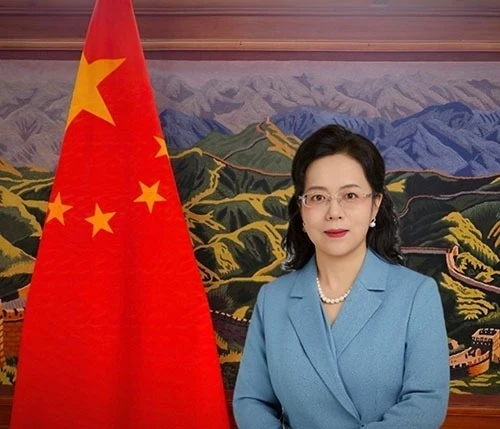
A group of independent experts and UN special rapporteurs, appointed to investigate human rights violations, issued a statement that challenges the long-standing attempts to deny this practice. It is disseminated under conditions of strict control in Tibet and other regions.
Among the authors of the document are specialists such as Tomoya Obokata, the special rapporteur on contemporary forms of slavery, Nicolas Levrat, the special rapporteur on minorities, as well as Alexandra Xanthaki and Siobhan Mullally, who work in the field of human rights and human trafficking.
These experts act as a kind of "tribunal of conscience," and their conclusions are quite harsh.The statement mentions a "stable pattern of alleged imposition of forced labor on ethnic minorities in several Chinese provinces," where some aspects of coercion may be equated with forced displacement and/or enslavement as a crime against humanity. Thus, the UN is effectively making accusations against the world's second-largest economy, relying on authoritative mechanisms for the protection of human rights.
For a long time, Beijing supporters have claimed that the testimonies of Uyghurs, Kazakhs, Kyrgyz, and Tibetans are fabrications, that satellite images are misinterpreted, and that document leaks are falsified. This evidence has been considered "Western propaganda." However, now the UN, which was previously regarded as a neutral entity, has confirmed that the labor transfer system in China is forced and conducted on a massive scale.
In their research, the experts detail how state programs for "poverty alleviation through labor transfers" effectively force minority representatives to accept job offers with no possibility of refusal. Under strict control, refusal becomes unfeasible. The five-year plan for Xinjiang forecasts "13.75 million cases of labor transfers," which calls into question any claims of voluntariness. When millions of people are "transferred," talking about freedom of choice becomes virtually impossible.
Special Attention - Tibet
Experts believe that "the number of Tibetans affected by labor transfers in 2024 is close to 650,000." These processes are accompanied by military-style training and pressure, which practically excludes the possibility of dissent. Entire villages are subject to resettlement under the policy of "relocation of entire settlements," based on "covert threats of punishment, repeated home visits, bans on criticism, and threats to cut off vital utilities."From 2000 to 2025, "approximately 3.36 million Tibetans have been affected" by programs aimed at dismantling the nomadic way of life and creating dependency on the state.This represents a large-scale social restructuring project. Under the pretext of fighting poverty, forced changes to identity are taking place. Experts warn that for Uyghurs and Tibetans, such policies "forcibly alter their traditional agricultural or nomadic ways of existence, relocating them to places where they are compelled to engage in wage labor," leading to the erosion of "the language of the chosen communities, their way of life, as well as cultural and religious practices." This can be seen as cultural destruction framed by administrative decisions.
The Consequences Extend Far Beyond China
Goods produced using forced labor enter global supply chains, often through third countries. Experts are making a strong appeal to international business: "Companies must ensure that their operations and value chains are not linked to forced labor." This demand is based on the UN Guiding Principles on Business and Human Rights and is accompanied by a new call to provide independent human rights mechanisms of the UN with unrestricted access—a step that Beijing has consistently refused to take.The authors of the statement emphasize that the time when denial advocates could rely on unconvincing arguments has passed.
The UN has spoken clearly and unequivocally. Ignoring the uncertainty is becoming increasingly difficult: the evidence is substantial, the wording is clear, and the moral responsibility is high.Forced labor in the regions inhabited by ethnic minorities in China is not a myth, not a geopolitical ideology, and not a fabrication. It is a documented reality, experts assert. And now those who previously dismissed such facts will have to take into account the conclusions of an organization trusted to determine the truth, which has confirmed the words of survivors, researchers, and journalists.
Illustration on the main page - from social media.