API error: no response
Curl error: HTTP/2 stream 0 was not closed cleanly: INTERNAL_ERROR (err 2)
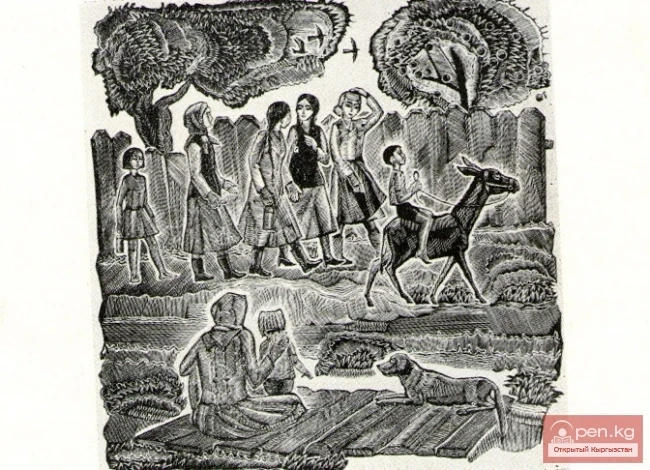
V. Gladkov is known in the republic as an illustrator and designer of books, paying attention to both the figurative and substantive aspects of illustrations and the organization of the entire ensemble of the book. He is characterized by broad creative interests, thoughtful reading of literary works, and an active search for expressiveness in graphic language. He has illustrated both books by Kyrgyz writers and works of Russian and world classics. His creative success includes the
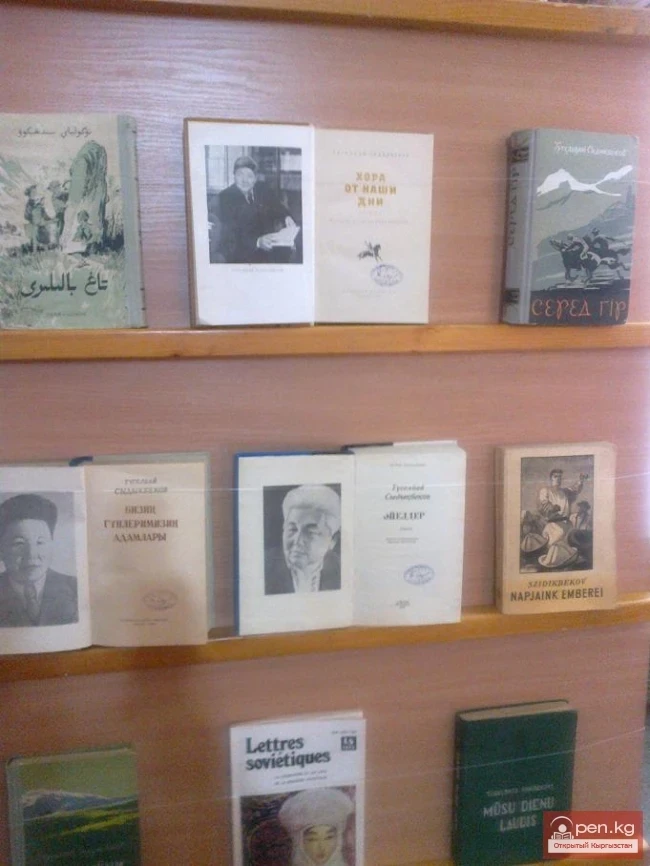
A. Misyurev fruitfully designed books published by republican publishing houses. He illustrated works by Kyrgyz writers Ch. Aitmatov ("Soldatenok," 1974, linocut), A. Tokombaev ("My Republic," 1974, linocut), T. Sydykbekov ("Address to Man," 1969, linocut), B. Zhakiev ("Meetings in the City of Winds," 1969, monotype), and other representatives of multinational Soviet literature (L. Tatyanycheva. "Zoryanka," 1973, wood engraving). He
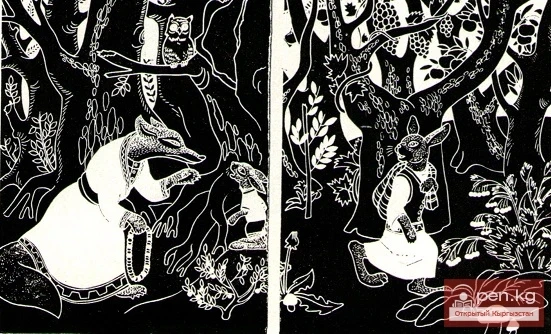
The talented illustrator of the Kyrgyz book was Belek Jumabaev, who possessed a unique perception of life and art, with a light, artistic drawing style. After familiarizing himself with various graphic techniques, he focused on drawing and zincography, in which he created his main works in book graphics. He quickly mastered the culture of book design, but saw his main task in the imagery of the illustrations, in their harmony with the idea and style of the literary work. He illustrated the
Curl error: HTTP/2 stream 0 was not closed cleanly: INTERNAL_ERROR (err 2)
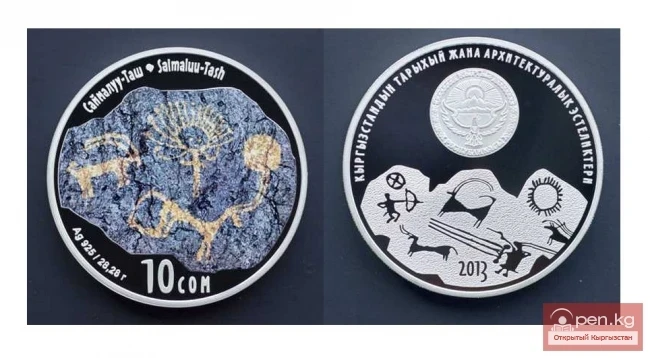
Since August 26, 2013, the National Bank of the Kyrgyz Republic has issued silver and copper-nickel coins "Saimaluu-Tash" with a denomination of 10 som and 1 som in honor of the Independence Day of the Kyrgyz Republic. The main design of the silver coin "Saimaluu-Tash" features rock drawings depicting a solar man, a mountain goat, and a bull carrying a solar disk. A distinctive feature of this coin is the colored execution of the drawings, which most realistically conveys
Curl error: HTTP/2 stream 0 was not closed cleanly: INTERNAL_ERROR (err 2)
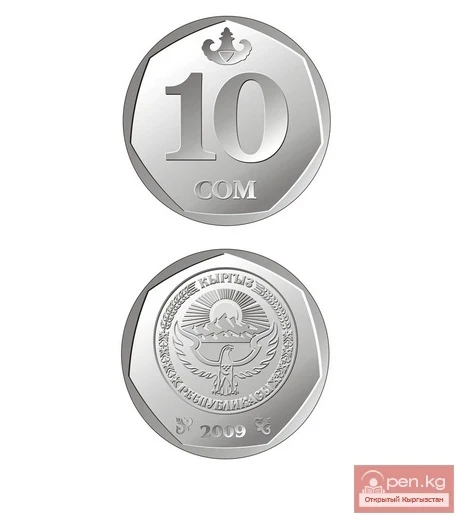
In accordance with Articles 4, 15, 16, and 18 of the Law "On the National Bank of the Kyrgyz Republic" and the resolution of the Board of the National Bank of the Kyrgyz Republic "On the issuance of the 10 som coin into circulation" No. 46/1 dated November 18, 2009, a circulating coin with a denomination of 10 som is introduced into circulation throughout the territory of the Kyrgyz Republic starting from December 1, 2009. The circulating coin with a denomination of 10 som
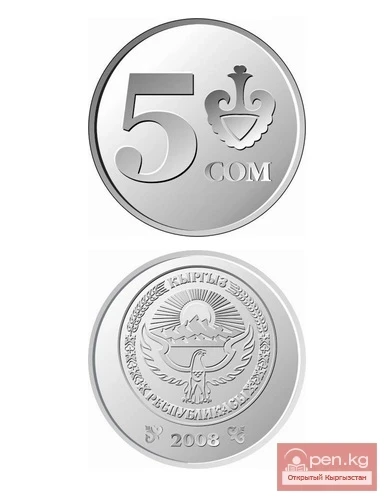
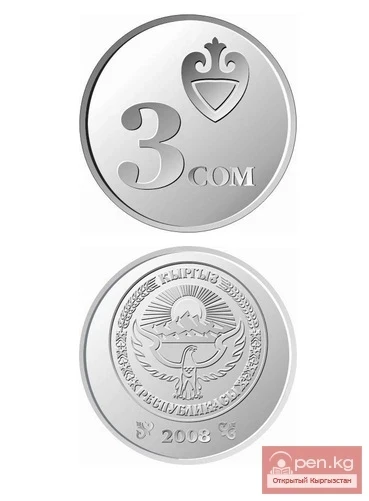
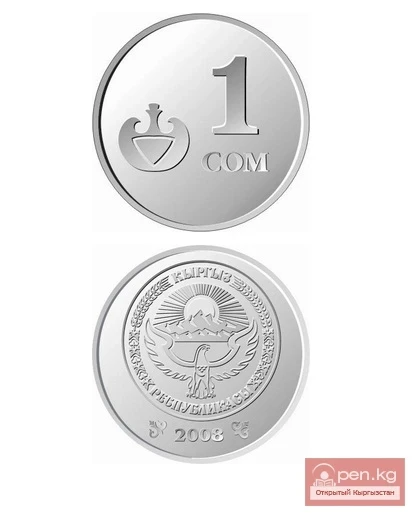
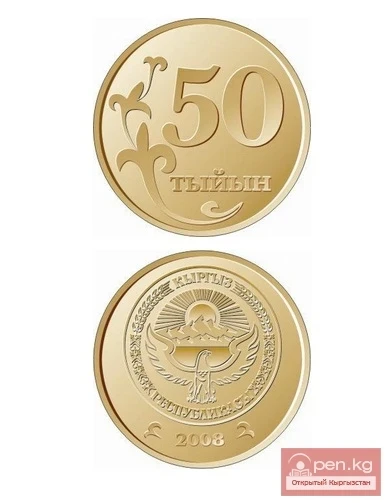
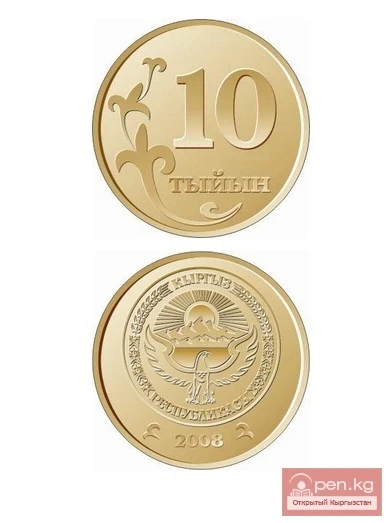
In accordance with Article 15 of the Law "On the National Bank of the Kyrgyz Republic" and the resolution of the Board of the National Bank of the Kyrgyz Republic "On the issuance of coins with a denomination of 1, 10, 50 tyiyn and 1, 3, 5 soms" No. 44/2 dated October 11, 2007, starting from January 1, 2008, a collection coin with a denomination of 1 tyiyn and circulating coins with denominations of 10, 50 tyiyn and 1, 3, 5 soms are introduced into circulation throughout
In accordance with Article 15 of the Law "On the National Bank of the Kyrgyz Republic" and the resolution of the Board of the National Bank of the Kyrgyz Republic "On the issuance of coins with a denomination of 1, 10, 50 tyiyn and 1, 3, 5 soms" No. 44/2 dated October 11, 2007, a collection coin with a denomination of 1 tyiyn and circulating coins with denominations of 10, 50 tyiyn and 1, 3, 5 soms are introduced into circulation throughout the territory of the Kyrgyz
In accordance with Article 15 of the Law "On the National Bank of the Kyrgyz Republic" and the resolution of the Board of the National Bank of the Kyrgyz Republic "On the issuance of coins with a denomination of 1, 10, 50 tyiyn and 1, 3, 5 som" No. 44/2 dated October 11, 2007, starting from January 1, 2008, a collectible coin with a denomination of 1 tyiyn and circulating coins with denominations of 10, 50 tyiyn and 1, 3, 5 som are introduced into circulation throughout the
In accordance with Article 15 of the Law "On the National Bank of the Kyrgyz Republic" and the resolution of the Board of the National Bank of the Kyrgyz Republic "On the issuance of coins with a denomination of 1, 10, 50 tyiyn and 1, 3, 5 som" No. 44/2 dated October 11, 2007, starting from January 1, 2008, a collection coin with a denomination of 1 tyiyn and circulating coins with denominations of 10, 50 tyiyn and 1, 3, 5 som are introduced into circulation throughout the
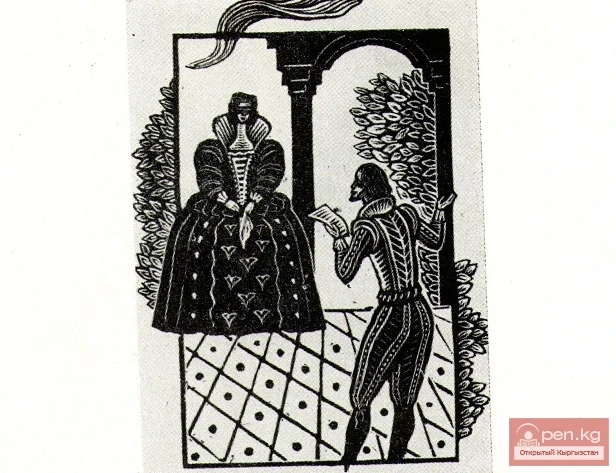
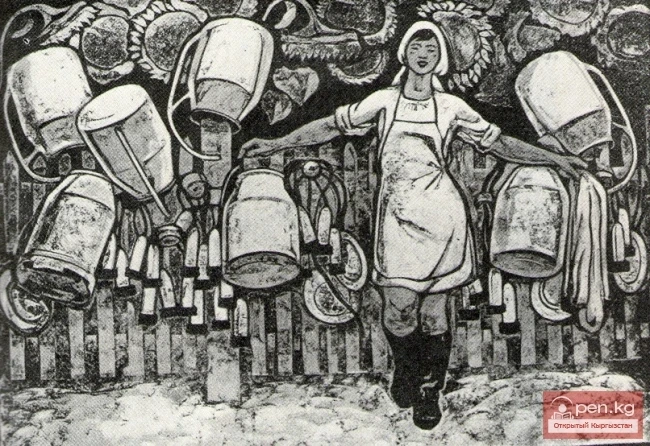
The art of book illustration in Kyrgyzstan until the turn of the 50s and 60s was almost exclusively represented by the works of L. Ilyina, who mainly collaborated with central publishing houses. In the 60s, due to the overall rise of publishing and the general culture of book graphics in the country, as well as local prerequisites—strengthening the printing base and the emergence of specialists in the field of artistic book design—book illustration developed more diversely in the republic and
Belek Koshoev mastered the technique of etching with great finesse. His etchings "Catching a Horse" (1970), "Mountains" (1974), "Yurt by the River" (1974) are characterized by an elegant linear rhythm, sharpness, and precision in conveying the movements of form, with a subtle stylization reminiscent of medieval graphics of the peoples of the Far East. Their main virtue is the imagery that reveals the artist's love for folk life and cultural traditions. In
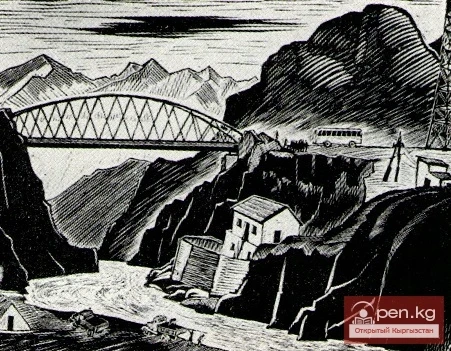
In printmaking, Myrsa Omorkulov has repeatedly tested his skills, although his favorite technique is watercolor. In the 1960s, he created colored linocuts for the series "The Road from Frunze to Osh" (1961). Here, the artist faced challenges related to mastering a new technique that required a certain discipline of thought and plastic generalizations. In the best sheet of the series "A Bridge is Being Built," the author managed to "convey his admiration for the
Among the artists of specifically realistic vision of life is Melis Haidarovich Akhmedov, who has been working in easel and book graphics since the early 1970s. As an easel artist, like other masters, he predominantly works on thematic series, which he always creates based on natural material. His work is characterized by a narrative-plot nature of the image, knowledge of folk life, and interest in details and ethnographic specifics. The object-spatial fullness of the sheet and factuality have
Curl error: HTTP/2 stream 0 was not closed cleanly: INTERNAL_ERROR (err 2)
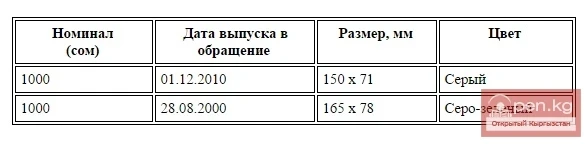
The 1000 som banknote of the 2010 series is made of white paper measuring 150x71 mm. The predominant color of the banknote is gray. The paper contains colorless fibers that fluoresce in UV light in red and blue colors. The paper has a localized watermark that repeats the portrait depicted on the front side of the banknote, as well as a watermark in the form of the banknote's numerical denomination. The banknote contains a windowed metallic security thread with microtext "1000
Curl error: HTTP/2 stream 0 was not closed cleanly: INTERNAL_ERROR (err 2)
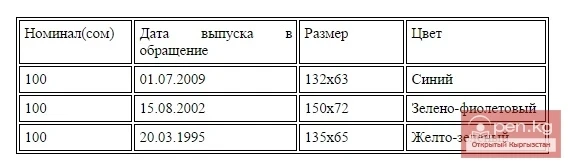
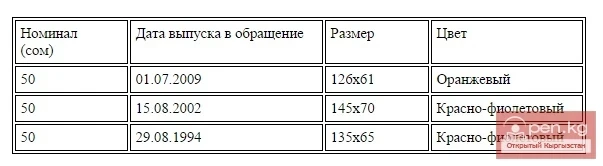
The 50 som banknote of the 2009 series is printed on white paper measuring 126x61 mm. The predominant color of the banknote is orange. The paper contains colorless fibers that fluoresce under UV light. It features a localized watermark that repeats the portrait depicted on the front side of the banknote. A windowed metallic security thread with microtext "50 СОМ" is embedded in the paper. White coupon fields are located along the edges of the banknote. The portrait, the inscriptions
Curl error: HTTP/2 stream 0 was not closed cleanly: INTERNAL_ERROR (err 2)
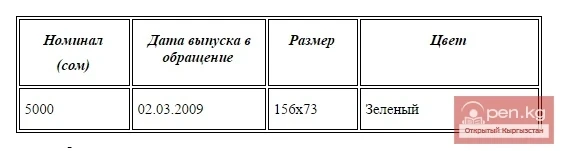
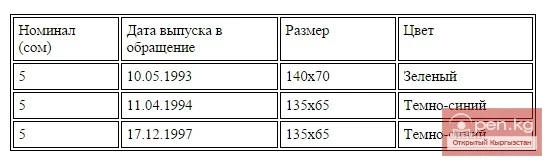
5 som banknote of 1993 is made of white paper measuring 140x70 mm. The predominant color of the banknote is green. The paper contains colorless fibers that fluoresce under UV light. The paper has watermarks in the form of an "eagle" located across the entire surface of the banknote. The banknote is printed using offset printing.
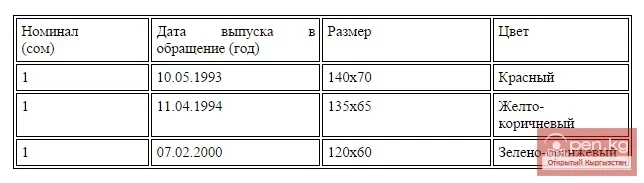
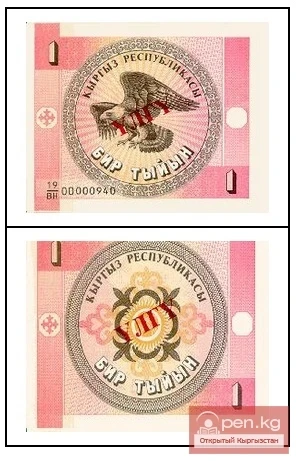
The 1 som banknote of 1993 is made of white paper measuring 140x70 mm. The predominant color of the banknote is red. The paper contains colorless fibers that fluoresce under UV light. It features watermarks in the form of an "eagle" spread across the entire surface of the banknote. The banknote is printed using offset printing.
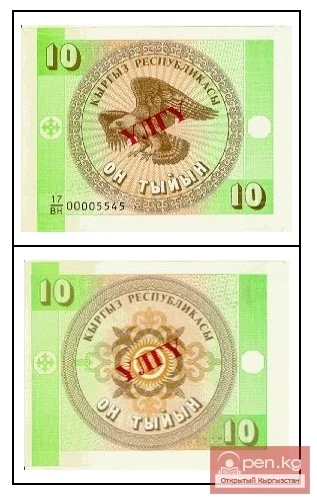
Paper banknotes with a denomination of 10 tyiyn, serving as change coins.
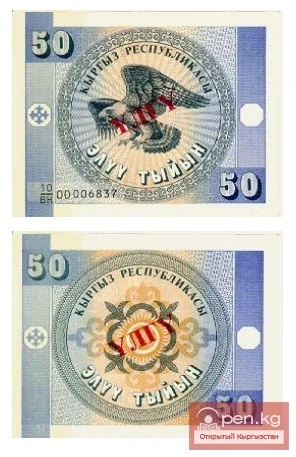
Paper banknotes with a denomination of 1 tyiyn, serving as change coins. The banknote is made of white paper measuring 90x70 mm. The predominant color of the banknote is red. The paper contains colorless fibers that fluoresce under UV light. The paper has watermarks in the form of an "eagle," located across the entire surface of the banknote. The banknote is printed using offset printing.
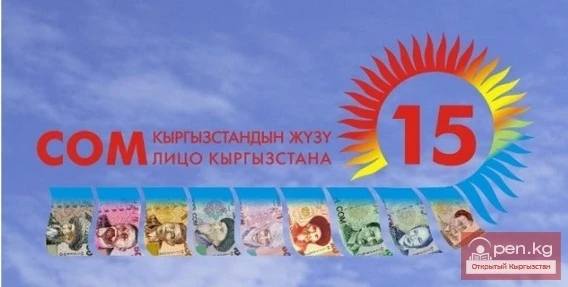
The Currency of Kyrgyzstan The world around us is changing rapidly: the planet's climate is changing, entire countries appear and disappear, political systems and ideologies change, and human thinking evolves as technologies improve. We live at the turn of the millennium in the center of the greatest technological revolution in human history, primarily associated with the rapid development of digital technologies, computers, and communication tools. The further development of human
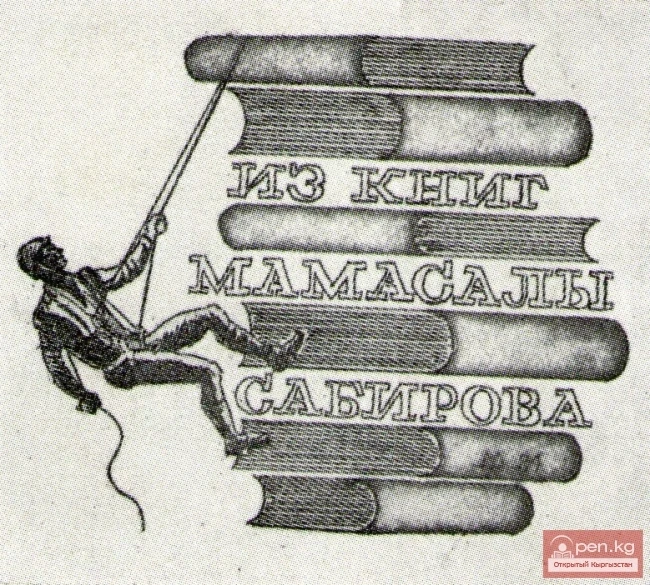
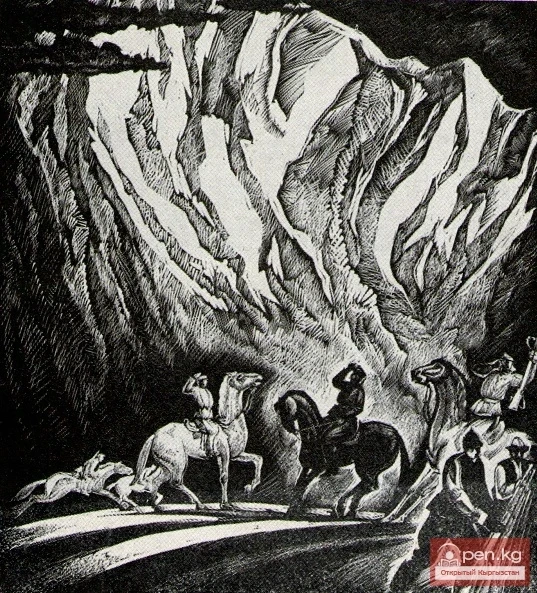
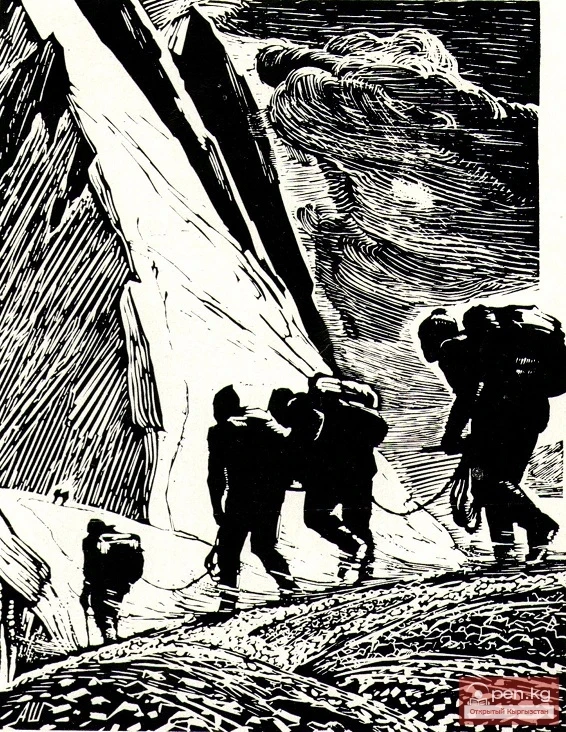
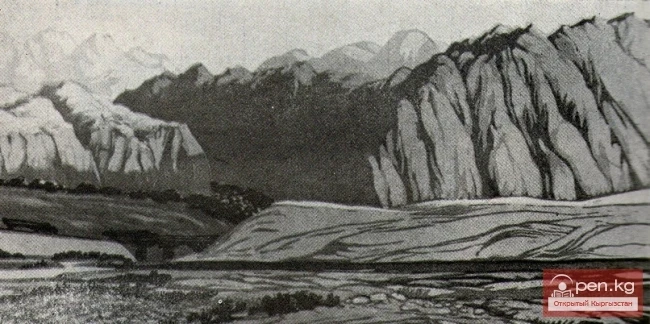
The singer of the mountain nature of Kyrgyzstan was the prematurely deceased artist-climber Afanasy Lazarevich Shubin, who worked in linocut, lithography, and etching. In his best prints, he created a romantic image of the highlands and the courage of people. The difficulties of hiking life, the brilliance of unconquered peaks, the sharp taste of risk, a moment of silence before the assault, the triumph of victory—all of this naturally and effortlessly found its way onto his sheets. This was
Curl error: HTTP/2 stream 0 was not closed cleanly: INTERNAL_ERROR (err 2)
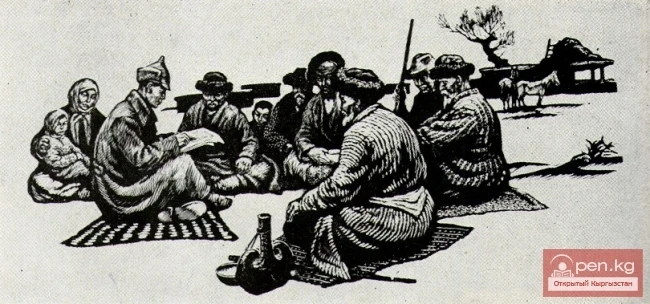
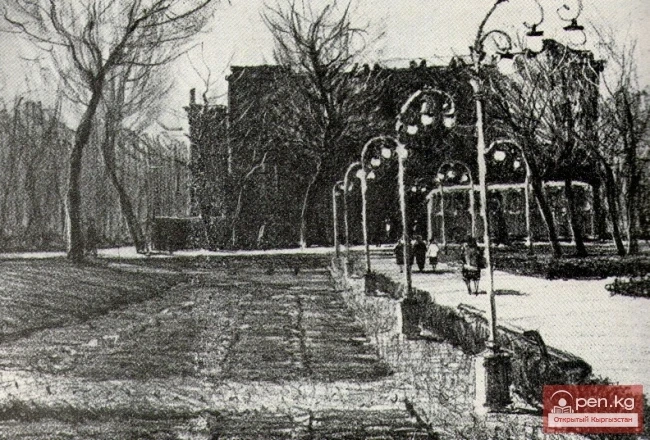
Akim Alekseevich Sgibnev mastered various types of graphic techniques, focusing primarily on linocut in its black-and-white and colored variants. His sheets from the 60s and 70s are rich in natural observations, character types, genre scenes, and landscape motifs drawn from numerous trips across the republic. Sgibnev is unique both in his choice of thematic aspects and in his interpretation of graphic form. The absence of a professional school for this artist is compensated by his study of