It is precisely about this region that famous travelers such as Semenov-Tian-Shansky, Mushketov, Severtsev, Przhevalsky, Fedchenko, and many others wrote with great admiration and inspiration. This is the highest mountainous zone of Kyrgyzstan: almost the entire territory of the Inner Tian Shan is located above the mark of 1500 meters above sea level. Here, so many bright attractions are concentrated that one can see them only by traveling to different corners of the globe.
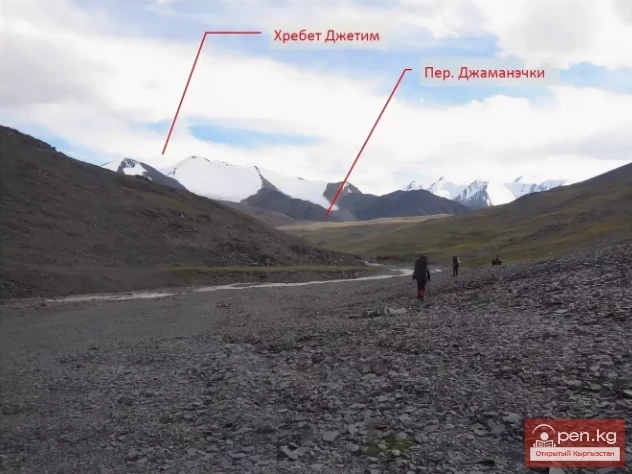
Occupying a quarter of the entire area of the republic, this region in the south borders China. While mountains occupy 3/4 of the entire territory of the republic, here the mountain ranges cover 70%, the largest of which are Kakshaal, At-Bashi, Naryn-Too, Jetim-Too, Moldo-Ttoo, and Fergana.
The holy book of Islam, the Quran, asserts that mountains were placed by Allah so that the earth with its people "would not shake." It is hard to say how Allah deals with shaking, but creating such a majestic mountain panorama as seen in the Inner Tian Shan is truly something only Allah could accomplish.
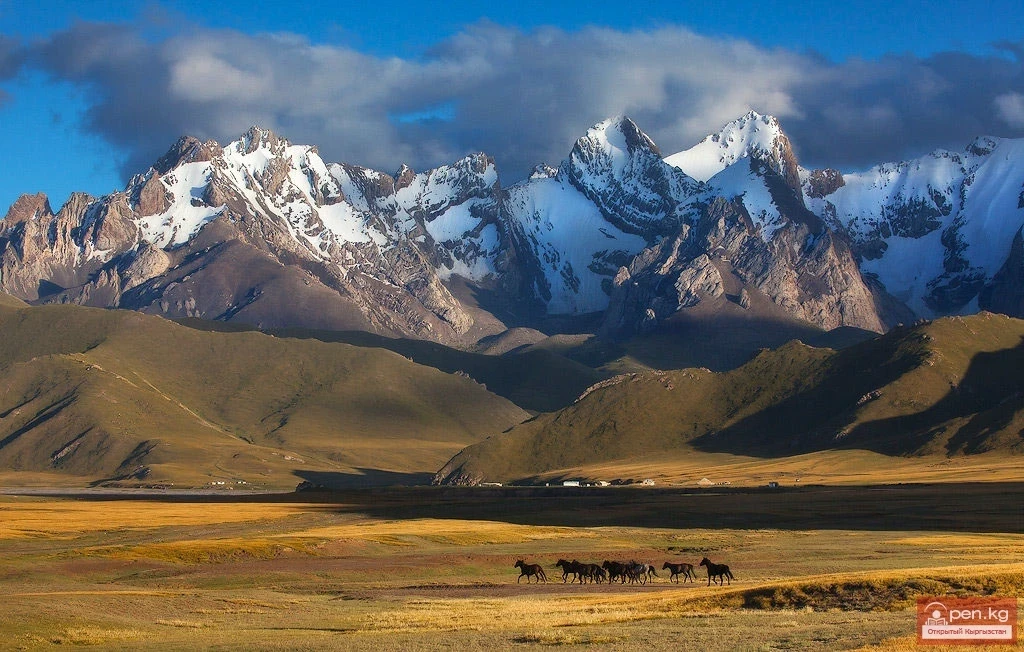
The sparse vegetation of the high mountain areas makes the landscape not particularly attractive. But travelers will find a surprise here as well. Closer to evening, when the sun begins to hide behind the mountain ridge, the surrounding lowland mountains begin to transform. The foothills of the mountains shimmer with a delicate pink hue reminiscent of apple blossoms. Gradually, the pink colors move up the mountains, giving way to soft blues, and later to rich cornflower blues, then dark blues, up to deep black. The traveler is presented with living canvases reminiscent of the works of Roerich—with the same clarity, contouring of the drawing, contrast, and brightness of colors...
From east to west, powerful mountain ranges such as Moldo-Ttoo, Naryn-Too, Jetim-Too, At-Bashi, and others spread out like a fan. The border with China runs along the ridge of the largest of them—Kakshaal—through the Torugart pass. Between the ridges, vast valleys stretch mainly in a latitudinal direction. The largest of them, the Naryn Valley, crosses the entire territory from east to west. To the north of the Inner Tian Shan are the intermountain valleys of Suusamyr, Jumgal, and Kochkor, separated by the Kyz-Art pass. To the south are the highest valleys of Atbash, Arpa, and Aksai, with the basin of Lake Chatyr-Kul.
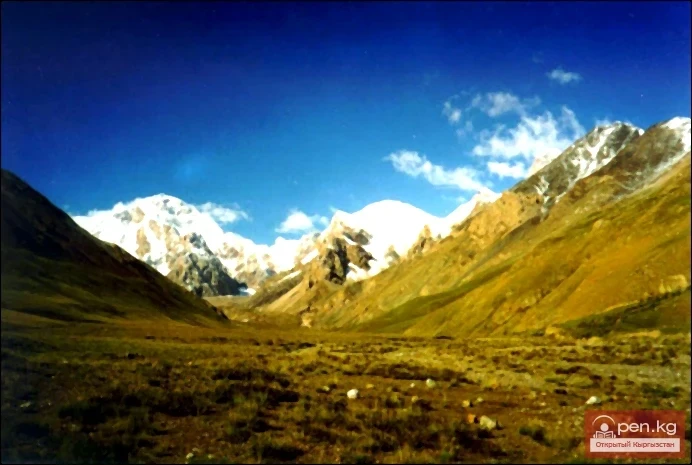
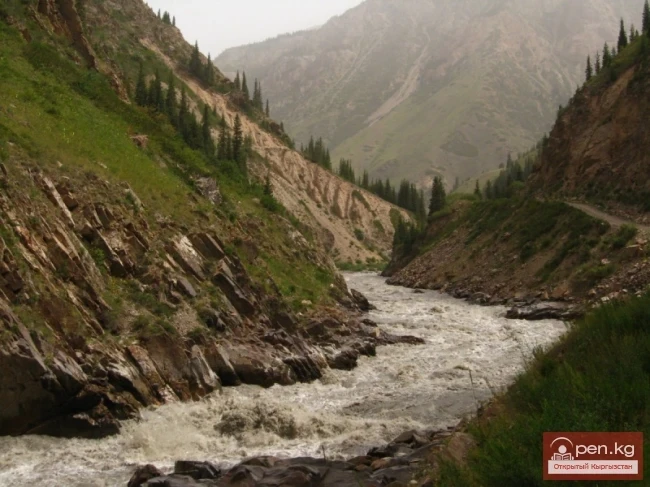
Mountain rivers carry their waters along the bottoms of the valleys. The largest of them is the most water-rich "sunny" river—this is the translation of the name Naryv from Kyrgyz. Most likely, the river is named so because it originates from the Ak-Shiyrak mountain massif, which rises high towards the sun. The Naryn is also called the "Kyrgyz river": for five hundred kilometers of its length, it stretches across the territory of Kyrgyzstan and only a hundred beyond its borders. Every kilometer, the river descends on average by three meters. Is that a lot or a little? One can compare it, for example, with the Volga, whose slope is only 7 centimeters per kilometer. The powerful flow rushes from east to west, breaking through the Fergana range and turning south into the hot, arid Fergana Valley. Along the way, it receives the Kek-Irim, At-Bashi, Ala-Buka, Kökö-Meren, On-Archa, Small Naryn, and more than five hundred large and small rivers that significantly dissect the Naryn Valley. The river Son-Kul, which flows from the eponymous high-altitude lake, also flows into the Naryn.
High in the mountains of the Inner Tian Shan begins the second largest river in Kyrgyzstan—the Chu. Along the southern edge of the region, the Ak-Sai river rushes through the bottom of the Ak-Sai valley. It receives many tributaries and flows into the Kakshaal river of the Tarim water basin, which belongs to the territory of China. The rivers are mainly fed by melting snow and glaciers and are therefore particularly abundant in June and July.
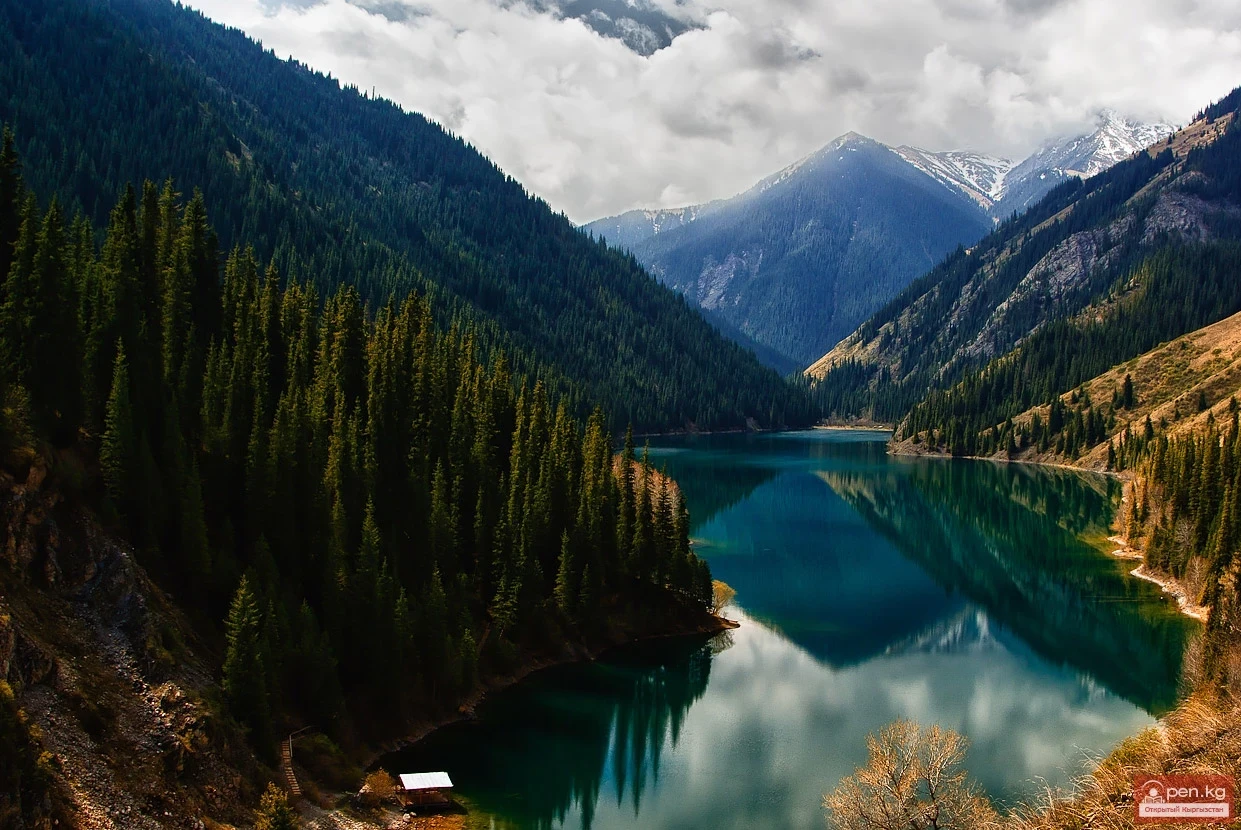
In the high mountain zone, more than five hundred lakes shine with their blue, green, and purple mirrors, 360 of which are located in the basin of the Naryn river. The largest lakes are Son-Kul and Chatyr-Kul, true pearls of the Inner Tian Shan.
The harsh climate of this region is notable. Winter lasts from six to eight months, and in the Ak-Sai and Arpa valleys, in the upper reaches of the Naryn, and in the basin of Lake Son-Kul, air temperatures reach 40-50 degrees below zero and never rise above zero, even in summer. The warmest, and sometimes even hot, summer occurs in the western part of the Naryn Valley, in the central part of the Atbash Valley, as well as in the Jumgal and Kochkor valleys. Despite the harsh winters, the snow cover over most of the territory is small and unstable. Snow really settles only in the forest belt, where winter sports can be developed. Precipitation ranges from 200-300 mm per year in the plains to 250-400 mm in the mountains.
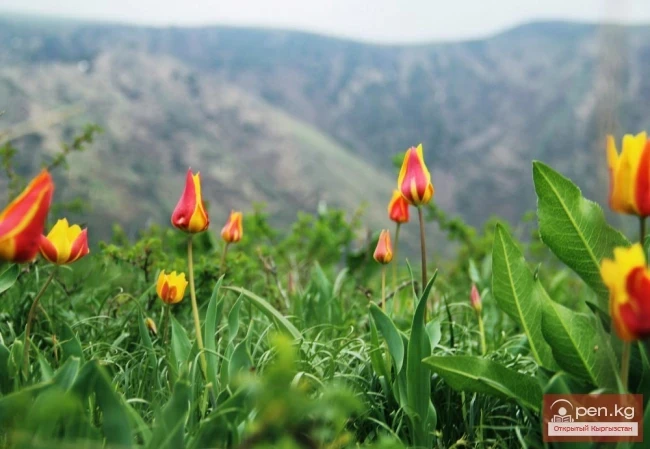
Despite the high altitude of the region, deserts and semi-deserts are quite common, occupying the flat territories of the Kochkor, Jumgal, Atbash, and Naryn valleys, the coastal strip of the Ak-Sai river, as well as the surroundings of Lake Chatyr-Kul. Steppe landscapes are located on the elevated territories of the Ak-Sai, At-Bashi, Kara-Kurji, Arpa, Naryn valleys, and Lake Son-Kul. Good moisture contributes to the lush growth of grasses and shrubs. The steppes are particularly attractive in spring and early summer during the flowering period.
The beauty of the green landscapes, the clean air filled with the aroma of resin and greenery, and the abundance of mushrooms and berries attract travelers to the few forests, which occupy just over three percent of the territory of the Inner Tian Shan. On the northern slopes of Kabak-Too, Moldo-Ttoo, and At-Bashi, coniferous forests prevail, while in the valleys of the Naryn, Kökö-Meren, Ala-Buka, and At-Bashi rivers, there are tugai forests.
Climbing even higher up the slopes of the ridges surrounding the Suusamyr, Jumgal, Naryn, and Atbash valleys, you will encounter subalpine and alpine meadows. The higher you go, the fewer green meadows there are; they are interspersed with patches of mountain tundra and high-altitude deserts. At the very top, in the zone of moraines and glaciers, unprepared tourists will find it tough: the conditions here are too harsh. However, the numerous and diverse mountain ridges provide a magnificent opportunity for sports tourists and climbers to test themselves.
In the coniferous forests of the Inner Tian Shan, you may well encounter a brown bear. In the river gorges, there are roe deer, martens, lynxes, wild boars, and porcupines. The upper reaches of the mountains are inhabited by herds of wild goats and argali. The snow leopard also hunts for food here. There are many birds, including the rare golden eagles and mountain geese found in other places.
The mesmerizing region, with its harsh beauty, has been inhabited by humans since ancient times. Everywhere, except for its eastern part, traces of primitive human settlements and ancient communities can still be found today. Stone sculptures, rock paintings, burial mounds—these silent witnesses of life that took place here many centuries ago—can be seen by travelers in the most seemingly unexpected places. There are also many monuments from the later medieval period: fortified settlements that arose everywhere based on nomadic camps, khan's residences, military-trade posts, along caravan routes from the Fergana Valley through the Tian Shan to the Indian Ocean.
Unlike their ancestors, modern people have settled only along highways and riverbanks. The only city in the region is Naryn, the economic and cultural center. There are two industrial settlements that emerged in the 1970s—Dostuk and Min-Kush.
The preserved landscape of the planet's glacial period: rocky-glacial views of Norway, Sweden, and Spitsbergen; unique ice sculptures; giant canyons reminiscent of the famous American Grand Canyon; a desert in the Jumgal valley—exactly like the classic American desert of Arizona; the "shepherd's Eldorado" in Suusamyr; which can only be seen in Siberia; the huge "prints" of the hooves of Tulpar—the legendary horse of the hero Manas—all of this will be encountered by tourists in various places of the Inner Tian Shan. Sixteen tourist zones have been designated in its territory. The Upper Naryn, Small Naryn, On-Archa, At-Bashi, Ak-Tala, Toguz-Toroo, Kökö-Meren, Suusamyr, Min-Kush, Jumgal, Orto-Tokoy, Toktogul, Son-Kul, and Chatyr-Kul zones can be considered multifunctional, as they provide conditions for sports tourism, educational activities, and simply for relaxation in the mountains.