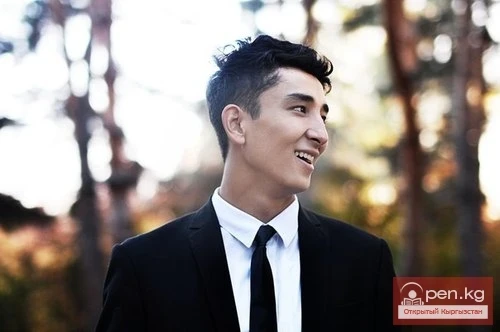
Nursultan was born in 1991 in the village of Kok-Oy, located in the Talas district of the Talas region. He received higher education in technosphere safety, which took him seven years. "From 2008 to 2013, I studied at the Kyrgyz-Russian Slavic University, and then from 2013 to 2015, I continued my studies at Tomsk Polytechnic University in Russia," he explained.
Nursultan is married and raising a daughter. His wife also serves in the Ministry of Emergency Situations of Kyrgyzstan. Since childhood, he dreamed of becoming a rescuer. "Two circumstances influenced my choice of profession. First, my older brother, who works in the Emergency Situations Department of the Talas region, often brought home books about civil defense and emergency prevention. I read them with interest and admired his uniform. Now he serves in the Batken region with the rank of lieutenant colonel. The second factor was the engineering structures for flood protection. In the 1980s, our village suffered from a flood, after which eight protective dams were built. I observed how these dams protected our settlement during heavy rains and snowmelt, which intensified my interest in safety and engineering issues," Nursultan shared.
Since April 2018, he has been working in the Ministry of Emergency Situations. "I started my career as a leading specialist in the Alamedin District Department of Emergency Situations, where I was appointed based on the results of a nationwide competition, scoring 56 points out of 60. In 2019, I was transferred to the central office of the ministry as a leading specialist in population and territory protection. In 2020, I was called up to the Armed Forces of Kyrgyzstan, and after that, I continued my service in the central office of the Ministry of Emergency Situations as an officer for population and territory protection. Since September 2024, I have held the position of head of the department in the coordination and control management," he reported.
Looking back on his career, Nursultan noted that his advancement is linked to hard work and knowledge. "Sometimes I surprise myself with this, but I am proud that each promotion has been the result of my education and experience. In childhood, I often heard: 'If you have no money or connections, you won't be able to get a government job.' But from my own experience, I have proven that this is not true," he said.
According to him, the work of a rescuer requires constant readiness and high responsibility. "Every position in the Ministry of Emergency Situations entails great responsibility. Professional, physical, and psychological training must be at a high level, as mistakes during rescue and recovery operations can have serious consequences. Every saved person is someone's family, a contribution to strengthening the state. As our ancestors said: 'A strong family is a strong state.'
Nursultan believes that the greatest reward for a rescuer is saved lives and preventing damage. "In our profession, the most honorable thing is every saved life, every protected object, and every assistance provided. We conduct numerous events annually that help protect residential buildings and infrastructure, reducing the risks of emergencies," he noted.
Regarding his current work, Nursultan emphasized that his activities include analysis and coordination. "My responsibilities include analyzing the work of the ministry, interacting with government agencies and local authorities on risk reduction issues. I also monitor the implementation of the Ministry of Emergency Situations' directives, coordinate the monitoring of hazardous zones, check approvals for the development of sand and gravel mixtures, and analyze protective measures. We conduct calculations and field inspections for each direction," he explained.
Nursultan's work is not limited to the office; he often goes on business trips. He particularly remembers trips to high-altitude lakes and glaciers. "Each such business trip is a separate story. Difficult roads, dangerous sections, stunning nature. One of the most memorable moments was our research of high-altitude lakes and glaciers in Tajikistan in the fall of 2025 together with scientists from Central Asia. We walked to the glacier for about 10 hours, lived at its foot for five days, and conducted research. There were times when we had to escort injured group members on foot to the nearest village," he shared.
Nursultan noted that the Ministry of Emergency Situations is a multifaceted agency that requires specialists from various fields. "The Ministry of Emergency Situations needs firefighters, fire safety inspectors, specialists in monitoring hazardous areas, engineers for building protective structures, hydrometeorologists, rescuers, civil defense specialists, and many others," he added.