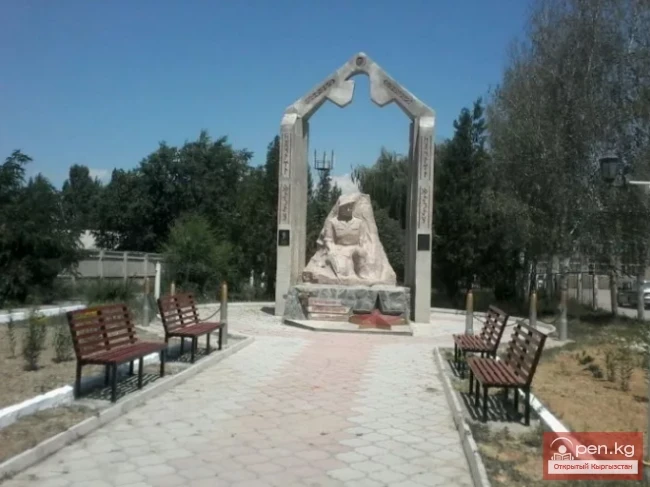
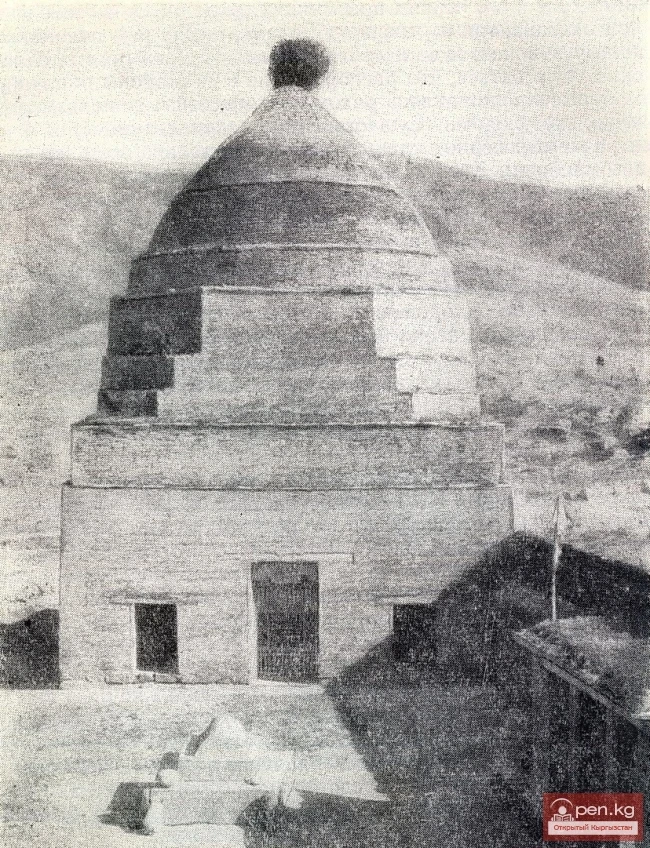
This monument is located on the Böltök hill, on the eastern bank of the Kümüştak River, south of the village of Baykay-Ata.
Saltanat Turdalieva, one of the local residents, shared a story about how representatives of the Chayan tribe once lived on this hill.
“I represent this tribe. The mausoleum was built in 1915. At that time, my mother Zharkynai was 17 years old. She passed away in 1985, living to be 88 years old. I will tell you what I know from her. According to her, this mausoleum was built by a wealthy man named Arzymat in memory of his father Küzök. My mother was the daughter-in-law of Bölökbay, Küzök's brother,” she recalls.
Küzök lived to be 99 years old. Arzymat created the mausoleum in honor of his father and organized a large memorial event, inviting relatives and neighbors. Forty craftsmen from Kashgar, as well as talented artists, were involved in the construction of the Kumböz. During that time, my mother prepared food for the builders. They built with bricks made from goat hair and fat, while the meat was distributed to the local residents. The bricks were baked in a tandoor, and the horsemen collected firewood to light it. Many members of the Chayan tribe helped with this construction, slaughtering horses to feed the workers. The height of the mausoleum exceeds 10 meters, and it is indeed impressive upon close inspection. We were often brought here as children,” she added.
S. Turdalieva also mentioned that on the walls of the Kumböz, there are depictions of four people drinking tea, among whom are a wealthy woman and a young woman with a camel, on which a girl is sitting.
“My mother said that these four are Arzymat bay, his wife Burul, and two others. The girl on the camel is Arzymat bay's daughter named Kynapiya, and the bride leading the camel is herself. I had the chance to see Kynapiya while she was alive. On the other side of the mausoleum, there was also a depiction of a golden eagle,” she noted.
With the advent of collective farms, people began to leave the hill, and it became deserted. Children started to paint on the mausoleum, and the original images gradually disappeared. Some of my ancestors were dispossessed. During the war, a group of Chechens and Karachays were resettled to us. One of the Chechens tried to dismantle the mausoleum for bricks to build a stove, but he fell and died. This scared people, and after that, no one touched the Kumböz. Since childhood, I came here with my mother and read prayers. Now I bring my children here. This story is very important to me,” she concluded.
Objects
Satellite
⛶