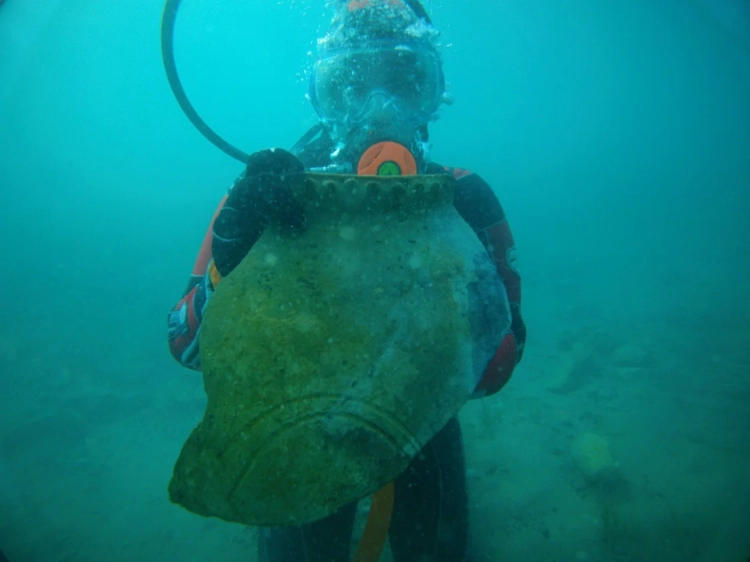
According to stories, this vessel was found by a friend of the owner’s father during the Soviet era and later passed on to him. There are suggestions that the jug was used by the citizens of ancient Nevaket.
“I don’t want to reveal my name, as everything found is considered state property. This vessel is a memory of my father for me. I plan to donate it to a museum or to someone who appreciates antiques. The jug is made of ceramic,” the man shared.
Note:
Nevaket is an ancient city located in present-day Kyrgyzstan. It is also known as the Krasnorechenskoye settlement and is situated 30 kilometers from Bishkek in the Chuy Valley. The city existed from the 8th to the 12th century and served as a transit point on the Great Silk Road. Its population included Sogdians, Turks, and Karluks. Various religious representatives lived in Nevaket: Buddhists, Muslims, Christians, and Zoroastrians. One of the most famous artifacts is a clay statue of Buddha. In the 12th century, the Christian community of Nevaket was part of the Kashgar Nestorian metropolis, headed by the “Metropolitan of Kashgar and Nevaket.” Burials from the 7th to 8th centuries were found in the ruins of the city, including one buried with a bronze cross. One of the leaders of the Christian community was a Turk named Yaruk-tegin. Nevaket also became a place where a missionary school was established, from which preachers were sent to Semirechye, the Great Steppe, and even to China. The fame of Nevaket was brought by the Nestorian missionary Subhalyeshu, who was sent from Persia. Nestorianism spread from Nevaket among the nomadic peoples and later reached Eastern Turkestan, where it was accepted by some settled Uyghurs.
On June 25, 2014, at a meeting of the Intergovernmental Committee for UNESCO World Heritage, a decision was made to include the settlements of Krasnaya Rechka (Nevaket), Ak-Beshim (Suyab), and Burana (Balasagun) in the World Cultural Heritage list as part of the transnational serial nomination “Silk Road: The Initial Section and Network of Routes of the Tian Shan Corridor.”