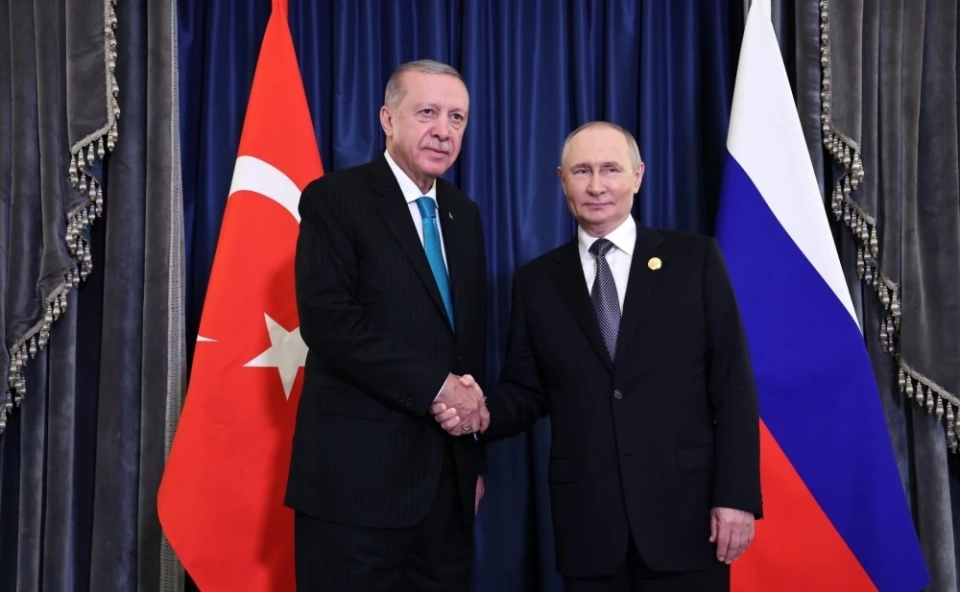
Turkish President Recep Tayyip Erdoğan, along with Azerbaijan and three Central Asian states, is seeking to achieve the exclusion of Russian oligarch Alisher Usmanov of Uzbek origin from the European Union's sanctions list through Slovakia. This update to the list is expected to take place in mid-March, according to information from Azattyk Asia.
Slovakia, supported by Hungary, has been actively lobbying for Usmanov's exclusion from European sanctions, as well as for Russian and Israeli oligarch Mikhail Fridman, for several weeks. Currently, the existing EU restrictions affect more than 2,700 individuals and legal entities that Brussels believes have contributed to undermining Ukraine's territorial integrity, including a visa ban and asset freezes.
Over the past four years, the sanctions list has been updated twice a year—in March and November—with the consent of the 27 EU member states.
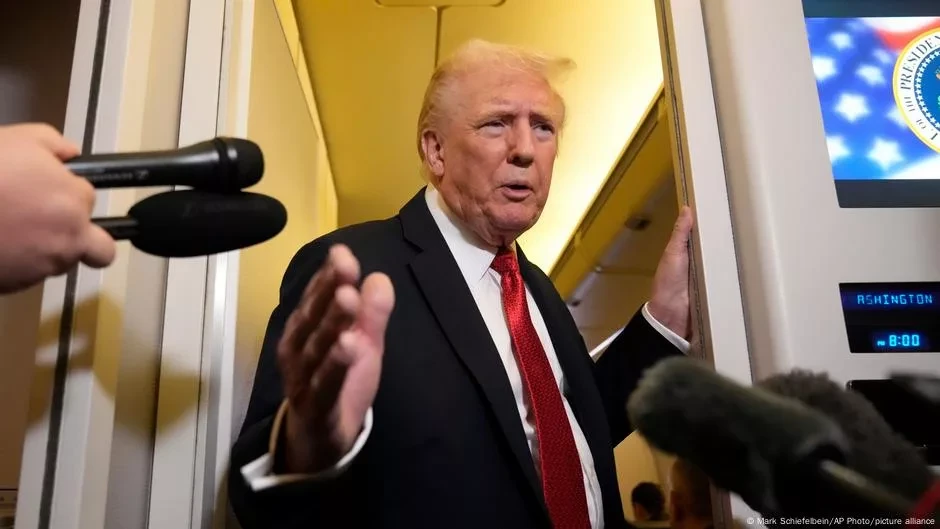
Before the new round of sanctions, Slovak Prime Minister Robert Fico sent a letter, signed by Erdoğan and dated March 2, to other EU capitals.
In this letter, the text of which was reviewed by the media corporation Radio Free Europe/Radio Liberty, Erdoğan emphasizes that Ankara does not intend to circumvent the EU and US sanctions imposed against Russia since the beginning of the full-scale invasion of Ukraine in February 2022. However, he adds that "citizens of third countries affected by these sanctions may face certain difficulties in relations with our country." He also mentions the EU sanctions against Alisher Usmanov and his family as the most significant example.
Erdoğan points out that "Mr. Alisher Usmanov has been conducting his business openly since the 1990s, without resorting to economic measures supported by the Russian government since the 2000s, and has not financed any initiatives in this direction."
He also adds that "having left active business about ten years ago and focusing on philanthropy, Usmanov has supported cultural, humanitarian, and sports projects that contributed to opening Central Asian countries to the West, as well as making a significant contribution to strengthening humanitarian ties in the Turkic world."
“PARTICULARLY CLOSE TIES” WITH PUTIN
The Turkish president refers to a letter he sent five years ago together with the leaders of the Organization of Turkic States, which includes, in addition to Turkey, Azerbaijan, Kazakhstan, Kyrgyzstan, and Uzbekistan. It was addressed to European Commission President Ursula von der Leyen and then-President of the European Council Charles Michel.
Erdoğan concludes his address to Fico with the words: "Considering Mr. Alisher Usmanov's sincere efforts for full cooperation with EU institutions and taking into account the humanitarian aspects, your support for his exclusion from the EU sanctions list and the restoration of his rights would be exceptionally important."
When sanctions were imposed against Usmanov in 2022, the EU stated that the oligarch maintains "particularly close ties with Russian President Vladimir Putin and is considered one of the few trusted with managing financial flows."
The document also states that Usmanov is "closely connected" with Dmitry Medvedev, Deputy Chairman of the Security Council and former president, who used luxurious residences controlled by Usmanov for his own interests.
Another reason for Usmanov's inclusion on the sanctions list was his ownership of the Russian newspaper "Kommersant." Brussels notes that under the oligarch's control, "the freedom of the editorial team was restricted, and the newspaper took a clearly pro-Kremlin position."
According to the American publication Forbes, published on March 10, Usmanov ranks 199th on the list of the world's richest people with a fortune of $14.5 billion.
LEGAL MECHANISMS
Usmanov has attempted to achieve his exclusion from the EU sanctions list through judicial channels. He appealed to the EU court, which ruled in September last year that there were no legal grounds for his exclusion.
Analysts note that the key issue now remains the standoff between Hungary and Slovakia on one side and the other 25 EU countries on the other.
EU ambassadors will meet in Brussels on March 13 to reach a consensus before the sanctions expire on March 15.
Some representatives of European countries expressed reluctance to exclude any oligarch from the list in comments to RFE/RL. One diplomat added that Erdoğan's letter provoked negative reactions: "Should countries that do not even impose sanctions against Russia and help circumvent them tell us who to exclude?"
Cyprus, holding the EU presidency, with the support of the other 25 member states, insisted that there be no political exceptions, as in the cases of Usmanov and Fridman, and that the sanctions be extended for 12 months. Ultimately, it was proposed to extend the sanctions for six months.
Slovakia rejected both proposals and received support from Hungary, which claims that the exclusion of Usmanov and Fridman is critically important.
Given the tight deadlines, Cyprus may take steps similar to those taken by Poland in March 2025, when during Warsaw's presidency, oligarch Vyacheslav Moshe Kantor, Russian Sports Minister Mikhail Degtyarev, and Usmanov's sister Gulbahor Ismailova were excluded from the sanctions list. At that time, Hungary threatened to veto the extension of sanctions without the necessary exceptions.
The current situation is exacerbated by the dissatisfaction of Hungary and Slovakia over the lack of Russian oil supplies through the Druzhba pipeline. Both countries claim that Ukraine refuses to restore the oil pipeline built during the Soviet era, which runs through its territory and supplies raw materials to the EU.
As a result, Bratislava and Budapest blocked a €90 billion ($105 billion) EU loan to Ukraine and the 20th package of sanctions against Russia proposed by the European Commission, announced in January.
Although EU officials familiar with the negotiations assert that the issue of "Druzhba" was not discussed in the context of extending sanctions, they note that Hungary has made it clear that it will not support "any measures in the interests of Ukraine until the issue with 'Druzhba' is resolved."
Additionally, Hungary has requested the EU to lift other energy sanctions against Russia, citing rising global energy prices due to the war with Iran. However, the sectoral sanctions will only expire in July.
The post How Turkey and Central Asian countries lobby for the lifting of sanctions on oligarch Usmanov first appeared on K-News.