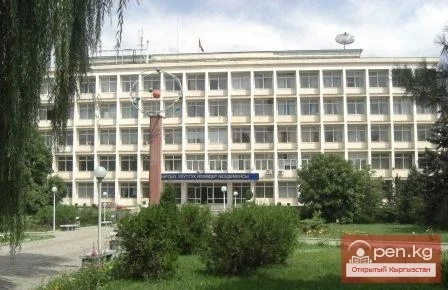
The number of higher educational institutions in the republic has increased more than fourfold since 1991. According to census data, the number of university students per 10,000 population in 2002 was 419, which is more than three times higher than in 1991. Over a decade (1989-1999), despite a high level of emigration, the proportion of the population with higher education increased (from 94 people per 1,000 people aged 15 and older in 1989 to 105 in 1999). This was the result of a series of targeted programs mentioned above and the opening of a large number of higher educational institutions, their branches, and structural subdivisions in all regions of the republic. The highest proportion of individuals with higher education is among Koreans - 23.3% (21.3% in 1989), Tatars - 15.7% (12.1%), Russians - 14.1% (12.5%), Ukrainians - 13.4% (11.5%), and Kyrgyz - 10.6% (8.8%).
Proficiency in a second language in Kyrgyzstan is quite common. The proportion of the population aged 15 and older who are fluent in a second language is 48% nationwide, 57% in urban areas, and 43% in rural areas. Among Dungans, Azerbaijanis, Kazakhs, Kurds, Uyghurs, Turks, Tatars, and Tajiks, 8-9 out of 10 are fluent in a second language; among Koreans, it is 6 out of 10; among Kyrgyz and Uzbeks, more than half; among Germans, slightly less than half; among Ukrainians, more than a quarter; and among Russians, only 6% of the population aged 15 and older speak a second language.
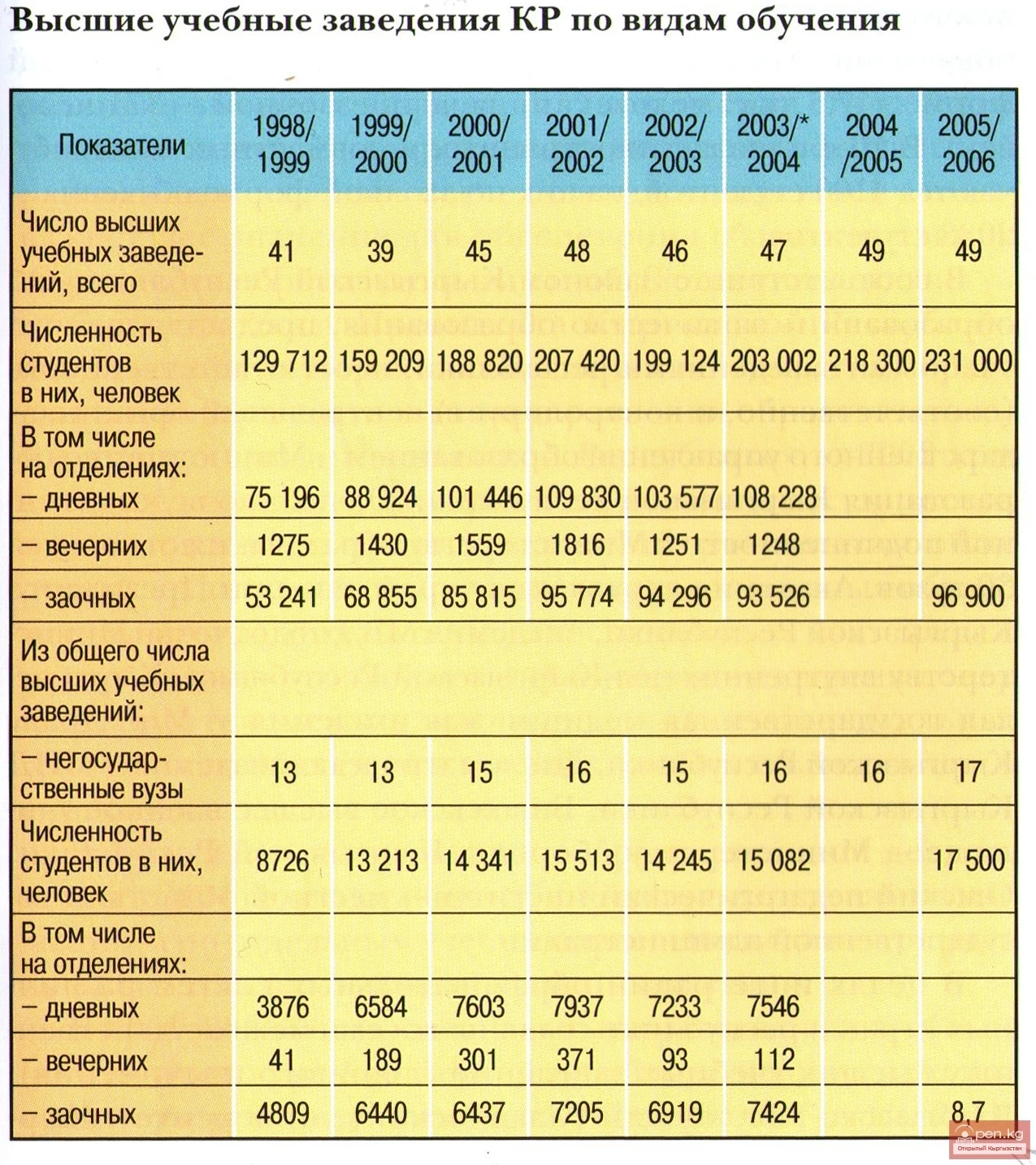
In 2005, 49 universities in the country were preparing specialists with higher education, of which 33 are state-owned and 16 are non-state. The growth of these indicators indicates a high level of demand for higher education among the population.
More than 231,000 students are enrolled in higher educational institutions in the Kyrgyz Republic (including 96,900 students in part-time education), of which 17,500 are in private universities.
In state universities, alongside state orders, education is also conducted on a paid basis. As of 2004, more than 193,000 people were studying under this form, which constitutes 87% of the total student body. Of these, about 99,400 people (44.7%) were studying part-time, and 445 people were studying evening and part-time. In private universities and branches of universities from CIS countries, only 10.3% (19,906 people) of the total number of students are studying under contract, of which 7,500 are part-time and 371 are evening and part-time. In 10 branches of foreign and joint universities, 4,100 students are enrolled, of which 2,088 are studying part-time.
According to the Law of the Kyrgyz Republic "On Education," the quality of education provided by educational institutions in the republic is the responsibility of (and is controlled by) the central government body for education - the Ministry of Education of the Kyrgyz Republic. However, 30 universities are under the departmental subordination of the Ministry of Education. The Academy of Management is established under the President of the Kyrgyz Republic, the Academy of the Ministry of Internal Affairs is accountable to the Ministry of Internal Affairs of the Kyrgyz Republic, the Kyrgyz State Medical Academy is under the Ministry of Health of the Kyrgyz Republic, the Diplomatic Academy is under the Ministry of Foreign Affairs of the Kyrgyz Republic, the Bishkek Higher Military School is under the Ministry of Defense of the Kyrgyz Republic, and the Osh Pedagogical Institute is under the local regional state administration.
To integrate the educational systems of various countries, eight intergovernmental higher educational institutions (of dual subordination) have been established in the republic: Kyrgyz-Russian (Slavic) University; Kyrgyz-Uzbek University; Kyrgyz-Turkish University named after Manas; American University in Central Asia (private university); Kyrgyz-Russian Academy of Education (private university); Eastern University (private university); International University of Ala-Too (Turkey, private university); Agha Khan University (private university). There are also 10 branches of universities from CIS countries operating.
The higher education system in the republic is funded through multi-channel financing. Diversification of funding sources reflects the support that society provides to higher education, which needs further expansion to ensure the development of higher education, improve its quality, and adequacy. State support for higher education and scientific research remains crucial for achieving a balanced solution to educational and social tasks.
According to the Decree of the President of the Kyrgyz Republic "On Further Measures to Ensure the Quality of Education and Improve the Management of Educational Processes in the Kyrgyz Republic," a new system of financing state universities has been introduced since 2002 in the form of state educational grants for student education based on the results of nationwide testing funded by the republican budget. Currently, mechanisms for allocating individual grants for education in higher educational institutions from the budget are being improved.
Non-budgetary funds from educational activities in 2004 amounted to 87.6% of state investments, and in some educational institutions even exceeded the amount of state funding.
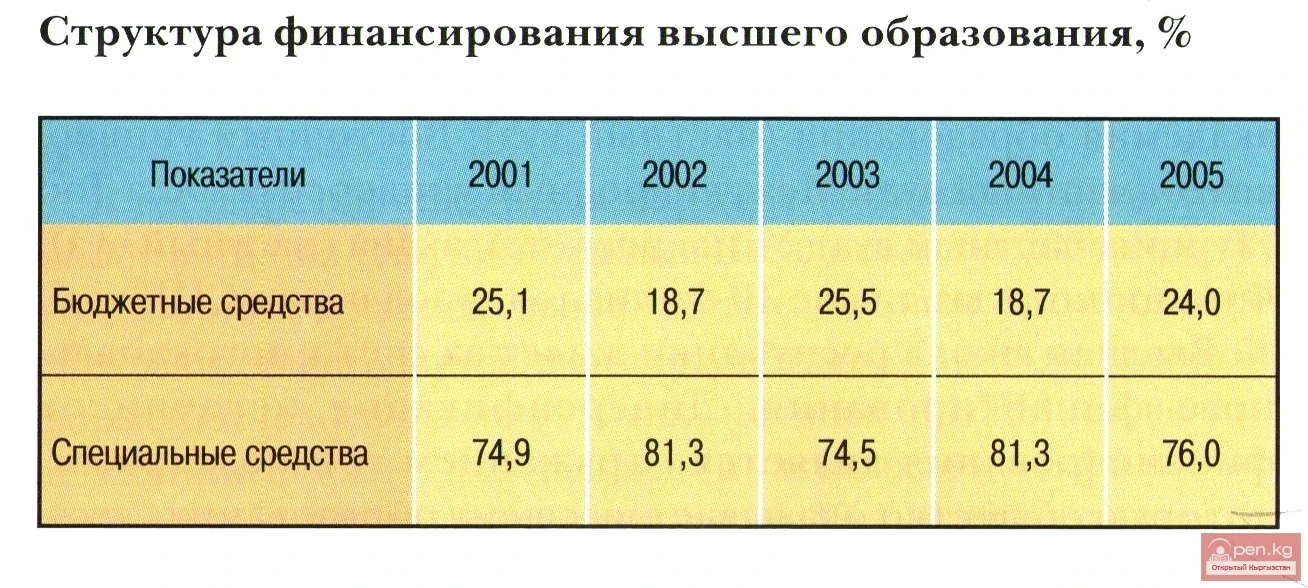
In 2001-2005, special funds from universities accounted for about three-quarters of their total income, with only one-quarter provided by the state.
In the future, according to the State Doctrine of Education and the Concept for the Development of Education of the Kyrgyz Republic until 2010, the policy of reducing state funding for universities will continue. The government will need to determine the list of state universities of republican and regional significance for state funding. It is planned that some state universities will change their form of ownership through privatization. The total number of universities (both state and private) will also be significantly reduced based on the results of a comprehensive assessment of the conditions and quality of education in them, which began in April 2006.
Other sources of funding for the higher education system include investments from sponsoring international and private organizations. Undoubtedly, it is the democratic processes that have allowed attracting investments in the development of education, re-equipping the educational process with modern equipment in many educational institutions.
The state’s policy on international cooperation in education is aimed at integrating and gradually bringing Kyrgyzstan into the global educational space, particularly joining the Bologna Process. At a republican meeting of university rectors in April 2003, the President of the Kyrgyz Republic set the task of improving the quality of educational services and integrating the higher education system of Kyrgyzstan into the global educational space, taking into account the established experience and national traditions. To achieve these goals, significant work is being done to study global trends in the development of education systems and to implement the principles of the Bologna Process within the framework of a pilot project based on seven universities.
To implement the national program "Personnel of the 21st Century" and the educational program "Bilim," more than 30 agreements and treaties have been concluded with countries near and far abroad based on intergovernmental agreements for the exchange of students and teachers, researchers, graduate students, doctoral students, for conducting joint seminars, conferences, and for creating a new generation of textbooks and teaching aids for educational institutions in the republic.
State policy also includes the internationalization of higher education as one of the important directions aimed at integrating Kyrgyz universities into the global educational space. Currently, the main directions in this regard are the recognition of diplomas from the Kyrgyz Republic abroad; accreditation of universities in international organizations; and raising the quality of education to world standards. The process of reforming the education system is based on the principles of creating a unified (common) educational space within the CIS and entering the global educational space.
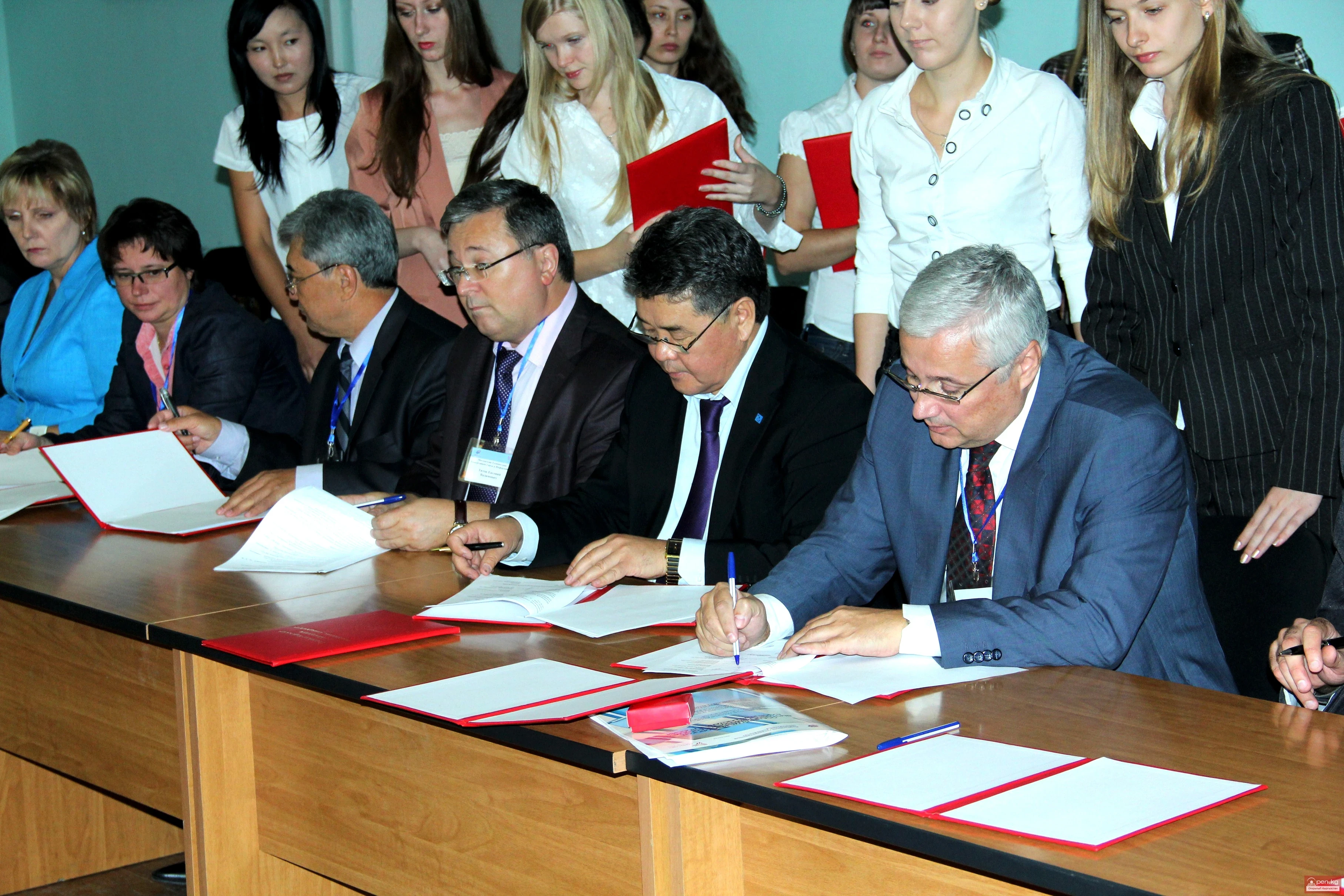
In the republic, work is beginning on the exchange of students and teachers in higher education, and a number of educational institutions have been established in collaboration with foreign partner countries (Kyrgyz-Russian (Slavic) University, Kyrgyz-American and Kyrgyz-European faculties at the Kyrgyz National University, American University in Kyrgyzstan, International University of Kyrgyzstan, Kyrgyz-Uzbek University, Kyrgyz-Turkish University, Kyrgyz-Kuwaiti University). The education system is attracting:
• Grants from the Soros Foundation, Eurasia, EU, and others;
• Investments from foreign banks (International Bank for Reconstruction and Development, European Bank for Reconstruction and Development, Asian Development Bank, Islamic Development Bank, etc.), as well as funds from international programs and organizations (IREX, ACCELS, UNDP, USIA, USAID, TEMPUS/TACIS, UNESCO, UNICEF, Peace Corps, etc.).
A number of intergovernmental agreements are aimed at inviting teachers and scholars from foreign countries to work in higher educational institutions in Kyrgyzstan (USA, Germany, France, India, Korea, Japan, China, Arab countries). Work with foreign embassies and representations of international organizations has been significantly intensified.
The integration of the higher education system of Kyrgyzstan into the global educational space using information technology and computerization of educational institutions is carried out with consideration of national experience and traditions. The integration is also facilitated by the republic's accession to the Lisbon Convention on the Recognition of Qualifications Concerning Higher Education in the European Region dated April 11, 1997, and the recognition of other international agreements on the equivalence of educational documents.