In its latest report, the EABR emphasizes that by 2030, electricity consumption in Central Asia is expected to grow by 40%, leading to the need to commission 62.8 GW of new capacity by 2035. In this regard, bank experts recommend following the "middle path" strategy, which offers a balanced approach that combines both the modernization of traditional generation and the development of renewable energy sources (RES). According to calculations, this approach could be 30-45% more economical than "green maximalism," while reducing the carbon footprint fivefold compared to conservative methods.
Abandoning Extremes
• The region's growth is accompanied by outdated infrastructure: by 2030, electricity consumption in Central Asia could increase by 40%, yet more than half of the power grids and stations already require upgrades.
• Extreme approaches in energy are ineffective: a conservative strategy maintains risks and a high carbon footprint, while "green maximalism" may threaten the reliability of energy supply and contribute to rising tariffs.
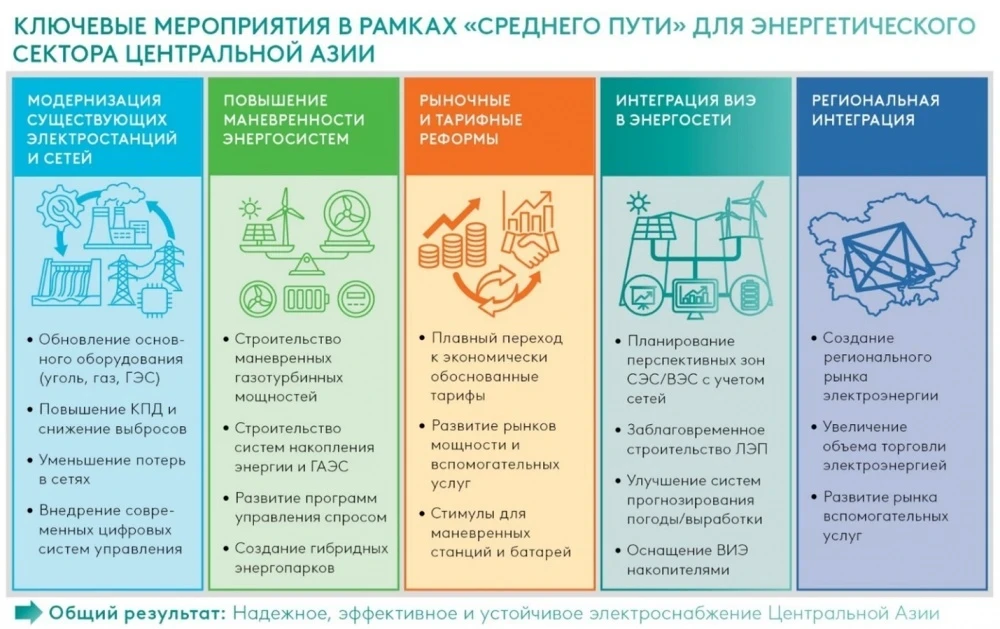
• The EABR's "middle path" strategy offers a harmonious combination of modernizing traditional sources, developing RES, implementing energy storage systems, and digitizing networks.
• Results for the region: capital costs could be 30-45% lower compared to "green maximalism," the cost of electricity could be 25-35% lower, and the carbon footprint could be five times less than under a conservative scenario.
The Energy Transition in Central Asia: Key Challenges
Global Changes: Records in Clean Energy for 2024
The global energy transition is demonstrating unprecedented rates. In 2024, record volumes of new solar and wind power plants have been recorded, and investments in clean energy now exceed those in fossil fuels. However, these successes also come with new challenges.
Growing Demand: Electricity as the Foundation for New Technologies
Demand for electricity is outpacing the development of low-carbon generation, leading to increased global CO₂ emissions. Electricity is becoming the foundation for sectors such as artificial intelligence, data centers, electric vehicles, and numerous connected devices that require stable energy supply 24/7. This is only possible through reliable and manageable energy sources, complemented by efficient networks and reserves.
Conservative and Green Approaches: Two Paths to the Future of Energy
Research on energy policies in different countries reveals two main directions. The conservative approach focuses on maintaining existing generation, leading to technological inertia and vulnerability to environmental risks. At the same time, "green" initiatives imply rapid decarbonization and a rejection of traditional sources, which can reduce the reliability of energy supply and increase costs. Optimal energy policy should combine various technological and investment solutions while minimizing systemic risks.
Central Asia: Old Power Grids and Growing Needs
The region faces unique challenges as electricity consumption is growing rapidly, potentially increasing by 40% by 2030. At the same time, a significant portion of the infrastructure needs modernization, and technical losses in the networks significantly exceed those in developed countries. The winter months have already brought energy crises to the region, including rolling blackouts and accidents at old power plants.
Natural Resources of Central Asia: Potential for Energy Transition
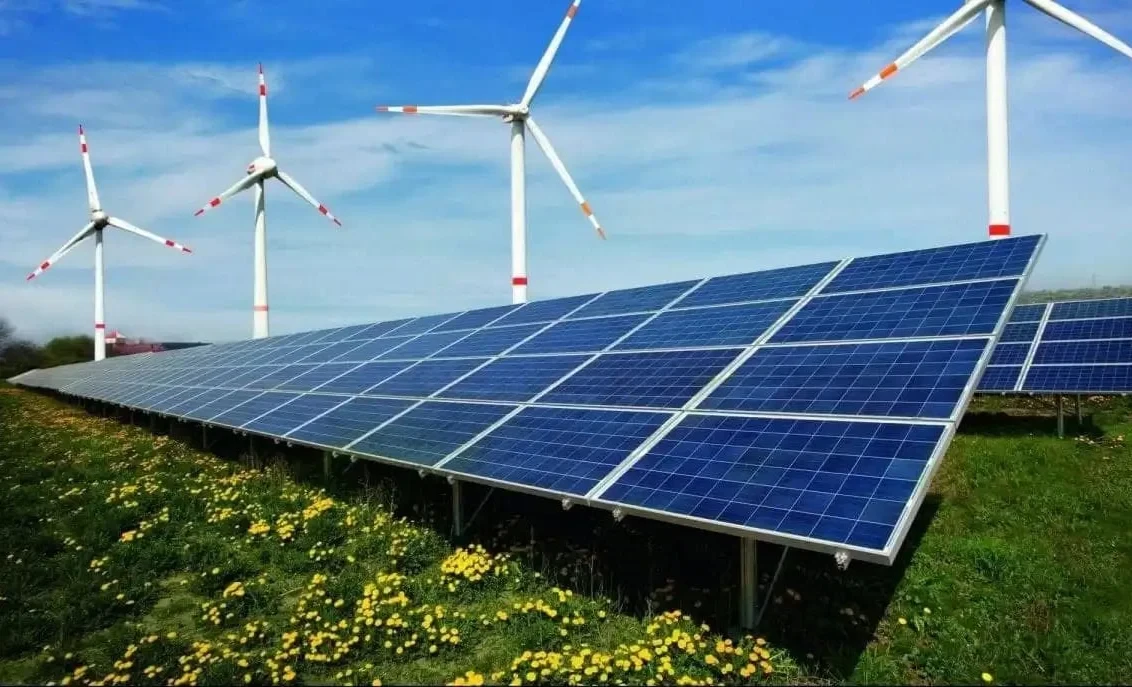
Central Asia has substantial resources for a successful energy transition. Southern Kazakhstan and Uzbekistan host some of the best solar zones, while Kyrgyzstan and Tajikistan have powerful rivers for hydropower, and western Kazakhstan and the Caspian coast are known for strong winds. The region also has significant reserves of gas and uranium, and decisions have already been made to develop nuclear energy.
Practical Application of the "Middle Path": Reliability and Environmental Friendliness
The EABR, in its new report, proposes a "middle path" strategy for the energy transition that demonstrates a balanced approach, allowing for the simultaneous achievement of environmental sustainability and energy security goals. This course is based on flexibility and pragmatism, taking into account the real capabilities of infrastructure and society.
Evgeny Vinokurov, Chief Economist of the EABR:
The "middle path" strategy combines the reliability of traditional energy with the environmental benefits of new technologies. This includes utilizing all available energy sources—from solar and wind to gas and nuclear. It is essential to develop RES while simultaneously upgrading traditional power plants and creating new networks and energy storage systems, ensuring sustainable economic growth for the region.
Five Steps to a Successful Energy Transition
To implement this strategy, cooperation between states, businesses, and international institutions is necessary.
EABR experts highlight five key directions:
1. Modernization of existing power plants and networks to enhance their efficiency and reduce emissions. It is also necessary to update the network infrastructure to integrate the growing volumes of RES.
2. Increasing the maneuverability of the energy system, which includes the construction of modern gas turbine units and the implementation of demand management systems.
3. Reforming markets and tariffs to attract investments in energy and modernize the electricity market.
4. Integrating RES into the energy grid, considering the necessary changes in network infrastructure.
5. Regional integration to enhance reliability and reduce energy supply costs through resource sharing.
Why the "Middle Path" Proves Most Beneficial: Numbers and Facts
A comparative analysis of various scenarios for the development of electricity in Central Asia shows that the integration strategy of the "middle path" provides the most sustainable outcome. It is expected that by 2035, the volume of new capacity will reach 62.8 GW, corresponding to 230 billion kWh of new generation per year. Modeling shows that this scenario implies capital costs 30-45% lower than "green maximalism," and comparable to the conservative scenario, while the carbon footprint is five times less.
Energy in Central Asia Without Upheavals: Advantages of a Balanced Approach
The balanced "middle path" strategy can serve as the foundation for modernizing the energy sector in Central Asia, providing reliable and affordable energy supply, reducing the carbon footprint, and conducting the energy transition without serious upheavals, which will be beneficial for the economy and allow for compliance with climate commitments.