On September 25, the court sentenced Sarkozy to five years in prison with a suspended sentence for participating in a criminal conspiracy related to the illegal financing of his 2007 campaign by Libyan authorities. He began serving his sentence on October 21 but was released on November 10 pending the consideration of his appeal. In his video address, Sarkozy described the 20 days in prison as a "nightmare" and reiterated his innocence.
The book, published by Fayard, includes 216 pages, averaging 11 pages for each day of his imprisonment. Sarkozy completed the work just a few days after his release and showed the manuscript to his wife, Carla Bruni, who highly praised his effort. After that, the lawyers made adjustments to some sections. "This is not a novel," he noted in the introduction. In his work, Sarkozy describes prison life, the daily routine and menu, as well as leisure activities.
"I never thought that at 70 I would end up in prison. It is a trial that I endured. I admit, it was hard, very hard. It leaves a mark on the soul of everyone," he shares in the book.The book has already taken first place in pre-orders on Amazon.
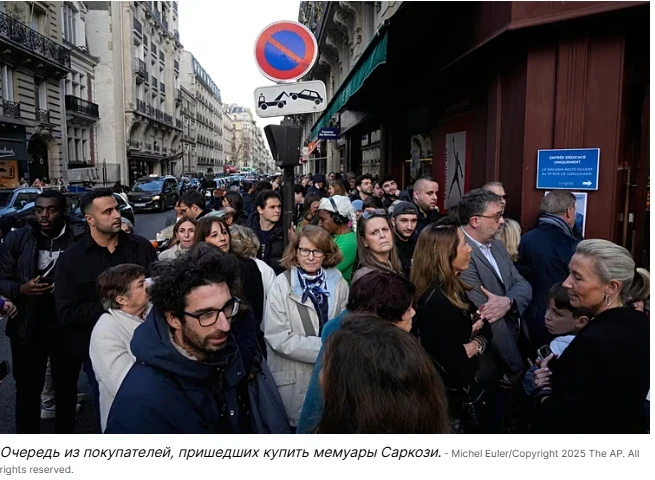
According to Euronews, this literary work serves as a political tool aimed at both right-wing voters and normalizing relations with the far-right. In particular, Sarkozy mentions a phone conversation with Marine Le Pen that took place in his cell.
Arnaud Benedetti, editor-in-chief of Revue politique et parlementaire, believes that this is more than just prison memoirs: "This is a hybrid work, but also a political statement. No matter how many criminal cases there are against him, Sarkozy's words remain significant in public debates."
Philippe Moro-Chevrolet, a professor of political communications at Sciences Po Paris, points to the clear goal of the book: to quickly regain control over the narrative in the context of unstable public opinion.
"The publication had to happen as soon as possible to set the framework for the discussion and not allow the French to form their own opinion," he adds.
This implied full control over the situation: mobilizing support before imprisonment, using symbols such as the novel "The Count of Monte Cristo," which Sarkozy took with him to prison, and active communication immediately after his release.