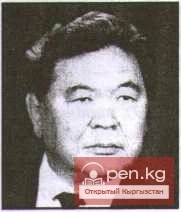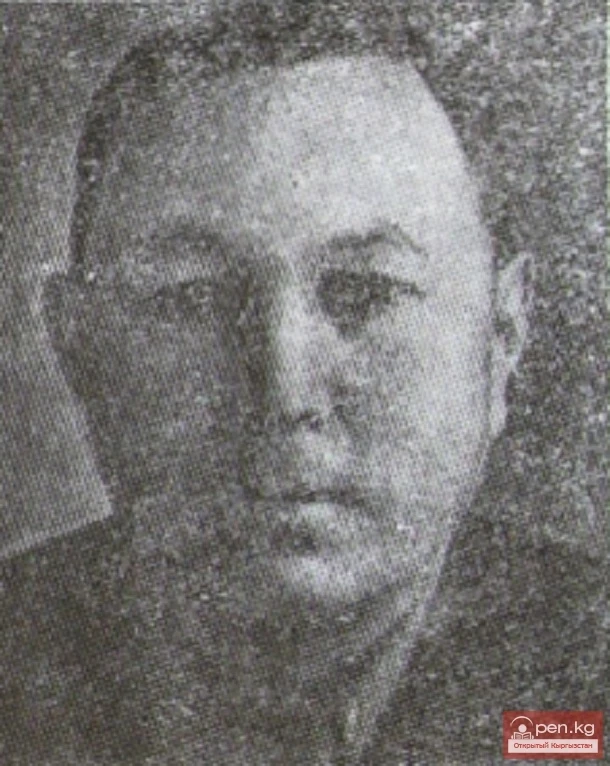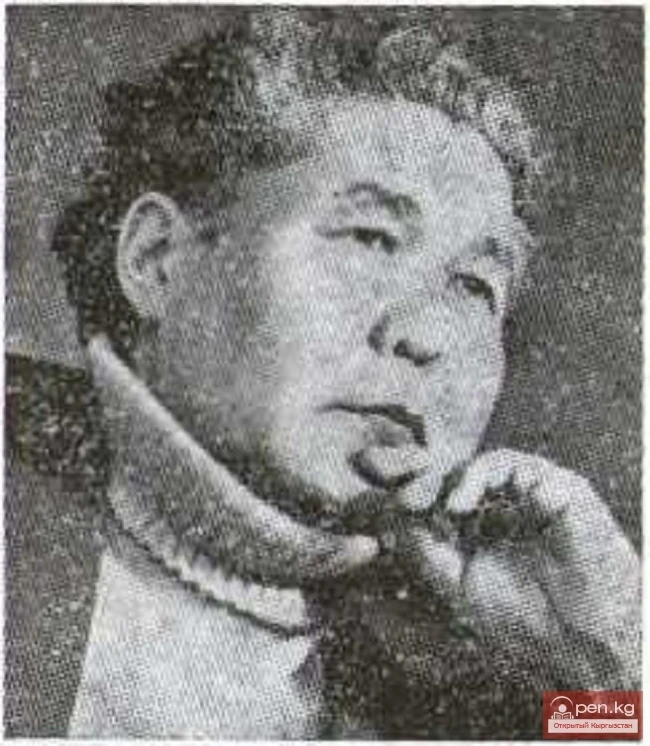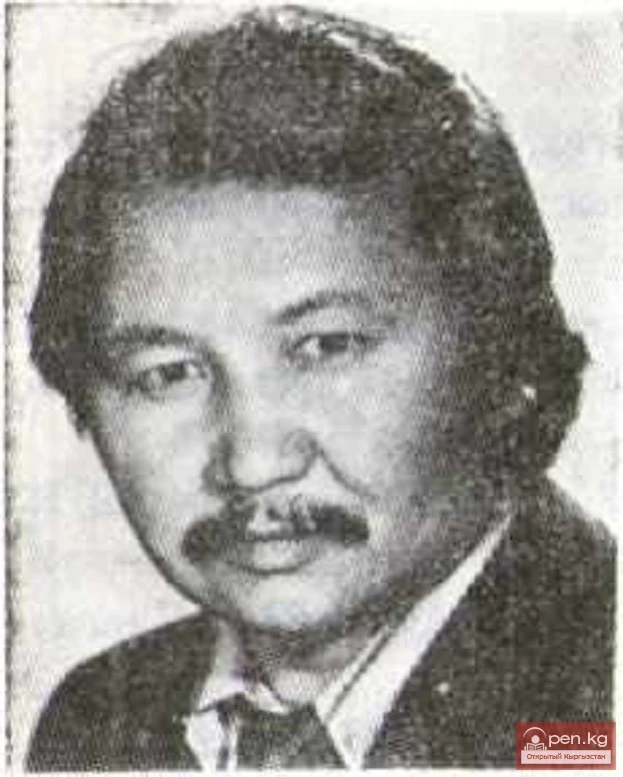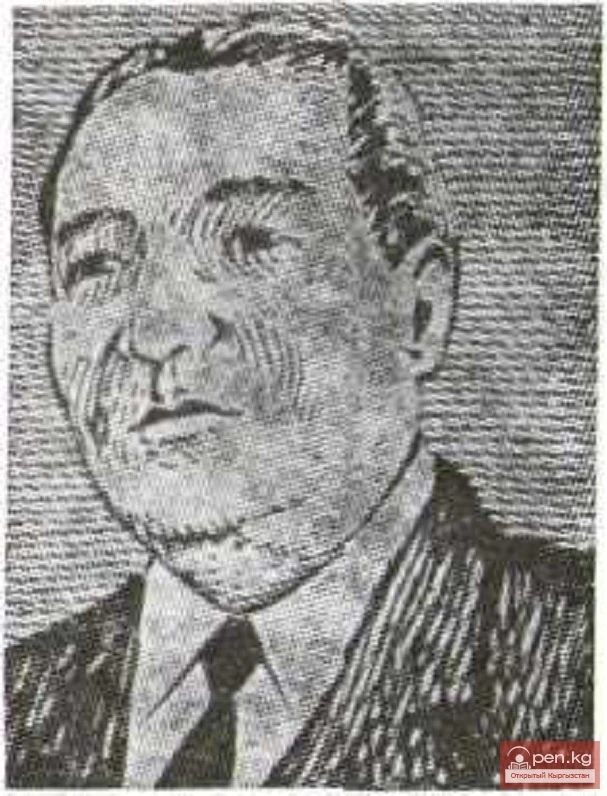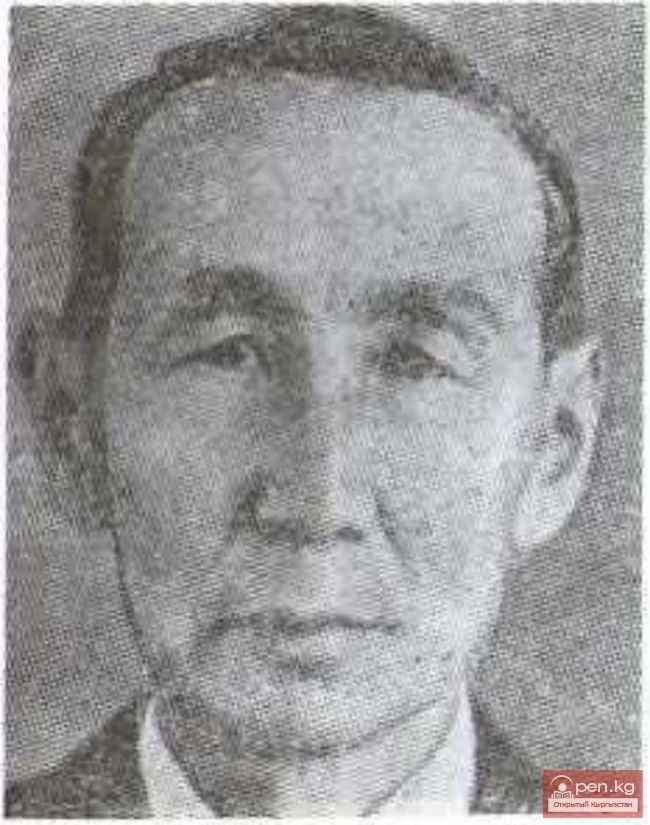
Brimkulov Ulan Nurgazievich (1948)
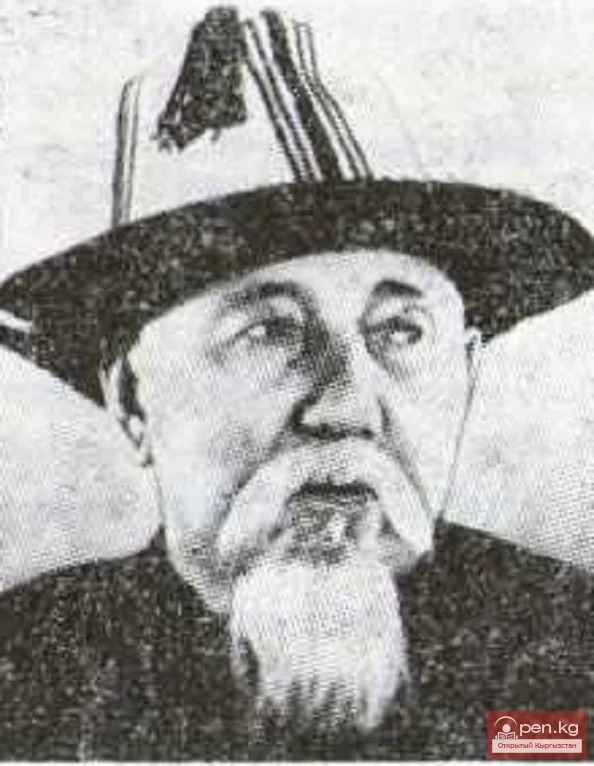
Brimkulov Ulan Nurgazievich (1948), Doctor of Technical Sciences (1992), Professor (1995), Corresponding Member of the National Academy of Sciences of the Kyrgyz Republic (1993).
Buylashev Talaybek Sabralievich (1957), Doctor of Medical Sciences (2001), Professor (2002). Kyrgyz. Born in the city of Naryn, Naryn Region. Graduated from KGMI (1981), postgraduate studies at the Research Institute of Pediatrics of the USSR Academy of Medical Sciences (Moscow, 1987). Worked as a junior researcher at the Kyrgyz Research Institute of Resortology and Physiotherapy, a doctor at the Republican Clinical Hospital, a doctor at the Children's Clinical Hospital, a senior
Boshkoev Zhusup Beyshekadyrovich (1962), Doctor of Medical Sciences (1999), Professor (2002). Kyrgyz. Born in the village of Orto-Uryukty, Issyk-Kul District, Issyk-Kul Region. Graduated from KGMI (1986), and completed postgraduate studies there (1991).
Botbaeva Mira Mahmudovna (1927), Candidate of Biological Sciences (1963), Professor (1985). Kyrgyz. Born in the village of Kara-Suu, Toktogul District, Talas Region. Graduated from KGU (1956), postgraduate studies at MSU (1958).
Botbaev Ilyas Mahmudovich (1931), Doctor of Agricultural Sciences (1984), Professor (1990), Academician of the National Academy of Sciences of the Kyrgyz Republic (1997), Laureate of the State Prize of the USSR in the field of science and technology. Kyrgyz. Born in the village of Kara-Suu, Toktogul District, Talas Region. Graduated from the Kyrgyz Agricultural Institute (1953), postgraduate studies at the A. N. Severtsov Institute of Animal Morphology of the USSR Academy of Sciences (1959).
Bochkaev Yakov Vasilievich (1928), Doctor of Technical Sciences (1967), Professor (1969), Corresponding Member of the Russian Academy of Agricultural Sciences (1991), Laureate of the State Prize of the Kyrgyz Republic in the field of science and technology (1976). Russian. Born in the village of Alamedin, Chui region. Graduated from the Kyrgyz Agricultural Institute (1954). Worked as an assistant, senior lecturer, head of the Department of Hydraulics and Automation, and dean of the
Botashev Azret-Aliy Ilyasovich (1937-1995), Doctor of Physical and Mathematical Sciences (1984), Corresponding Member of the Academy of Sciences of the Kirghiz SSR (1989).
Borubaev Altai Asylkanovich (1950), Doctor of Physical and Mathematical Sciences (1991), Professor (1992), Laureate of the State Prizes of the Kyrgyz Republic in the field of Science and Technology (1998, 2002), Academician of the National Academy of Sciences of the Kyrgyz Republic (2000)
Boronbaev Erkin Kaparovich (1947), Candidate of Technical Sciences (1979), Professor (1995).
Borbugulov Mukhtar Borbugulovich (1930), Doctor of Philological Sciences, Professor (1970), Laureate of the State Prize of the Kyrgyz Republic in the field of science and technology. Kyrgyz. Born in the village of Kyz-Kol, Suzak District, Jalal-Abad Region. Graduated from KSU (1952), postgraduate studies at the Institute of World Culture of the USSR Academy of Sciences named after A.M. Gorky (1957).
Mikhail Nikolaevich Bolshakov (1907-1992), Doctor of Technical Sciences (1952), Corresponding Member of the Academy of Sciences of the Kyrgyz SSR (1954). Russian. Born in Kaluga, Russian Federation. Graduated from Leningrad Polytechnic Institute (1931).
In ancient times, the functions of a compass and a clock were performed by the Sun, the Moon, individual stars, and clusters of stars (constellations). Kyrgyz hunters and herders, especially shepherds, who moved from place to place, needed guiding signs that helped them confidently find their way in vast valleys and mountainous areas.
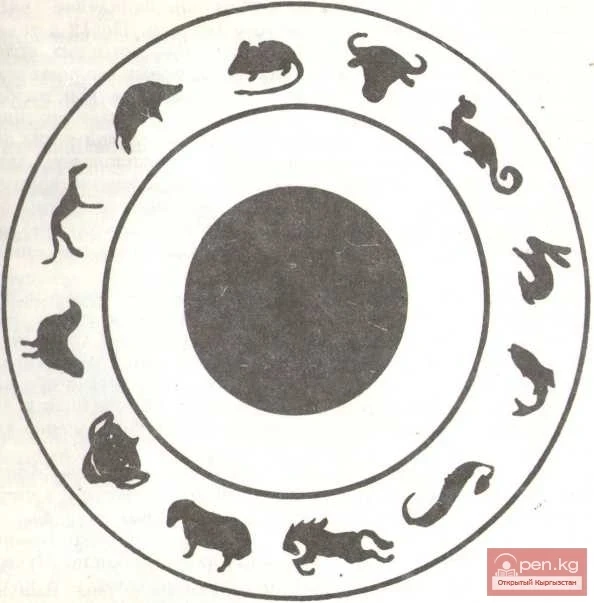
Kyrgyz Calendar with a 12-Year Cycle Among the Kyrgyz (as well as many other peoples), a 12-year cycle of counting years was practiced, where a specific year was named after an animal: chychkan — mouse, uy — cow, bars — snow leopard (sometimes jolbors — tiger), koyon — hare, zhayaan — catfish (sometimes dragon), zhylaan — snake, zhylyky — horse, koy — sheep, mechin — monkey, took — chicken, it — dog. The acceptance of the 12-year cyclicality contains, on one hand, a certain objective basis,
The Basis of the Ancient Calendar. Even ancient hunters, observing the change of seasons and seasonal changes, learned to correlate them with periodic phenomena in nature. People knew that the river freezes in severe cold, that before the ice forms, trees shed their leaves, grass turns yellow and fades, and the days become shorter. The rhythm of people's lives and the cyclicity of their economy depended on the alternation of the seasons. People understood that after a certain period of
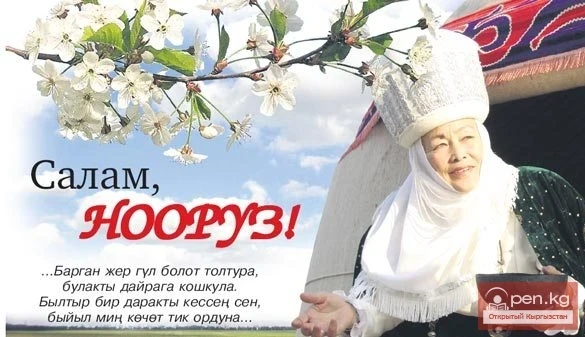
On the day of the meeting of the Jaz Mayram — the spring holiday, people usually dressed festively, striving not to think about anything bad. This holiday is primarily a family one. Wherever a person may be, they must come to the uy-bule chogulup tamakhtanu — the family reunion meal with their parents. An unchanging feature of traditional Nooruz (New Year) is the expression of respect for the elders, masters of their craft, and aksakals. From the mountains, they brought archu — tree-like
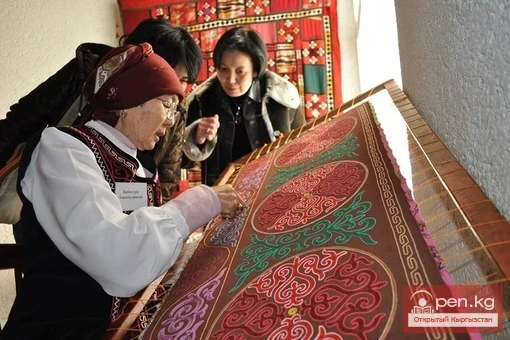
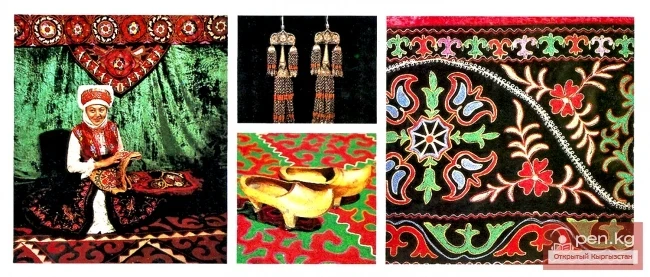
Embroidery was a very popular and widely practiced form of handicraft, practiced by women of all ages, from young girls to the very elderly. This type of handicraft, compared to other traditional crafts, was more individualistic, as it did not require collective efforts.
The need for measurement and counting arose among the Kyrgyz in the context of their relatively advanced social production and social differentiation. In Kyrgyz culture, several counting systems coexist, which indicates their diverse origins.
Among the Kyrgyz, as among other peoples of the world, concepts denoting physical quantities were developed in the process of understanding the connections between phenomena, processes, and generalizing their aspects and characteristics important for practice. The formation of concepts reflects the activity and creative nature of thinking, while success in using these concepts entirely depends on how accurately they reflect objective reality. Through concepts obtained by abstraction, reality
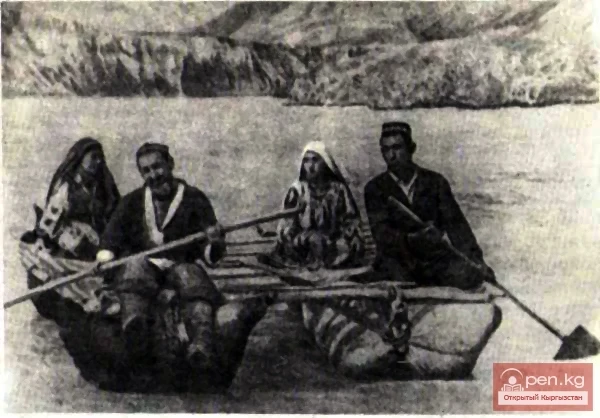
In the south of the republic, when crossing turbulent mountain rivers, they still successfully use sal — a unique raft made from inflated skins of water bags.
Knowledge and understanding of natural processes in which human life takes place is a prerequisite for successful practical activity. Unlike animals, humans, in the process of labor, comprehend reality, purposefully accumulating and passing on acquired knowledge to others. "As long as people do not know the forces of nature, they blindly submit to them; but once they know them, then the forces of nature submit to humans," noted G. V. Plekhanov.
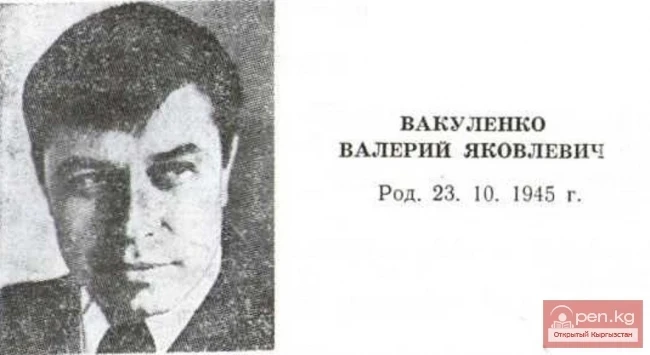
Literary scholar, translator V. Vakulenko was born in the settlement named after M. V. Frunze in the Sokuluk district of the Kyrgyz SSR in a working-class family. In 1963, he graduated from high school in his hometown, and in 1971, he graduated from the philological faculty of Leningrad State University named after A. Zhdanova. From 1964 to 1967, he served in the ranks of the Soviet Army. He began his professional career in 1971 as an editor at the "Kyrgyzstan" publishing house, and
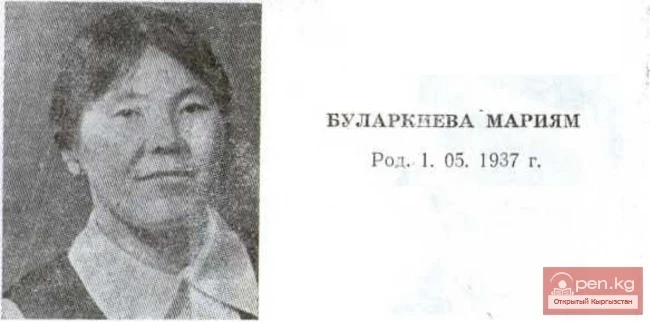
Poet M. Bularkieva was born in the village of Kozuchak in the Talas district of the Talas region in a peasant family. In 1954, she graduated from high school in her native village, and in 1959, she graduated from the philological faculty of KGU. From 1963 to 1965, she was a student at the Higher Literary Courses under the USSR Union of Writers in Moscow. She began her labor biography in 1959 as an editor at Kiruchpedgiz, and from 1966, she served as the responsible secretary, and from 1980, as
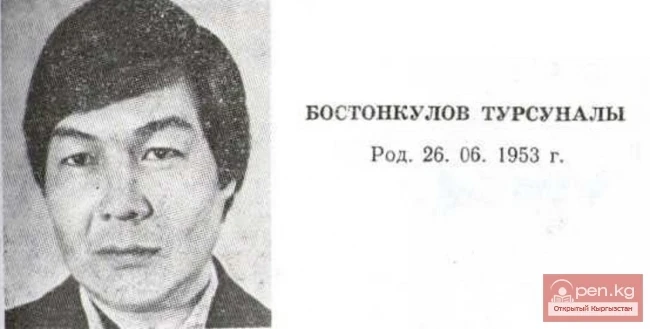
Poet and playwright T. Bostonkulov was born in the village of Ana-Kyzyl in the Uzgen district of the Osh region in a peasant family. In 1971, he graduated from the X. Tashirov Secondary School (Kara-Suu district), and in 1984 — from the A. M. Gorky Literary Institute under the USSR Writers' Union in Moscow. From 1971 to 1973, he served in the Soviet Army, and from 1973 to 1979, he worked as a collective farmer and laborer. Since 1984, he has been working as a proofreader at the
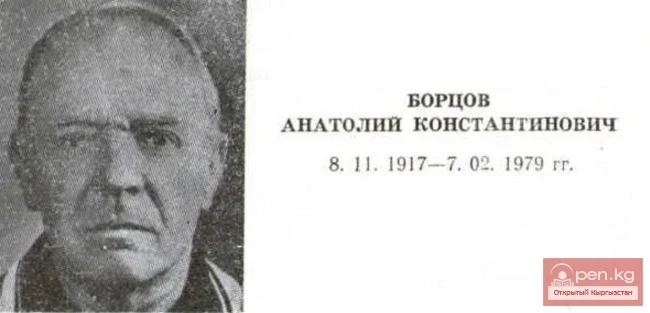
Poet A. Bortsov was born in the city of Odessa in a family of a doctor. In 1932, he graduated from a seven-year school in Odessa, then studied at a vocational school for tram drivers. From 1933 to 1938, he worked as a mechanic at various enterprises in Odessa. From 1938 to 1949, he served in the ranks of the Soviet Army. In 1949, he moved to Frunze. From 1950 to 1953, he worked as the commandant of the RPSH under the Central Committee of the Communist Party of Kyrgyzstan. In 1954, he was
Improvisational poet I. Boronchiev was born in 1910 - 1978 in the village of Alchaluu, Chui region of the Kyrgyz SSR, in a family of poor peasants. In 1929, he joined a collective farm. This period marks the beginning of his creative activity. He became known among the people as a singer-improviser. In 1936, he was accepted as a soloist in the Kyrgyz State Philharmonic. That same year, his poem "The First Five-Year Plan" was published for the first time, followed by the poem
Literary scholar, prose writer, playwright, poet M. Borbugulov was born on May 5, 1930, in the village of Kyz-Köl, Suzak district, Osh region, in a peasant family of modest means. From 1946, he studied at the Jalal-Abad Pedagogical School, from 1947 at the Teacher Training Institute, and in 1949 he transferred to the second year of the Kyrgyz State Pedagogical Institute in Frunze. In 1952, he entered the graduate school of the A. M. Gorky Institute of World Literature of the USSR Academy of
Prose writer, playwright, screenwriter E. Borbiev was born on August 12, 1937, in the village of Kashka-Suu, Sokuluk District, Kyrgyz SSR, in a teacher's family. After graduating from Kyrgyz Secondary School No. 5 named after A. S. Pushkin in Frunze in 1956, he studied at the FPI, and from 1960 to 1966 — at the journalism department of the philological faculty of KGU; from 1971 to 1973 — a student at the Higher Directing and Screenwriting Courses in Moscow. From 1960 to 1963, he worked as
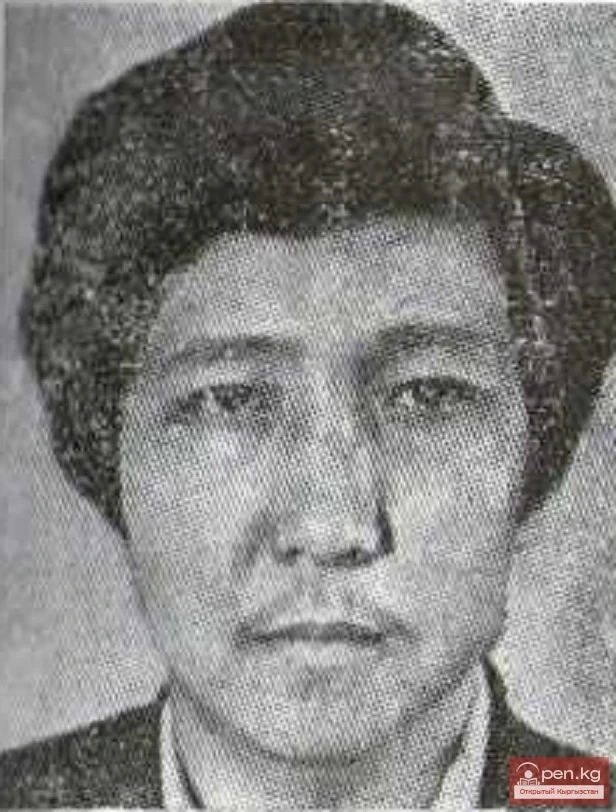
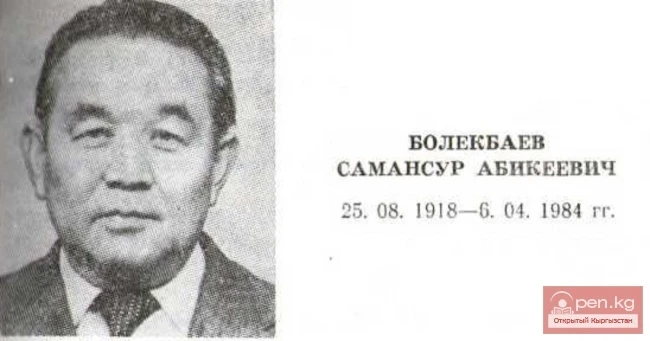
Prose writer and translator S. Bolekbai was born in the village of Kyzyl-Dyikan in what is now the Moscow district of the Kyrgyz SSR into a peasant family. In 1937, he graduated from the Kyrgyz Pedagogical Technical School in Frunze. From 1952 to 1955, he studied in the evening department of the philological faculty of KRU. While a student at the pedagogical technical school, he worked as a correspondent for the newspaper "Leninchil Zhas," where he later worked in 1941 and from 1947
Improvisational singer and akyn-songwriter O. Bolebalaev was born in 1888—1967 in the village of Chondaly (now part of the Kant district of the Kyrgyz SSR) in a family of a herdsman. He learned to read and write from the village mullah. In his youth, he composed love lyrical and lyrical-epic songs. As an improvisational singer, he emerged after the Great October Socialist Revolution. The development of O. Bolebalaev's creativity as an akyn was significantly influenced by K. Akiev, with
Poet and playwright J. Bokonbaev was born on May 16, 1910 — July 1, 1944, in the village of Mazar-Sai in what is now the Toktogul district of the Osh region, into a poor family. Having lost his parents at an early age, he was raised in the Kogart orphanage near Jalal-Abad from 1924 to 1926. From 1926 to 1931, he studied first at the Osh and then at the Frunze Pedagogical Technical Schools, and from 1933 to 1935 — at the Communist Institute of Journalism in Moscow. From 1931 to 1933, he worked
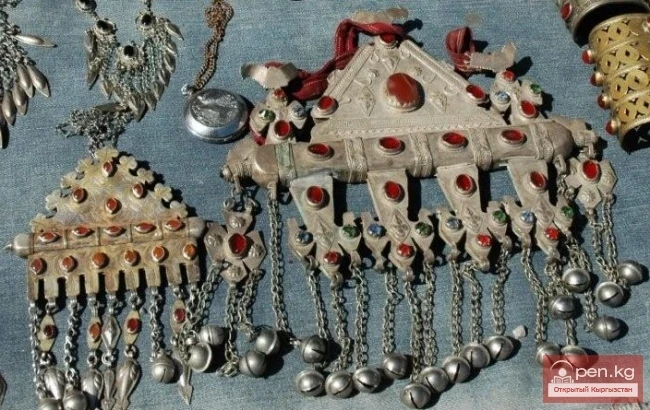
Ancient jewelers produced a variety of women's jewelry, horse harness items, household utensils, belts, and hunting equipment. They primarily used silver, sometimes gilded, in combination with precious stones. They were familiar with various techniques for manufacturing and finishing products: stamping, openwork carving, embossing, granulation, blackening, and decorating items with enamel.
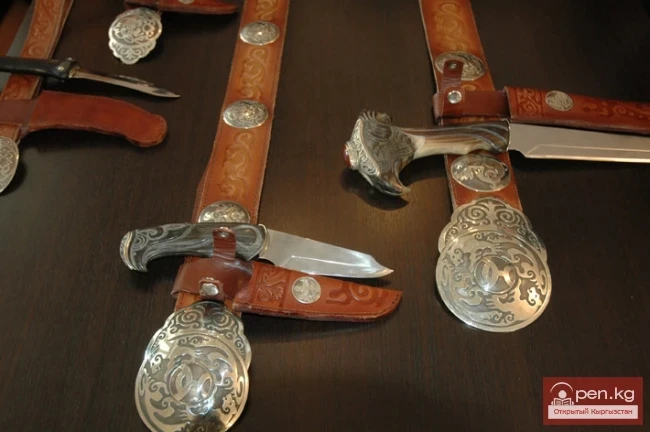
In the past, the Kyrgyz produced two types of weapons — cold and firearms, and they made bulletproof clothing. This was necessitated by inter-feudal wars and frequent clan conflicts. They skillfully utilized natural defensive conditions (the surrounding mountains) and constructed special fortifications.
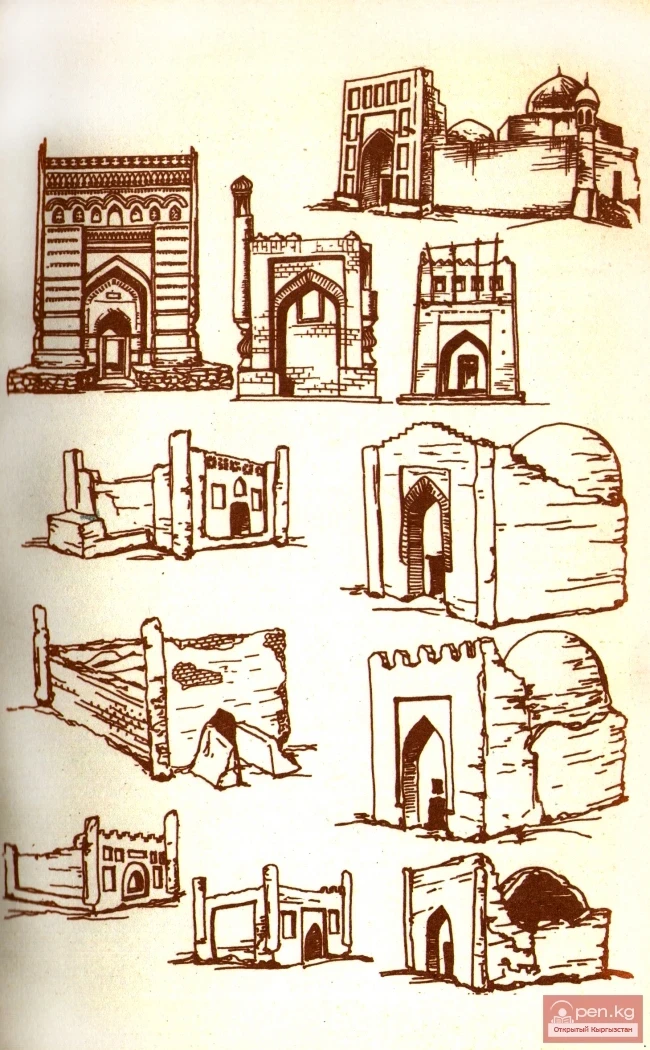
Deep ancient local traditions in the art of the Kyrgyz can be traced when studying the ornamentation of the domes, which our predecessors paid little attention to. Three types of ornament were used in the decoration of Kyrgyz burial sites: painting, appliqué, and patterned brickwork.
The material culture of the Kyrgyz people from the 16th to the first half of the 19th century has not yet been the subject of special study, and during our expeditionary work, it was important for us to gather any information in this area. Moreover, the study of fortresses was interconnected with the nature of Kyrgyz settlements and dwellings, while the ornamentation and paintings of epitaphs and domes directly relate to the traditional decorative applied art of the Kyrgyz.
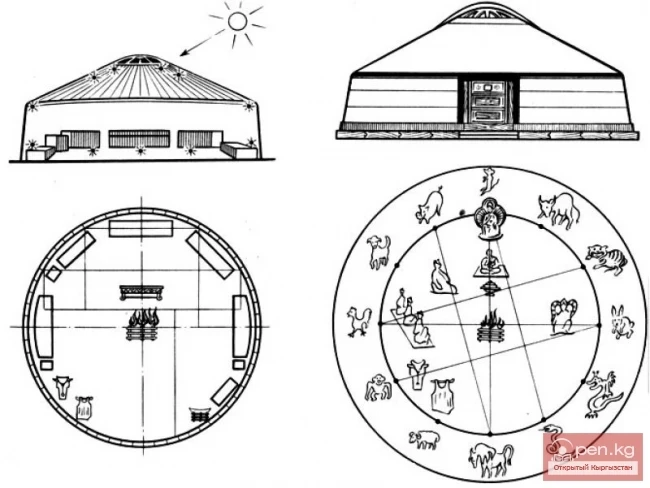
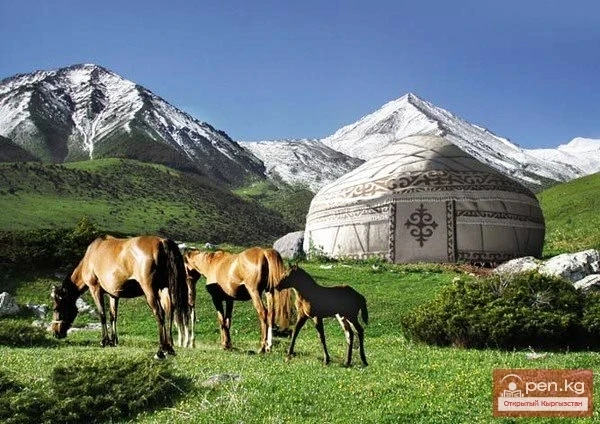
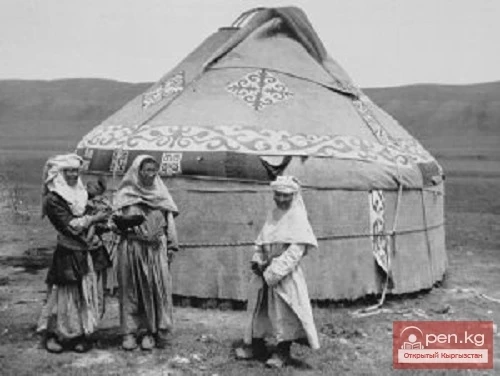
The dominant type of dwelling in the conditions of centuries-old nomadic life of the Kyrgyz was the yurt. Even when erecting burial structures — gumbazes — the Kyrgyz often gave them the shape of a yurt so that the soul and body of the deceased would feel comfortable in the "afterlife." The yurt encompassed the entire life of the herdsman, starting from birth. He wintered in it even during the harshest frosts and migrated with it across vast pastures.
Critic, poet, prose writer K. Bobulov was born on May 15, 1936, in the village of Osor, Nookat district, Osh region, in a peasant family. In 1953, he graduated from high school in his native village, and in 1958, he graduated from the philological faculty of KSU. In 1962, he entered the graduate school of the AON under the Central Committee of the CPSU in Moscow. After a brief break, he resumed his studies in 1965 and defended his dissertation for the degree of Candidate of Philological
Prose writer K. Berdikeev was born on September 1, 1939, in the village of Kairma, Jumgal District, Naryn Region, in a peasant family. In 1955, he graduated from Chayek Secondary School, and in 1960, he graduated from the veterinary faculty of the Kyrgyz State Agricultural Institute named after K. I. Skryabin. He began his labor biography in 1960 as a veterinarian in the collective farm named after V. I. Lenin, and from 1964 he worked as the deputy head of the district veterinary station, from
Poet A. Berdibaev was born on 9. 1916—24. 06. 1980 in the village of Maltabar, Moscow District, Kyrgyz SSR, in a poor family. He lost his sight in childhood. From 1944 to 1953, he worked as a soloist at the Toktogul Satylganov Kyrgyz State Philharmonic. From an early age, he became fond of oral tales and songs of his native people and performed them for his family. At the age of ten, he began to pick melodies on the komuz, and in his older years, he traveled to villages, memorizing new songs
Kyrgyz Ail of Past Centuries The Kokand fortresses, even large ones like Pishpek, could not serve as a base for the formation of settled settlements, as they were perceived by the Kyrgyz as a symbol of khan's oppression and were destroyed during Kyrgyz uprisings. However, even in the surviving fortresses, from which the Kokand conquerors were expelled, the Kyrgyz did not settle and avoided them in every way, as they reminded them of the cruel khan's arbitrariness. In the southern
Domes and Mazars — burial mausoleums of the Kyrgyz — have their origins in the domestic architecture of earlier times. This architecture has almost not survived, but it existed. It belonged to a people who later became purely nomadic. These monuments are also the most significant evidence of the local nomadic population's involvement in agriculture, mining, and trade in the distant past. Over time, the original forms of the domes evolved, acquiring features of the typical dwelling of
Samples of decorative brickwork of domes Alymbek Medrese is one of the well-known madrasahs in Osh, built in the late 1850s by the Kyrgyz tribal leader of Alai, a prominent Kokand feudal lord Alymbek-Datka. According to contemporaries, its decoration competed with the khan's madrasah in Kokand. The building, made of fired brick, was notably strong. According to archival documents, a circus was later established here. It consisted of a darс-khana, khanaka, and 28 cells, where three
Poet K. Belekov was born on November 23, 1956, in the village of Korumdu, Issyk-Kul district, Issyk-Kul region, in a family of civil servants. In 1974, he graduated from Korumdin Secondary School, and in 1979, he graduated from the philological faculty of KSU named after the 50th anniversary of the USSR. From 1980 to 1985, he worked as a correspondent for the newspaper "Leninchil zhash," and as a literary employee in the editorial office of the magazine "Ala-Too." Since
Poet A. Belekov was born on February 1, 1928, in the village of Korumdu, Issyk-Kul District, Issyk-Kul Region, in a poor family. In 1943, he graduated from Toktogul Satylganov Secondary School in the village of Temirovka, and then studied for a while at short-term teacher training courses. From 1948 to 1952, he studied at the Faculty of Kyrgyz Language and Literature at the Kyrgyz State Pedagogical Institute, and from 1957 to 1959, he was a student at the Higher Literary Courses under the
Translator S. Bektursunov was born on December 20, 1909, and died on June 13, 1962, in the village of Uch-Koshoy, currently in the Talas district of the Talas region, in a family of poor farmers. Orphaned at an early age, he was raised in an orphanage and studied at a rural school. In 1930, he graduated from the Kyrgyz Pedagogical Technical School in Frunze. He began his labor biography in 1930 as the director of a school in the village of Aravan in the Osh region and then worked for some time
Prose writer and playwright K. Bektenov was born in the village of Dolinka in the Issyk-Kul district of the Issyk-Kul region in a peasant-poor family. Having lost his parents early, he worked as a laborer. He studied at a workers' faculty and graduated from GITIS named after A. V. Lunacharsky in Moscow in 1941. From 1949 to 1950, he was a student at the higher directing courses at the Tashkent Theatre Institute named after A. N. Ostrovsky. During the Great Patriotic War, he was at the
Translator Z. Bektenov was born on October 29, 1911, in the village of Ken-Suu in the current Tyup district of the Issyk-Kul region, in the family of a rural paramedic. In 1925, he graduated from elementary school in his native village, in 1930 — from the Kyrgyz Pedagogical Technical School in Frunze, and in 1940 — from the Kyrgyz State Pedagogical Institute. He began his career in 1930 as the head of the district education department in the city of Sulyukt. From 1931 to 1932, he worked as the
Poet J. Bekniyazov was born in the village of Kyzyl-Dyikan in the Moscow district of the Kyrgyz SSR into a peasant family. In 1957, he graduated from Budennovskaya Secondary School, and in 1964 — from the Faculty of Russian Language and Literature at Przhevalsky Pedagogical Institute. In 1964, he was drafted into the ranks of the Soviet Army. Since 1965, he worked as a teacher at his native Budennovskaya Secondary School, from 1967 — as a proofreader at the publishing house
Prose writer and playwright Sh. Beishenaliev was born in the village of Kurtka in the current Ak-Talinsky district of the Naryn region into a peasant family. In 1943, he graduated from the incomplete secondary school named after Togolok Moldo in his native village, and in 1952, he graduated from the philological faculty of KGU. From 1962 to 1964, he was a student at the Higher Literary Courses under the Union of Soviet Writers in Moscow. He began his labor biography as a teacher at an