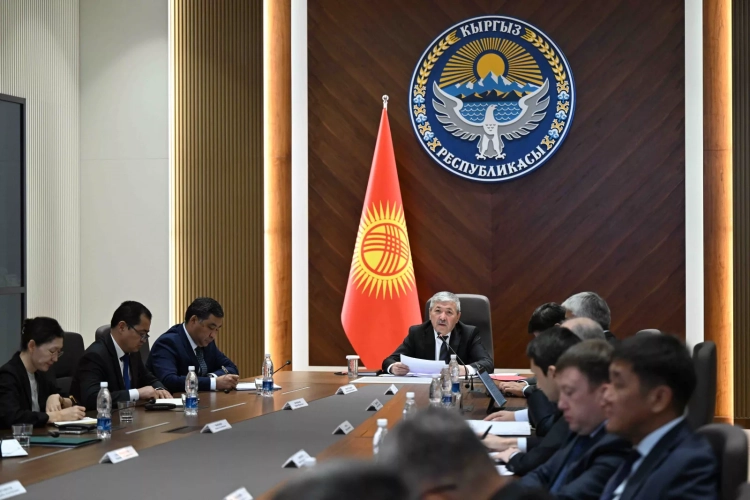
According to Cabinet Resolution No. 833, this measure is aimed at strengthening the role of science in the sustainable development of the country.
Under the new resolution, ministries and other state bodies, including the offices of the presidential representatives in the regions, as well as bodies with special statuses, except for the National Bank and the Social Fund (by agreement), are instructed to:
1) allocate annually 1% of the annual budget and special funds of the central offices for conducting scientific research, experimental design, project survey, and other scientific and technical works;
2) take all necessary measures to implement this resolution.
The resolution will come into effect 7 days after its official publication.
Appendices
REGULATION
on the procedure for forming proposals for conducting scientific research in state bodies of the Kyrgyz Republic
According to the Law of the Kyrgyz Republic "On State Procurement," where scientific research is considered as services.
4. Scientific research is conducted to scientifically substantiate decisions made by state bodies.
5. This regulation does not apply to scientific research related to the protection of state secrets and does not cover scientific research regulated by the Law "On Science."
According to the Law "On State Procurement."
10. The collection of proposals is carried out on current issues within the framework of the activities of the state body.
Each proposal must be accompanied by the following documents:
1) initial materials for preparing procurement documents according to Article 12 of the Law "On State Procurement";
2) a concept for the scientific research.
11. The concept must contain:
1) goals, objectives, relevance, and feasibility of the work;
2) analysis of global trends and assessment of novelty;
3) assessment of the resources needed to carry out the scientific research;
4) expectations from the scientific research and forecast of results;
5) a calendar plan for the execution of the scientific research;
6) proposals for the organization and financing of the scientific research.
12. The Scientific and Technical Council evaluates the proposals and sends decisions to the head of the state body within 3 weeks.
13. The decision of the Scientific and Technical Council must include:
1) feasibility of financing the scientific research;
2) originality of the scientific research;
3) compliance with national programs.
14. The head of the state body makes the decision on conducting state procurement on the selected topics of the scientific research.
15. Procedures are conducted on approved topics according to the Law "On State Procurement."
16. The executor of the scientific research can be either a legal entity or an individual determined in the procurement process.
17. Executors can be any organizations, regardless of ownership form.
18. The executor must have the necessary equipment and qualified personnel to carry out the scientific research.
19. Executors may attract specialists, including foreign ones, in accordance with the labor legislation of the Kyrgyz Republic.
20. The state body may provide the executor with the necessary equipment.
21. The executor has the right to purchase equipment and materials for carrying out the scientific research.
22. The executor is obliged to provide interim reports every 6 months and a final report upon completion of the scientific research.
Reports are prepared in accordance with the interstate standard GOST 7.32-2017.
23. The evaluation of the results of the scientific research is carried out by the Scientific and Technical Council based on the criteria outlined in Chapter 4 of this Regulation.
According to the Law "On State Procurement," the norms of the above-mentioned Law apply.
| Points | Compliance of the report's content with the stated topic and directions of socio-economic issues | Compliance of the report with the current level of development of fundamental, applied science, and technology | Difference from similar works in the world/country | Assessment of the report's compliance with the set tasks | Other criteria (as proposed by the Scientific and Technical Council) |
| 0 | Does not correspond to the stated topic | Not related to the current level | Complete lack of novelty | Tasks are not reflected | The report completely does not meet the criterion |
| 1-2 | Formal, extremely weak connection | Severely outdated data | The work repeats known results | The report hardly reveals the tasks | Compliance is extremely low |
| 3-4 | Partial, superficial reflection of the topic | Partial reliance on modern achievements | Minor differences, overall duplication | Task execution is fragmentary | Compliance is partial, limited |
| 5-6 | Generally corresponds to the topic, but there are deviations | Modern approaches are used with limitations | There are elements of novelty, but they are insignificant | Tasks are not fully completed | Satisfactory level of compliance |
| 7-8 | Mainly corresponds to the topic and problems | Good compliance with the current level, some gaps | Clear differences and new elements | Tasks are completed, with some weak spots | High level of compliance |
| 9 | Almost complete compliance, minor remarks | Full compliance with the current level, minor shortcomings | Serious differences, originality at a good level | All tasks are completed, minor remarks | Almost complete compliance with the criterion |
| 10 | Complete compliance with the topic. Full coverage of socio-economic issues | Complete compliance with modern achievements in science and technology | High degree of novelty and originality | All tasks are fully completed | Complete compliance with the criterion |
| Appendix 2 | ||
| (to the resolution of the Cabinet of Ministers of the Kyrgyz Republic dated December 25, 2025, No. 833) |
STANDARD REGULATION
on the scientific and technical council of the state body of the Kyrgyz Republic
According to the Constitution and other laws of the Kyrgyz Republic.
Chapter 2. Tasks and functions of the Scientific and Technical Council
4. The main tasks of the Scientific and Technical Council are to support state policy in the field of science and coordinate scientific research.
5. The functions of the Scientific and Technical Council include:
- formation of scientific and technical policy and development of proposals on priorities;
- determination of priority directions for scientific research;
- control over the implementation of scientific research and assessment of their scientific value;
- informational and analytical support and interaction with other organizations.
6. Principles of the Scientific and Technical Council's work:
- transparency, collegiality, scientific justification, and openness.
Chapter 3. Rights and obligations of the Scientific and Technical Council
7. The Scientific and Technical Council has the right to:
- make proposals on issues within its competence;
- request information from state institutions;
- attract experts and specialists for consultations;
- hold meetings with representatives of various organizations.
Chapter 4. Formation of the Scientific and Technical Council
8. The composition of the Scientific and Technical Council is formed from scientists, experts, and representatives of state bodies and businesses.
9. Candidates must have a scientific degree and experience in the scientific field.
10. The composition of the Scientific and Technical Council includes a chairman, a deputy chairman, and members representing various fields of science.
Chapter 5. Organization of the Scientific and Technical Council's work
11. The Scientific and Technical Council holds meetings at least twice a year and as needed.
12. The chairman of the Scientific and Technical Council organizes meetings and controls the implementation of decisions.
13. The deputy chairman coordinates the activities of the members of the Scientific and Technical Council and prepares reports on their work.
14. The secretary of the Scientific and Technical Council is responsible for organizing the current activities of the council and keeping the minutes of meetings.
15. Members of the Scientific and Technical Council actively participate in discussions and make proposals.
16. Decisions of the Scientific and Technical Council are formalized in minutes and are advisory in nature.
Chapter 6. Final provisions
17. The Scientific and Technical Council is responsible for the justification of its decisions.
18. Minutes of meetings are kept in the state body according to the legislation.
19. Based on this regulation, provisions for the Scientific and Technical Council of each state body may be developed.
20. The activities of the Scientific and Technical Council may be terminated by the decision of the state body.