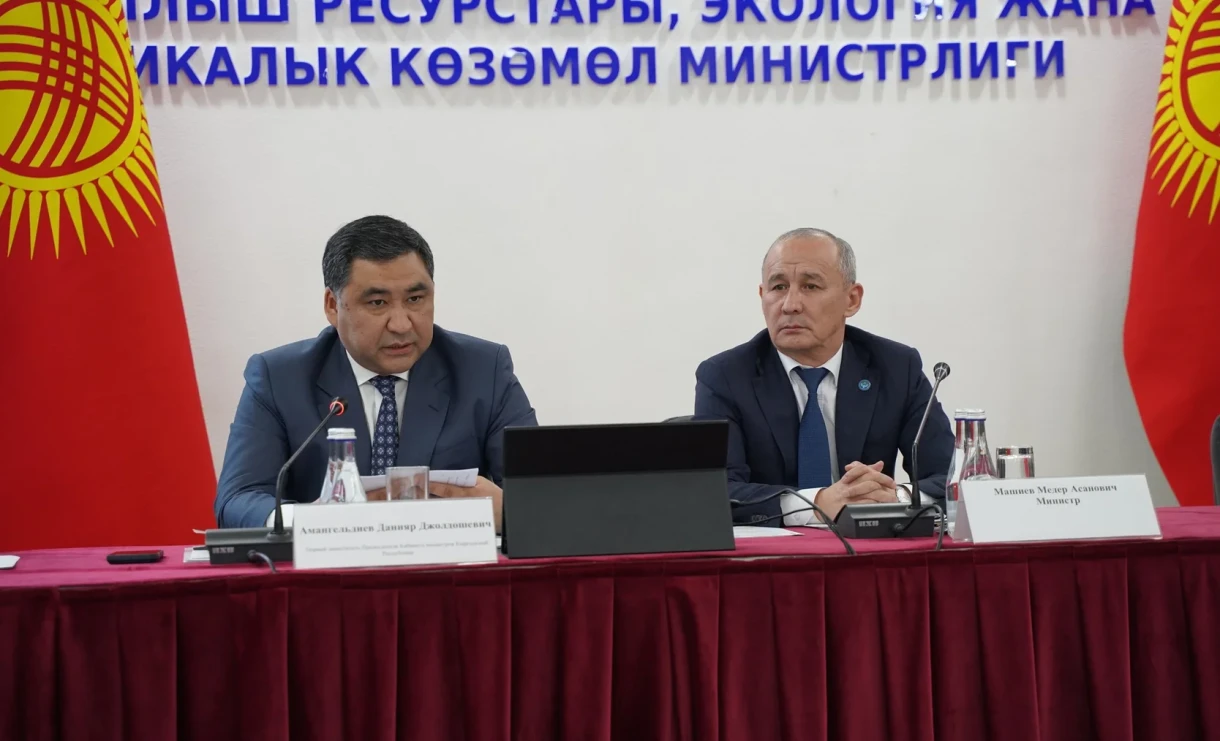
The Ministry of Natural Resources, Ecology, and Technical Supervision will be responsible for the implementation of the system. The Climate Finance Center under the Cabinet is also involved in the process.
The ministries of natural resources, finance, economy, and commerce, together with the Climate Finance Center, have been tasked with developing a procedure for accounting and distributing revenues from the sale of carbon units.
This document was adopted in accordance with Kyrgyzstan's commitments under the Paris Agreement and aims to create a carbon market and reduce greenhouse gas emissions. The resolution came into effect on March 6, 2026.
Regulations on the National System for Accounting Greenhouse Gases, Monitoring, Reporting, Verification, and Carbon Unit Trading of the Kyrgyz Republic
Chapter 1. General Provisions
1. These Regulations describe the legal, organizational, technical, and financial principles for the creation and functioning of the National System for Accounting Greenhouse Gases, Monitoring, Reporting, Verification, and Carbon Unit Trading of the Kyrgyz Republic (hereinafter referred to as the National System).
2. The National System is a state information and regulatory resource that serves as a basis for:
- fulfilling the international obligations of the Kyrgyz Republic under the Paris Agreement and the UN Framework Convention on Climate Change, ratified by the Law of the Kyrgyz Republic;
- monitoring the achievement of goals defined at the national level;
- functioning of carbon markets;
- attracting financing and implementing climate projects;
- preventing carbon leakage.
3. The main principles of the National System's operation are:
1) continuity - a constant process of data collection, processing, and verification;
2) consistency - coherence and comparability of data;
3) transparency - openness of methodology and results to the public;
4) accuracy - minimizing errors and working to reduce uncertainty;
5) completeness - phased expansion of coverage of all significant sources;
6) scientific validity - application of methods that meet international standards;
7) confidentiality - protection of personal data;
8) environmental integrity - each carbon unit represents a real reduction in emissions;
9) permanence - minimizing the risks of reversibility of reductions;
10) fair distribution of benefits - consideration of the interests of all parties;
11) no double counting - strict accounting of all operations;
12) respect for the rights of local communities - obtaining consent for projects.
4. The methodological basis of the system includes:
- IPCC principles;
- methodological guidelines of the UNFCCC;
- international ISO standards;
- national standards and guidelines developed by authorized bodies.
5. In the future, it is planned to approve ISO standards for the monitoring system as state standards.
Paris Agreement.
Article 6 of the Paris Agreement.
61. The decision on the authorization of international transfers is made by the Committee.
62. Cooperation with international organizations for the recognition of carbon units.
63. Mutual recognition procedures include certification and agreements with other countries.
Chapter 10. Quality Control, Verification, and Uncertainty Assessment
64. Quality control is carried out at three levels: internal, external, and international.
65. Uncertainty assessment is conducted for all categories of emissions.
66. Technical mechanisms to prevent double counting include unique identifiers.
67. Administrative measures include regular record reconciliations.
Chapter 11. Rights and Obligations of Participants
68. The rights and obligations of system participants include opening accounts and conducting operations.
69. Participants have the right to access information about projects and participate in consultations.
Chapter 12. Final Provisions
70. Individuals who violate the requirements are held accountable in accordance with the law.
71. Violations of the rules for working with the Registry entail the application of measures.
72. Monitoring of effectiveness is carried out based on key indicators.
73. An annual assessment of the effectiveness of the system's functioning is conducted.
74. Summary data is published in open access.
75. The trading of carbon units does not restrict the rights of the local population.
76. Participants must comply with legal requirements when implementing activities.
77. Authorities are required to consider property rights when developing climate projects.