According to the latest data from the World Wildlife Fund (WWF)-Mongolia, provided this past Sunday, the population of the endangered Mongolian argali in Western Mongolia has reached 3,600 individuals.
From 2023 until October of this year, a census of argali—wild sheep inhabiting the western regions of Mongolia along the border with Russia—was conducted. This process covers the aimags of Bayan-Ölgii, Khovd, and Uvs, as noted in a statement from WWF-Mongolia.
The agency noted that recent conservation measures aimed at reducing the impact of environmental factors and human activities, including compliance with legislation, habitat management, disease prevention, and public engagement, have contributed to the growth of the argali population in Mongolia.
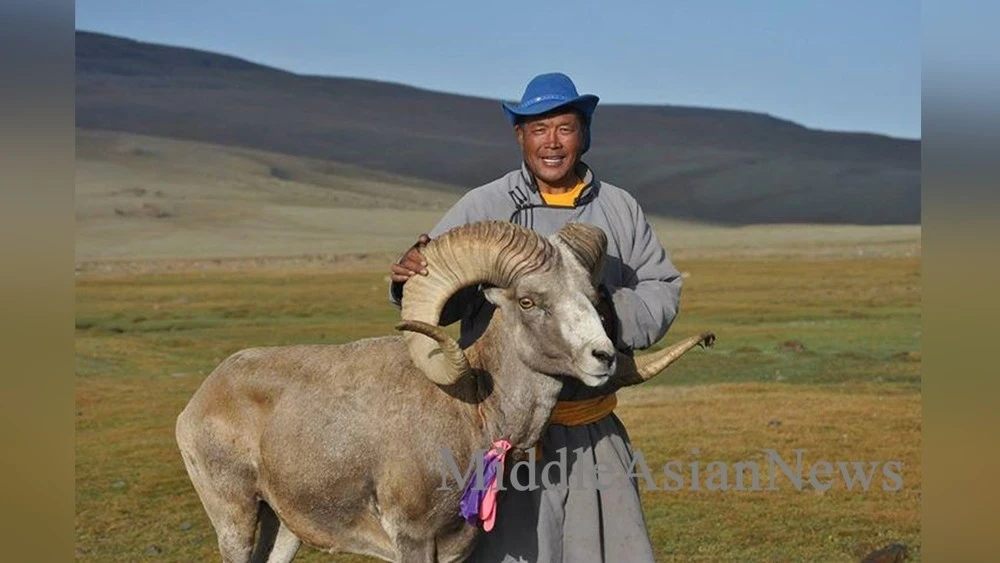
The argali is the largest wild sheep found in the highlands of Mongolia. It can reach a height of 120 cm, weigh up to 140 kg, and measure 1.8 m in length. Males have large rounded horns that can grow up to 190 cm, while females have smaller horns.
Argali and ugals, which are ancestors of modern sheep, are currently among the endangered species. Males are referred to as ugals, females as khom, and their offspring as khurga, similar to Mongolian sheep.
Interestingly, the Latin name of this species is associated with the name of the god Amun. According to a myth recounted by Ovid, the gods, fearing Typhon, took on the forms of various animals, among which Amun became a ram. In ancient culture, Amun was depicted as a man with ram's horns.
The horns of the ugal are majestic and large, and they have repeatedly won gold medals at international exhibitions for their length and thickness.
Argali are widely distributed in the mountain ranges of Tsambagarav, Baytag-Uul, the Mangan Ugalzt ridge in Khovd aimag, as well as in the areas of Kharkhiraa and Turgen in Uvs aimag, and in the mountains of Khar Azarga Gobi-Altai, Khantaishir, and Burkhan Budai, as well as in the foothills of Khangai and Khenkhi in Mongolia.
The appearance of the argali is similar to that of Mongolian sheep; however, to adapt to harsh natural conditions, they have long and thin legs, coarse and stiff wool, and a short and fluffy tail.
Argali form groups that can consist of up to 100 animals, but outside the breeding season, males and females tend to stay separate. Females reach sexual maturity at two years of age, while males reach it at five. The breeding period varies among populations but generally lasts from October to November. The mating rituals of argali include male competition for females, which is manifested in horn clashes. Pregnancy lasts 150–160 days, and usually, 1–2 lambs are born. Before giving birth, the female leaves the herd to find a secluded place where she spends the first days with the newborns. Care for the offspring lasts about 4 months, after which the lambs become independent, and males do not participate in raising them. The lifespan of an argali is 10–13 years.
Tatar S.Maidar
source: MiddleAsianNews