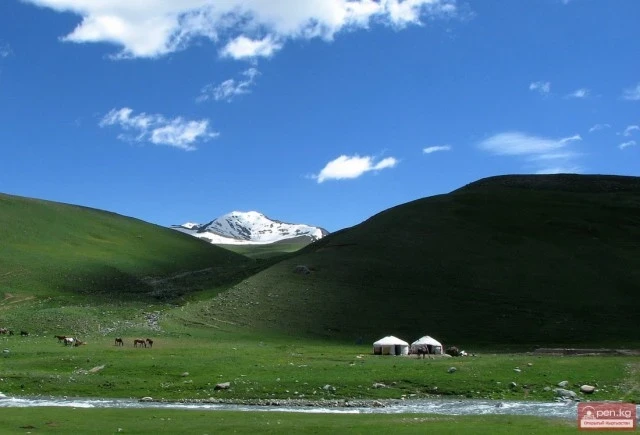
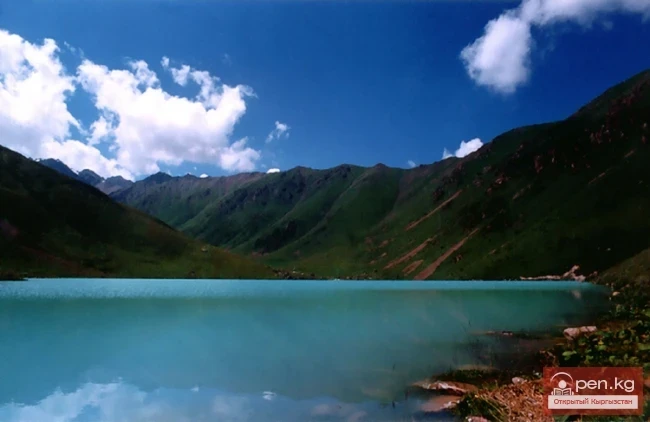
The village is located at an altitude of 2050 to 2400 meters above sea level, eight kilometers from the administrative center of the district, 128 kilometers away from the region, and 485 kilometers from the capital of Kyrgyzstan, Bishkek.
The total area of the village is 35,632 hectares, of which 1,289 hectares are occupied by water resources, and pasture lands account for 16,576 hectares. The main activities of the local residents are livestock breeding and agriculture. Currently, there are 322 families living in the village, totaling 1,451 people.
As noted in the district encyclopedia, during Soviet times, the village council of Terek included two settlements: Terek and Kelte-Chap.
“The name of the settlement Kelte-Chap is associated with the mountain ranges located to the north of Jama-Tuu and Orto-Tuu, situated in a small depression. During the period of collectivization, from 1924 to 1927, a union called 'Koshchu' was created. In 1930-1934, the villages of Terek and Kelte-Chap merged into one collective farm. In 1934, Kelte-Chap became part of the collective farm 'Kengesh', while Terek became part of the collective farm 'Kalinin'. Subsequently, after the merger with the villages of Dörbölzhün, Kara-Suu, Jany-Tilek, Ak-Chiy, and Ichke-Suu, they became part of the collective farm named after Danov. After the collapse of the Union, these settlements became independent,” the source states.
Public figure and veteran Toktonaly Degenbaev noted that later Kelte-Chap was annexed to the village of Terek.
“In Terek, there are representatives of 6-7 Kyrgyz clans: Yman, Chon Murun, Kochok Uulu, Koigeldi, Kypchak, and Tezhik. Additionally, there are 4-5 families of Kazakh descent. In comparison, the majority consists of Kyrgyz families of Sayak and Basyz. Basyz includes Kochok Uulu, Chon Murun, Koigeldi, and Joldosh Uulu, while Sayak is represented by Yman, Tezhik, and Kazak,” he shared.
Meanwhile, the place where the village of Terek is located was once an empty field. Representatives of the Kochok Uulu clan settled along the Baktygul canal, while the Chon Murun clan occupied the territory of Kelte-Chap, and the Koigeldi clan settled in the Chodura-Koo area. The Yman clan settled in Kara-Suu. When Kasyimbek bolush (Kasyimbek Baatay Uulu) was distributing territories, my great-grandfather Kojo expressed his unwillingness to join him. He was one of the first to build a house near the reservoir and moved there, followed by his relatives. In 1893, the volost, which was under the administration of Kasyimbek bolush, split into two parts. My ancestor Kojo passed away in 1898. Initially, the village was supposed to be named Kelte-Chap, but my grandfather Duysho and Maamet Abyshbaev, holding high positions, built the first school in Terek, wishing for the 'Sayaks to lead'. As a result, the village of Kelte-Chap disbanded as a separate settlement, and the residents united in Terek,” he recounted.
Additionally, T. Degenbaev shared a local legend about the origin of the name of the village Terek:
“Long ago, among the Kyrgyz living in the Terek area, there was a boy from the Kalmak clan named Eshberdi, who was assigned as a shepherd. When he sang in Kalmak, it would start to rain. The Kyrgyz residents understood that he was not an ordinary boy and decided to take him in. After 2-3 years, an old woman with long gray hair that dragged on the ground came and demanded the return of her son. The boy was not given back: he was either hidden or killed. In response, the woman promised to exterminate their clan. After her departure, a snowstorm began, which lasted both day and night, with the snow cover reaching the height of a camel's tail, and people could not leave their yurts. The locals began to suspect that it was the work of the old woman. Young men saddled the best horses and went in search of her, finding her by the Naryn River. They asked her if she intended to exterminate an entire people. She admitted that she had used strong sorcery. The elders decided that the old woman should be burned, but first, her mouth had to be tightly closed so that her curse would not work. As a result, she was tied to a tree by the Naryn River, her mouth was stuffed, and she was burned. The smoke rose to the clouds, and the sky cleared. When the sun appeared, the snow melted, floods began, and a river formed from Ugut to Kara-Talaa. The water uprooted all the trees except one. The place where this tree grew is now called Zhalgyz-Terek (zhalgyz - alone, terek - tree). Initially, the village was called Terek-Say (terek - tree, say - river), and later it became simply Terek,” he narrated.