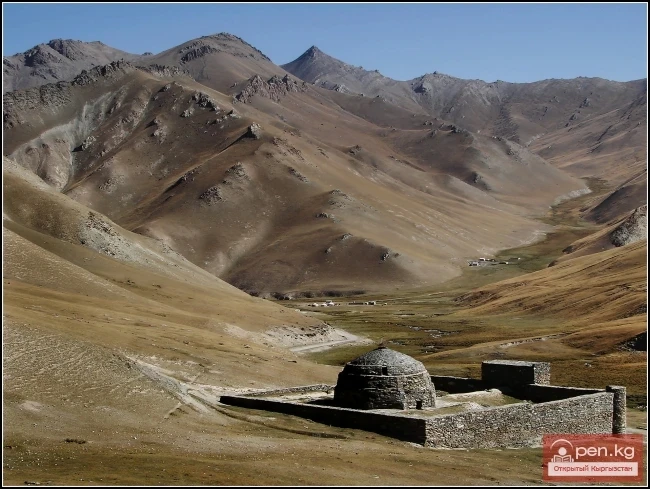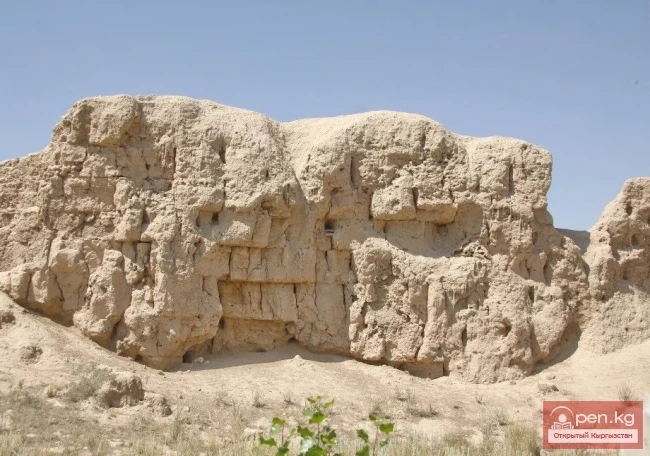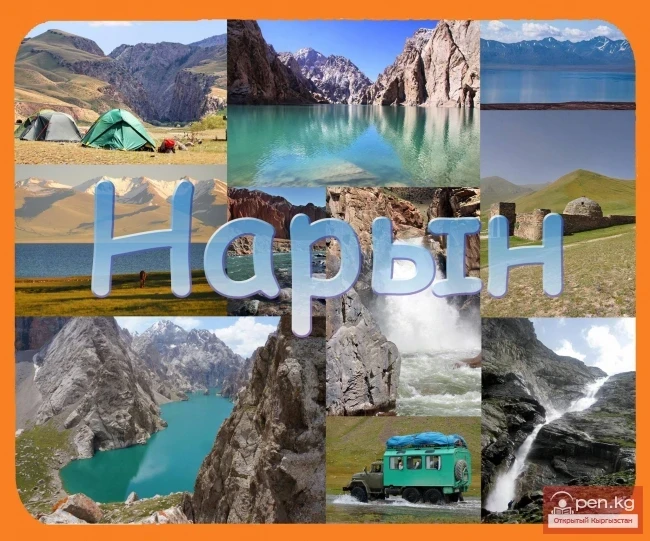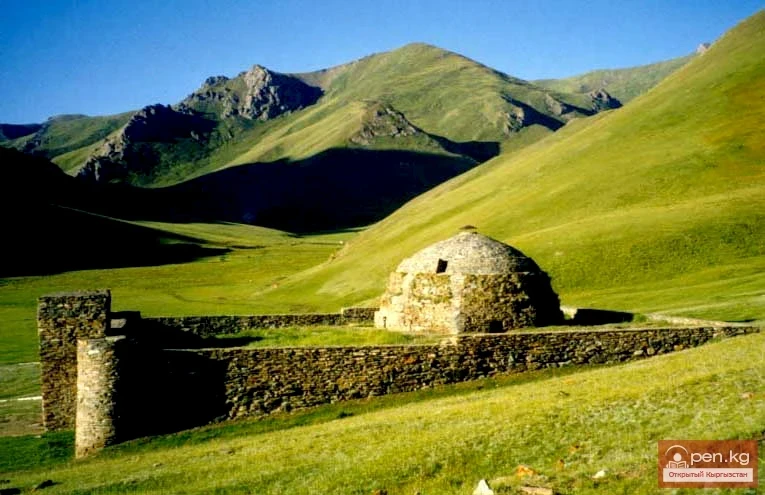
This tourist area includes two ancient monuments — the caravanserai Tash-Rabat and the settlement of Koshoy-Korgon. They are located on the banks of the Kara-Koyun River, sixty-eight kilometers apart: the caravanserai is situated in the middle reaches of the river, while the settlement is in the lower reaches.
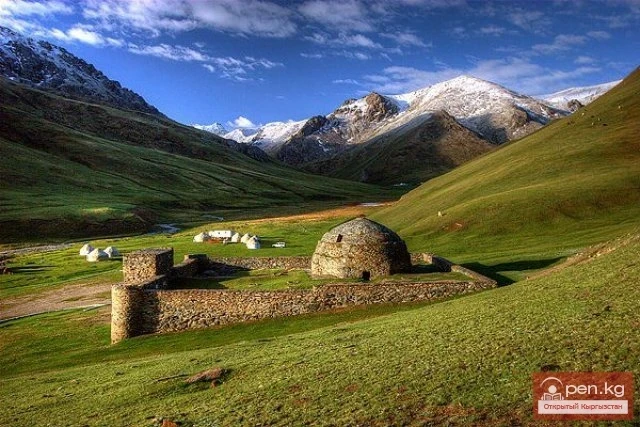
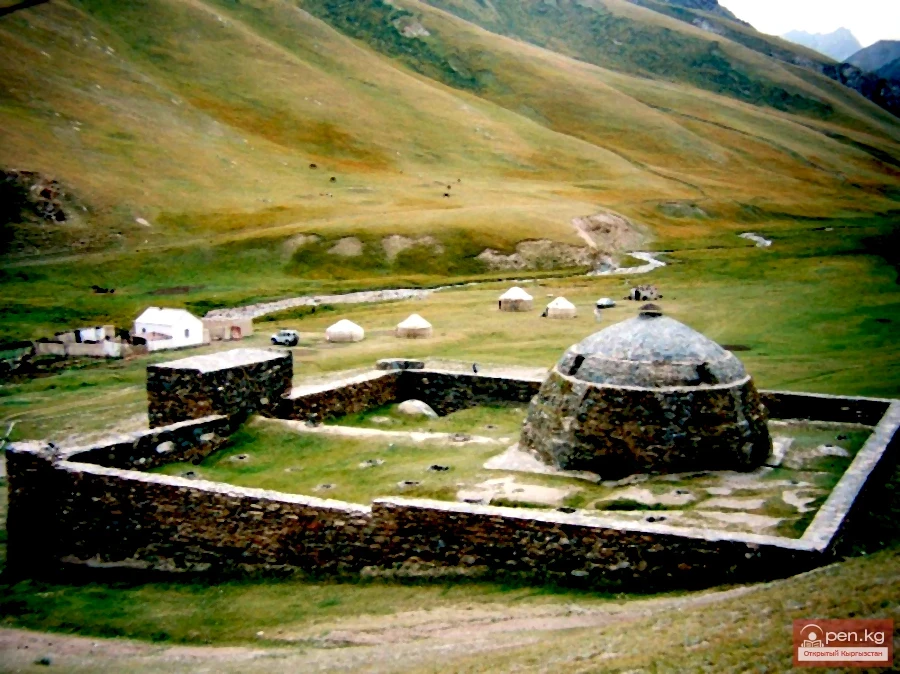
The caravanserai Tash-Rabat, an inn for merchants and travelers, was built in the 15th century on the ancient trade route from Central Asia to China. It is the largest structure of Central Asian architecture from that time, constructed from stone, but it stands out not only for its size but also for its unique layout based on impeccable symmetry. Hidden among pristine nature in the mountains at an altitude of over three thousand meters above sea level, the caravanserai appears stern, monumental, and impregnable. The massive stone walls with two towers and a powerful entrance portal provided reliable protection for its guests.
The caravanserai Tash-Rabat is located sixty kilometers from the modern district center — the village of At-Bashi. This monument has survived to us in a semi-ruined state. However, in recent years, conservation efforts have been undertaken, and restoration work has partially returned the caravanserai to its former appearance.
Twenty kilometers west of the village of At-Bashi lies the settlement of Koshoy-Korgon. These are the remains of a fortress that existed along the caravan route in the 8th to 10th centuries. It was the residence of Turkic khans. The rectangular-shaped settlement, measuring 250-260 meters on each side, is surrounded by walls with towers, buttresses, and entrance pylons. Behind the crumbling walls and towers, one can discern the strict and once impregnable stronghold.
What awaits us in the future? The most feasible development appears to be in mountain sports tourism, auto tourism, mountaineering, and water tourism. This variety will be complemented by educational tourism, primarily developed in connection with the exploration and arrangement of the Great Silk Road within the framework of international tourism under the auspices of UNESCO.
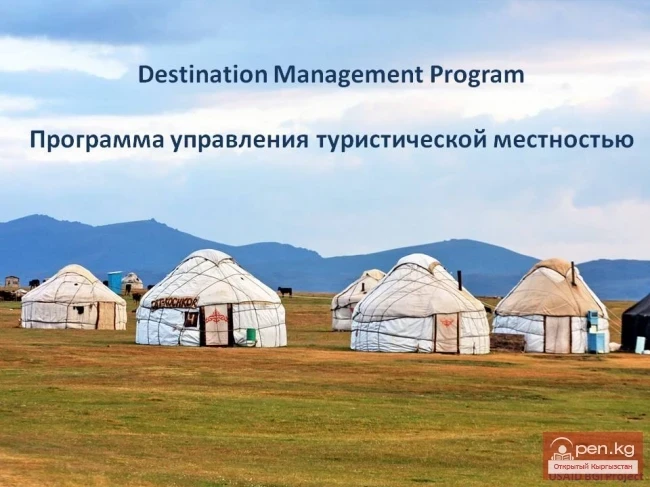
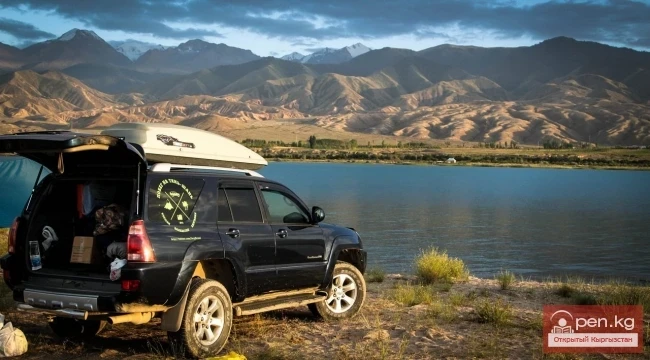
The role of a tourist center will be fulfilled by a tourist hotel in Naryn — especially since the route of the Great Silk Road passes through the city. In addition to accommodating foreign tourists, this hotel will also welcome a flow of domestic travelers: auto tourists, mountaineers, water tourists, and others. The significance of this hotel in the development of auto tourism is particularly noteworthy: here, highways converge leading to the Issyk-Kul basin, the Chui valley, southern Kyrgyzstan, high mountain pastures, the Ak-Sai valley, and Lake Chatyr-Köl. In various corners of the Inner Tien Shan, tourists will be able to see the "huge tracks" of the hooves of Tulpar — the horse of the hero Manas (according to another version — the "frozen" tracks of a dinosaur). They can reach the "land of Sannikov" in the Suusamyr valley, touch the "eternal" glaciers of the highlands, visit the rock paintings of the 2nd millennium BC at Saymaly-Tash near Kazarman, experience the amazing, celebrated by many poets, jailoos — summer pastures, and — if lucky — spend at least an hour in a shepherd's yurt with the invariably hospitable hosts. The law of hospitality is the highest law in the mountains of the Tien Shan. This custom, in the context of urbanization, is increasingly "forgotten," and its original meaning is lost. But what could be more pleasant than being greeted from the road like a close relative, as the hostess ceremonially breaks off a piece of homemade flatbread and pours tea into the very bottom of the bowl! And if the generous host picks up a komuz — you can expect a celestial miracle. You will never hear such a piercingly poignant and tender melody in a city, in a stone building, nor such a rich palette of the subtlest musical shades, in each of which, it seems, lies the mystery of the universe.
The region is equally promising for the development of water tourism. The most water-rich river in the region is the Naryn, which, as they say, translates from Mongolian for some reason as "sunny." There is probably a reason for this: the Naryn originates from the glaciers of the Ak-Shiyrak mountain range. Of course, it is the result of the sun's action. But there is another translation, now from Kyrgyz: "broth." This certainly reflects the character of the river, which truly boils for 600 kilometers. Along its course, the Naryn absorbs over 600 large and small rivers, with its most water-rich tributary being the Kökömeren, named for the abundantly growing thyme here, better known as wild thyme. Both the Naryn and its tributaries can be used for rafting on rafts and kayaks.
Another promising point is the auto camping "Kazarman." Located on the highway connecting Southern Kyrgyzstan and the Inner Tien Shan, the camping can accommodate not only domestic tourists but also foreigners. The road coincides with the Silk Road route. Along this road, there are historical and cultural monuments: the fortresses of Caravan-Sarai, Chaldybar, Shyrdakbek, and others. The service area of the auto camping includes the tourist zones of "Ak-Talaa" and "Toguz-Toroo."
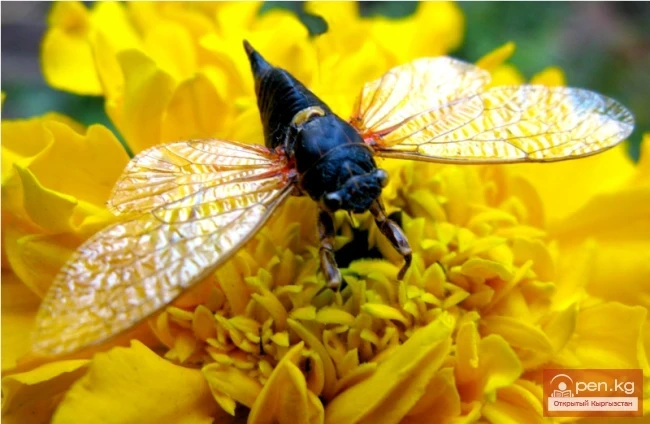
The wildlife of the Naryn region is diverse. In the steppe areas of the valleys and basins, there are ground squirrels, foxes, hares, and ferrets. In the floodplain steppe forests, one can find wild boar, roe deer, marten, and lynx. The largest rodent in Central Asia — the porcupine — can also be encountered, and a nighttime encounter with it can be quite frightening. In moments of danger, the porcupine bristles its quills, increasing in size by 1.5 to 2 times.
On the high slopes of the mountains, herds of wild goats and argalis graze, and snow leopards can be found. In the alpine zone, brown bears inhabit the coniferous forests. Rarely seen now are the beautiful marals, who have fallen victim to their antlers. Wolves are widespread. There are many different species of birds: pheasants, gray partridges, and chukars. In the lakes, especially Son-Kul, there are many ducks, and Indian geese arrive. High in the mountains, powerful vultures nest, tirelessly performing their sanitary service. On the rocky slopes near the eternal snows, the snowcocks nest, which are mistakenly considered mountain turkeys; their meat is not only extraordinarily tasty but also, according to popular belief, medicinal. The snowcock lives in such inaccessible places that, according to the people's beliefs, it can only serve as food for Allah. It is no wonder that the fairy tale motif is widespread: it walked on such high cliffs where even the snowcock did not fly. Legends tell either of truth or fiction. You decide for yourself. A pilgrim in Mecca was always asked whether he had ascended the great high mountain Ala-Too, whether he had eaten the meat of the snowcock. If the unfortunate traveler answered affirmatively, the Arabs would kill him, and from the remains of the poor fellow, they would prepare a healing potion to distribute to the needy.
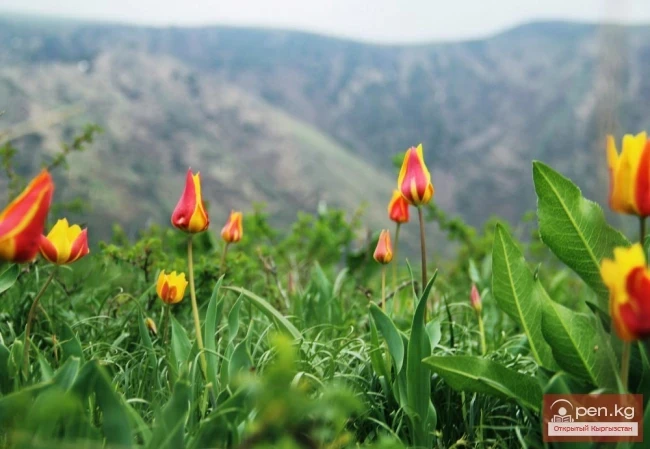
In the Naryn region, as in other areas, the character of the vegetation changes depending on the altitude. There are many summer pastures and alpine meadows. Wormwood grows, sometimes feather grass. There are many ephemeral plants, named so for their relatively short growing season. The northern slopes are covered with shrubs and park-type pine forests. It seems that it is about such places that Jean-Jacques Rousseau wrote, that "the land, animated by nature and dressed in bridal garments, among water sources and the singing of birds, presents to man in a harmonious combination of all three kingdoms a spectacle, full of life, interest, and charm — the only one in the world that never tires either the eye or the heart..."