Islam (from Arabic letters - "submission," "surrendering oneself to the will of God") emerged in the 7th century AD in Hijaz in Western Arabia as a new religion in opposition to the polytheism of the Arabs of that time. The founder of Islam was Muhammad - the leader of one of the tribal communities (ummah), who first presented the ideas of Islam in Mecca in 610 (died in 632) as a reaction to the acute crisis of Arab society caused by the disintegration of tribal relations and the beginning of the formation of an early class society. The activities of Muhammad and his companions, the religious-political movement under the banner of Islam, led to the creation of a theocratic system of governance in the Muslim community, which was simultaneously a political organization and a religious corporation based on a unified faith in God (Allah), rather than blood ties. The source of authority for Muhammad, as the head of the ummah, preacher, legislator, and supreme commander, is considered to be God (Allah).
The ancient god of the tribe of Quraysh was Allah (from Arabic Ilah - "deity"), who is declared by Islam to be the only true God. Allah endowed His messenger (rasul) with absolute religious prerogative, which united the secular and spiritual spheres in a theological framework under the dominance of the religious factor and identified morality and law.
The messenger of Allah was the prophet Muhammad. A comprehensive total system emerged, claiming to satisfy all spiritual needs and demanding from a person unconditional devotion and submission in all areas of his life (ethics, rituals, mythology, traditions, etc.). Many of its features are similar to Christianity, Zoroastrianism, and other Middle Eastern religious, philosophical, and political movements. They were borrowed, transformed in the spirit of Islam itself, and became elements of religious, political, cultural, legal, and other structures. A religious faith in Allah was formed. Islam became an independent religion, gained stability, attractiveness, and spread widely. The main principles of Islam were transmitted to Muhammad, as stated in the Quran, through the angel Gabriel.
With the creation of a powerful centralized state - the Arab Caliphate - with a population professing various religions, adhering to different traditions, customs, and having diverse cultures, the universalization of Islam occurred on the basis of the Arabic language (the language of worship, law, science), the cult of the Messiah, education, aesthetic, ethical, legal, and political ideals. Professional jurists - theologians (faqihs), including Muslim scholars of theology and jurisprudence: Abu Hanifa, Malik ibn Anas, Muhammad ibn Idris ash-Shafi'i, Ahmad ibn Hanbal, played a significant role in this. As a result, the integrity of Islam emerged. Later, legal schools based on four main interpretations (madhhabs) named after these jurists - Hanafis, Malikis, Shafi'is, and Hanbalis - appeared.
In the 9th-10th centuries, Islam transformed into a complex system with philosophical-theological (kalam) and legal (sharia) foundations, the principles of which are reflected in the holy book of Muslims - the Quran (Qur'an, Al-Qur'an - from Arabic, "reading").
Islam originates from the individual: the subject of worship is the individual. Prayer, pilgrimage, supplication in the mosque are individual, but dependent on the religious-political community. Islam posits that everything is predetermined, given by God; but at the same time, this teaching recognizes free human will alongside predestination. In the 8th-9th centuries, political movements such as Murjites, Jabrites, Qadarites, and Mu'tazilites formed. The reason for the struggle among them was the different understanding of the principles of Islam, and as a result of their compromise, an orientation towards fatalism combined with indeterminism (the assumption of some derivative actions with moral responsibility for them) emerged. Figuratively speaking, everything depends on God, but "every man is the architect of his own fortune." The vitality of Islam is ensured by its myths, ritual prescriptions, universalism, and perception of other cultural values.
Structurally, Islam consists of two parts: iman - faith (faith in the truth of Islam) and zin (religious practice - a set of religious rituals, morals, traditions, etc.), the details of which are defined by the Quran and other sources. The essence of iman is monotheism, faith in the prophetic mission of Muhammad and the prophets who preceded him, in angels, in revelation, in the Day of Judgment. The symbol (shahada) of the Muslim faith is expressed in the words of a Muslim: "There is no deity but the one God (Allah) and Muhammad is His messenger." This is the foundation of Muslim self-awareness, religious faith (itiqad). In Islam, God is omnipotent; unique; eternal; the creator who gives life and death, jealous and punishing, but just and merciful. All this allows a good Muslim (who sincerely believes in the truth of the shahada and performs religious rituals) and a wicked person from among Muslims (fasiq) to hope for heavenly bliss, while non-Muslims are destined for eternal torments in hell.
Islam is based on the dogma of Muhammad as the seal of the prophets - the last of the prophetic messengers (rasul) and simple prophets (kabi), who completed the preaching begun by the prophetic messengers. Among the highest of the rasul, Islam recognizes Muhammad, Adam, Noah, Abraham, and Jesus Christ. From pre-Islamic Arab religious beliefs, Islam retained the belief in jinn and jinnis, dividing them into the faithful (Muslims) and the unfaithful (non-Muslims).
The religion is based on the five pillars of faith: the confession of faith by pronouncing the shahada aloud; the daily five-time prayer (from Arabic - salat; from Persian - namaz) with prayer, ablution, prayer postures, and gestures; fasting (sawm) during the month of Ramadan and voluntary fasts at any time of the year; obligatory charity (tax - from Arabic, zakat) alongside voluntary almsgiving (sadaqa); pilgrimage to the city of Mecca.
Islam has an extensive ritual complex that supports faith in the omnipotent God and Muslim solidarity through customs and traditions, serving as a means of social control. Special significance is attached to the Friday prayer in the mosque, confirming belonging to the community of the faithful. The most important holidays of Islam are the holiday of breaking the fast after Ramadan (Id al-Fitr, Türekek, Uraza-Bayram); the holiday of sacrifice (Id al-Adha, Qurban-Bayram); Miraj (related to the myth of Muhammad's ascension to heaven), Mawlid (the birthday of Muhammad), and others. A religious duty of a faithful Muslim is recognized as jihad (ghazawat), i.e., a war for faith, a holy war.
The significance of local religious and cultural traditions gradually increased in contrast to the unified religious-political system due to the continuously growing contradictions between them. Autonomist and separatist tendencies grew, and sects (Kharijites, etc.) emerged. Alongside orthodox Islam (Sunni), in the 7th century, a branch of the Muslim religion known as Shiism took shape. From it, in the 8th-9th centuries, Zaidis, Ismailis, Imamis, and others emerged. In the 8th century, a mystical trend - Sufism - began to develop in Islam, which, in contrast to orthodox Sunni Islam, emphasized the value of the individual and supported humanistic thought. The ideological foundation of both Sunni and Shiite Islam consisted of the sayings of Muhammad and the four righteous caliphs: Abu Bakr, Omar, Uthman, and Ali. Shiites recognized only the caliph Ali (Muhammad's son-in-law), rejecting all Sunni caliphs as usurpers and opposing them to the dynasty of Ali and his direct successors.
The main distinction between Shiites and Sunnis lies in their understanding of supreme authority: Sunnis reject the view that the main institution in Islam is ijma (consensus of the entire community, unity of opinions of competent and authoritative theologians-jurists on specific religious, legal, and everyday issues not provided for by the Quran and Sunnah - the Holy Scripture), while Shiites grant the right to interpret, apply, and develop the Quran only to the imam and in his name - mujtahids. The founders of the four Sunni schools (madhhabs) in the 8th-9th centuries were recognized as indisputable authorities - the last who could interpret Ijtihad, the Quran, and Sunnah, and in fact, all theological-legal problems (the identity of religious, cultural, and political institutions), which hindered the development of social relations and contributed to the decline of the traditional power of Islam and the secularizing tendency in the separation of social ideology and religion.
In the 18th-19th centuries, with the development of social relations, the intensification of social, religious, national, and other contradictions, and the influence of European culture, attempts were made to transform Islam or to return it to the ideal form it had in the early stages of its evolution, or to bring it in line with the main trends of the new capitalist era. Modernizers of the 19th-20th centuries, such as Abdu Rashid Rida, Iqbal, and others, aimed to revive Islam in the spirit of contemporary scientific and technological progress. They advocated for the expansion of the interpretation of the Quran and Sunnah, simplification of rituals, softening of ritual prescriptions and norms; improvement of women's status, elimination of polygamy, introduction of Europeanized legal systems, and more. This was an attempt to adapt Islam to new conditions, which, however, did not achieve success: Islam continued to play its role.
In the last quarter of the 19th century, pan-Islamism emerged - a religious-political ideology based on the idea that Islam provides a supranational and supraclass community of its adherents and that the political unification of Muslims under the leadership of a caliph is more important than all other state and political unions. At that time, its main goal was to preserve the independence of the feudal state and to resist colonizers. The first ideologist of pan-Islamism was Jamal al-Din al-Afghani. In the early 20th century, pan-Islamism lost its anti-colonial orientation and was used, for example, by Sultan Abdul Hamid II and later by the Young Turks for aggressive policies. The last anti-colonial content of pan-Islamism was the movement of Khalifists in India. In Russia, among some Muslim peoples, pan-Islamism manifested itself as Jadidism. In Central Asia in 1918-1919, it was the slogan of the Basmachi movement.
Currently, Islam is strengthening its positions. A number of countries have established theocratic and clerical forms of governance (Iran, the United Arab Emirates, Pakistan, Afghanistan), orthodox Islam and Shiism are being revived (in Iran), and various sects and directions are emerging.
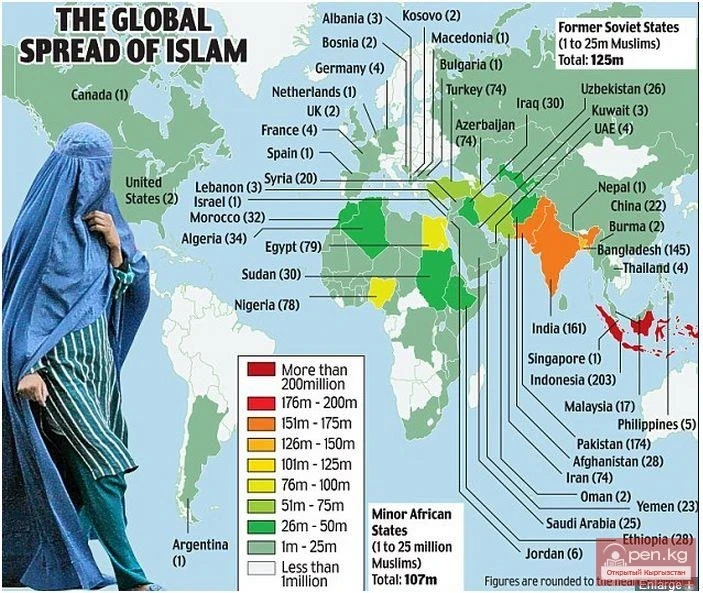
In the context of the progressive development of human society and democracy, Islam cannot remain in a stagnant state, as a dogma. This is particularly dictated by the fact that Islam has gained very wide dissemination: about a billion people profess the Muslim faith (Iran, Pakistan, Egypt, Indonesia, Sudan, Afghanistan, Saudi Arabia, Iraq, etc.), including the population of liberated countries with varying levels of development of social relations. Individual Islamic states adopt global standards of culture, traditions, rituals, etc. (the Republic of Turkey, the Republic of Egypt, etc.). Islam has also developed in the CIS countries and other states of the former USSR based on the principles of freedom of conscience and religion in accordance with UN declarations. These features are also characteristic of the legal system of Islam - Sharia, which arose simultaneously with Islam and coexists with it, as clearly seen in the example of the sources of Sharia.