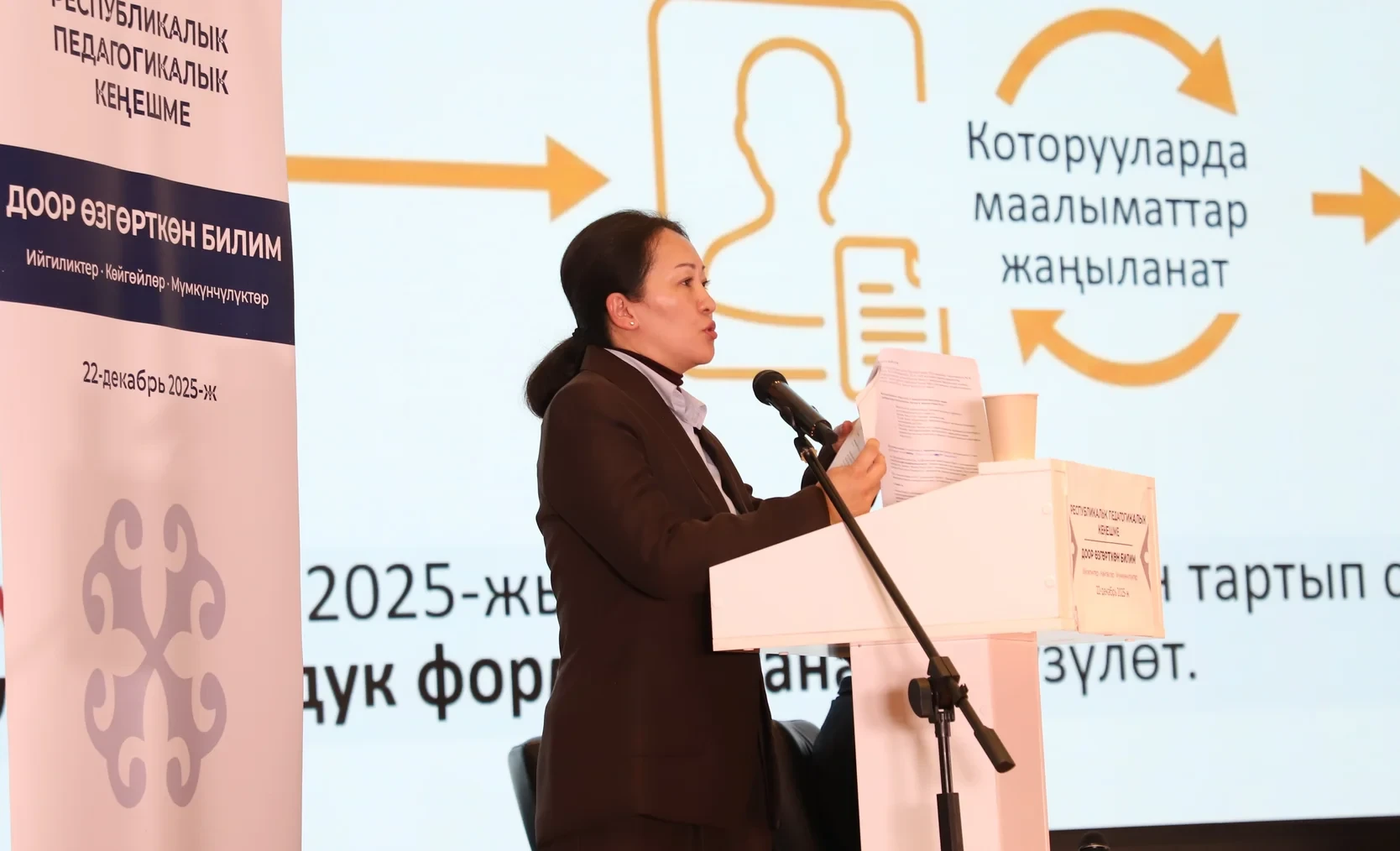
As part of the republican pedagogical forum "Altyn Kazyq: Key Achievements and Future Plans," Lira Samykbaeva, Deputy Minister of Education of the Kyrgyz Republic for Digital Development, presented information on key results and future directions of digital transformation in the field of education.
Speaking to the audience, she emphasized that the digitalization of education in the country is being carried out in accordance with the Concept of Digital Transformation for 2024–2028 and is primarily aimed at facilitating the work of educators, improving the quality of the educational process, and making management decisions based on relevant and accurate data.
According to her, the implementation of digital technologies is not an end in itself but serves to achieve specific changes in the educational environment, allowing teachers more time to work with students and providing students with the opportunity to receive a clearer and more personalized educational pathway.
The Ministry of Education noted that one of the significant successes has been the creation of a unified digital education ecosystem consisting of three key registries: students, educators, and educational institutions. These registries allow information to be collected in one place, ensuring its availability for government bodies and transparency in educational processes.
As of today, a unified digital registry of students has already been formed in the automated information system "Kündölük," which covers general and initial vocational education. As for the preschool education registry, it is currently absent; however, the ministry is working on creating a system for collecting portfolios from kindergartens.
"Information about the child will be collected from an early age and will accompany them at all stages of education. Starting from September 1, 2025, personal files of students will be maintained exclusively in electronic format, which will completely eliminate the need for paper documents and simplify the process of transferring between schools and levels of education," Lira Samykbaeva noted.
The electronic portfolio of a student will include data on grades, attendance, participation in Olympiads and competitions, as well as socio-demographic and medical information, allowing for a comprehensive approach to learning. All information will be stored systematically, including archival data from previously existing paper files.
Thanks to the implementation of automation, about 70 percent of statistical data in the field of education is generated based on digital technologies, and a large portion of reporting forms that were previously filled out manually have already been converted to electronic format. This has significantly reduced the volume of paper reporting and decreased the administrative burden on teachers and school directors," the ministry added.
In her speech, the deputy minister also highlighted the automated system "Mughalim," which has become the national registry of teaching staff. This system contains complete information about the qualifications, experience, certification results, and professional development of educators. It also serves as a single platform for access to other educational services and ensures transparent selection of candidates for the personnel reserve for educational institution leaders.
Additionally, a unified digital registry of educational organizations has been implemented in the management of school infrastructure, allowing for online tracking of school occupancy, the number of shifts, and exceeding project capacity. This data is already being used as a primary tool for planning the construction of new educational institutions and developing educational infrastructure.
A digital library of educational and methodological materials called "Sanarip Kampa" has also been created in the country, which collects interactive resources on key natural science subjects for students in grades 5–11 and their teachers. Currently, the library is being integrated with the electronic journal and will become part of a unified digital educational environment.
In conclusion of her speech, Lira Samykbaeva emphasized that digital transformation brings comprehensive benefits for all participants in the educational process. It provides students with a convenient and transparent educational pathway without unnecessary bureaucratic obstacles, reduces the burden on teachers, opens up new professional opportunities, and provides accurate data for management systems, facilitating effective planning. Overall, digitalization is seen as an important element in enhancing the quality, openness, and sustainability of education within the framework of the "Altyn Kazyq" program.