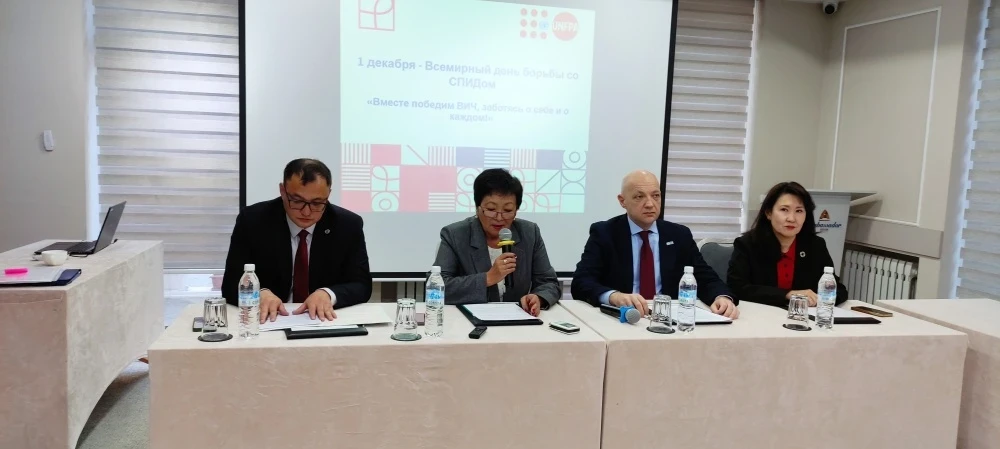
During the press conference dedicated to World AIDS Day, experts discussed current issues related to HIV infection in Kyrgyzstan. The event was attended by Anara Mambetisaeva, chief specialist of the Public Health Management Department of the Ministry of Health, Liviu Vedrasco, head of the WHO country office in Kyrgyzstan, Meerim Sarybaeva, UNAIDS coordinator, Baktybek Kainazarov, head of UNFPA, and Umutkan Chokmorova, director of the Republican Center for the Control of Hematogenic Viral Hepatitis and HIV. They shared information about the most vulnerable population groups, the effectiveness of diagnostics, and new approaches to HIV treatment in the country.
Despite efforts, the number of new HIV cases continues to rise. According to official information, 978 new cases were registered in the first ten months of this year. Since the beginning of the epidemic in 1996 until November 1, 2025, there have been 15,183 registered cases of HIV in the country, of which 14,285 are citizens of Kyrgyzstan. However, the actual number is likely much higher, as many people are unaware of their status and remain sources of infection.
More than 60% of all identified HIV cases are among people aged 20-39, who contracted the virus through unprotected sexual contact. Behind these numbers are human destinies: those living with HIV experience fear and stigma, often leading to job loss, family breakdown, and lack of support.
Unfortunately, HIV prevention in the country has not been adequately developed, and young people have not had access to necessary information about safe sexual behavior. This oversight was a result of the influence of certain activists who protested against educational materials related to HIV prevention, including a book by Boris Shapiro, the founder of the Republican Center "AIDS." This manual contained sections on sexual health and was removed from schools, which, as practice has shown, was a significant mistake.
At the press conference, it was noted that the primary mode of HIV transmission is sexual, especially among youth. At the time when activists were opposing the dissemination of information, many of these young people were school students deprived of access to important information.
It has become clear that HIV prevention continues to lag behind the pace of the disease's spread. Public health funding has been based on a residual principle. However, according to the Ministry of Health, the public health budget will double in 2026, which may change the situation. Nevertheless, every individual must recognize their responsibility for their health and lead a healthy lifestyle, as there are currently no vaccines against HIV.
Stigma and discrimination against people with HIV remain relevant, as noted by Umutkan Chokmorova. In the early years of the HIV epidemic, it was perceived as a death sentence, creating fear among both the infected and healthcare workers. Although the disease is considered the "plague of the 21st century," many do not understand that modern medicine offers effective treatment methods.
At the conference, it was planned to invite people receiving treatment, but no one came, indicating fear of judgment and isolation. Participants emphasized the need for further public education to ensure a normal life for people with HIV and to prevent new infections.
It is important to remember that HIV may not manifest for a long time, and the only way to know one's status is to get tested, which is available and confidential in Kyrgyzstan. A positive test does not mean that a person has AIDS; this is the last stage of HIV, which can be avoided with timely treatment.
Modern antiretroviral drugs are available in the country, including the combined therapy TLD, which minimizes side effects and allows people to lead normal lives. About 80% of HIV-positive citizens receive the necessary treatment. Regular adherence to therapy can reduce viral load to an undetectable level, significantly lowering the risk of virus transmission.
The press conference also discussed that the term "people living with HIV" emphasizes the possibility of an active and fulfilling life with this diagnosis. Participants were given brochures with useful information about HIV.
How HIV is transmitted:
- through unprotected sex;
- from mother to child (during pregnancy and breastfeeding), however, proper use of antiviral therapy almost 100% protects the child;
- through non-sterile instruments (medical, cosmetic, during tattoos);
- when using shared needles and syringes, personal hygiene items;
- when blood enters the body through cuts and mucous membranes.
How HIV is not transmitted:
- through handshake;
- through kissing;
- in saunas, swimming pools, public transport;
- through dishes, linen, towels;
- through sneezing and coughing;
- through bites from animals and insects.