
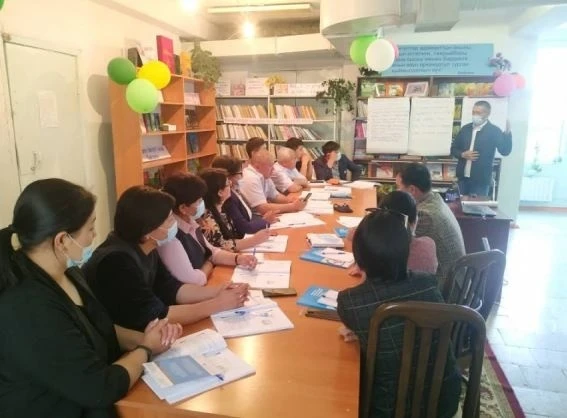
Starting from December 2025, nationwide training sessions for local council deputies will be held in regional and district centers of Kyrgyzstan, focusing on legislative issues. This event is organized by the Ministry of Justice of the Kyrgyz Republic in collaboration with the State Agency for Public Service and Local Self-Government. The project also involves the Public Association "Development Policy Institute" (DPI) and the Union of Local Self-Governments of Kyrgyzstan.
Currently, there are 264 local councils operating in the country, which hold 6,384 mandates: 34 city councils (1,024 mandates) and 230 rural councils (5,360 mandates). These councils regularly adopt normative acts that must be legally justified and registered in the State Register of Normative Legal Acts (CDB), the maintenance of which is overseen by the Ministry of Justice. Over the past nine months of this year, 8,760 documents have been added to the register. The highest activity is observed in the Osh, Jalal-Abad, and Bishkek/Chui regions, while the workload in the Talas region is significantly lower.
The volume of this work reveals existing systemic problems, such as the duplication of acts by representative and executive bodies, violations of legal techniques, non-compliance with established requirements, and delays in the submission of documents to the CDB. Even minor errors can lead to the annulment of decisions, slow down the work of rural administrations and mayors, and negatively affect the accessibility of services for citizens and businesses. In this regard, the training aims to improve the legislative practice and enhance the quality of local governance.
The training program is designed to improve the quality of normative acts, enhance interaction between representative and executive bodies, ensure proper management of the State Register of NLA, implement unified standards of legal technique, and increase the transparency of management processes. During the sessions, participants will study the requirements for the structure and content of documents, the procedure for coordination and decision-making, as well as the mechanism for including acts in the CDB.
Participants will include chairpersons of city and rural councils, deputies, responsible secretaries, heads of rural administrations, and mayors who work with normative acts and influence the development of their territories. The training includes practical sessions, analysis of typical mistakes, examination of real examples, and discussion of cases.
Upon completion of the December cycle, a summary report on the progress of the training and the results achieved will be compiled.


